On Saint Frances of New Orleans
For the past several years, I’ve maintained the discipline of listening to mostly Christian music during Advent, most of it Christmas music. Last year was the year I fell in love with “O, Holy Night,” particularly the version sung by Tracy Chapman. I’m also fond of the reggae version]() from Christafari (their Reggae Christmas compilation is on regular repeat during this time of year). It is this latter version that I first caught the words of the third verse:
Truly He taught us to love one another; His law is love and His gospel is peace; Chains shall He break, for the slave is our brother, And in His name all oppression shall cease. Sweet hymns of joy in grateful chorus raise we, Let all within us praise His holy name; Christ is the Lord, Oh, praise His name forever! His powr and glory evermore proclaim! His powr and glory evermore proclaim!
For whatever reason, I did not know that this was an abolitionist hymn. This is probably due to the fact that the first verse is the most commonly sung (even Tracy Chapman doesn’t sing either of the other verses in her otherwise excellent rendition). Regardless, something about this line moves me to tears when I first hear it during the Advent season. It speaks powerfully to what Saint Mary sings in the Magnificat, what the birth of Jesus is intended by God to do: to usurp the power dynamics of our world and to proclaim freedom to the captive.
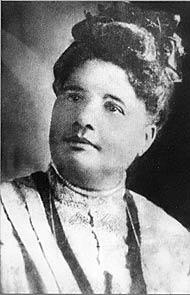
This is reflected in the saint commemorated in the Episcopal Church’s calendar today: Frances Joseph-Gaudet. Initially I was going to write about Saint Anysia of Thessaloniki. This was partly due to some confusion on my part over our calendar (Frances is listed as being commemorated on the 31st in our current edition of Lesser Feasts and Fasts, but was commemorated on the 30th in the previous editions). But Anysia is not recognized in our calendar (she’s remembered in the Orthodox Churches). Plus, she’s another martyr and—intending no disrespect to any of the Holy Martyrs—I imagine that some of us are a bit overwhelmed by reading about murdered saints day-after-day. What of someone who incarnated the gospel in a way that didn’t end with hurled rocks, or decades of exile, or political executions, or drawn swords in a cathedral? That brings us to Frances.
From what I can gather, Frances is held in high regard in the diocese of Louisiana, where she lived and ministered. She was not an ordained person, but nonetheless lived a life dedicated to the gospel of Jesus Christ, particularly that part about breaking chains and having love as His law. She was dedicated to the work of prison reform, especially in regards to young Black men. Which she did in 1930s Louisiana. As a woman. Born of mixed race as Black and Native American.
No wonder she’s a saint.
There is one connection with Saint Anysia that is worth commenting on: both were committed to the work of the gospel during troublesome times as single women. Saint Anysia was a consecrated virgin active during the persecutions of Diocletian. Saint Frances was a divorced woman (seeking the divorce because her husband was an alcoholic—this also influenced her commitment to the Temperance movement), raising her three children as a seamstress, during the deep racism of pre-Civil-Rights America.
Frances began her ministerial work by holding prayer meetings for families with sons and daughters in prison. This then turned into prayer meetings with prisoners, making and proving clothes to prisoners, and the work of helping young men get back to some kind of normal life after being released from prison. She would take charge of young men after attending juvenile court (something that she also advocated for—previously, young men were tried as adults exclusively), eventually needing to acquire more land in order to house them and educate them. This evolved into the Gaudet Episcopal Home (after she donated the property to the Episcopal Diocese of Louisiana).
All of this as she remained a woman of meager means. She focused her efforts on her school and became its principal, but she was never a wealthy woman.
She serves as an example we all need: someone who did great things for the gospel using what she had in front of her. She heard the plight of her friends and neighbors, saw the injustice of the penal system (which perpetuates to this day, sadly), and did what she could, building on each development as the Lord provided.
One of my little maxims when it comes to parish ministry is that the most effective ministry is the one that a parish wants to do, not the one it feels obligated to do. We’ve seen this throughout Saint Mary’s history. In our story, we’ve been a Sunday School for Chinese and Japanese children, a medical dispensary, an orphanage, a school, and a parish (which actually is a fairly recent development for us, only really beginning in the 1960s). Each time we’ve made a change, it seems to be based on us discerning what we are both willing and able to do rather than taxing ourself with what we feel obligated to do.
But this philosophy is not limited to parish communities. It also applies to individuals. The first time I ever saw this, I was still in seminary. I had interned at Saint Paul’s in Newnan, Georgia for a summer. In one of my sermons I mentioned how we could use what we already have for the benefit of God’s work, referencing the model used by Toms Shoes as an illustration. Toms, which were immensely popular in the late 00s, have a one-for-one model: you buy a pair of their shoes and another pair is set aside for person in need, footwear being a significant preventative for lots of diseases and infections throughout most of the world. After that summer, I went back to seminary for a semester and then was home for Christmas, where the rector of Saint Paul’s invited me to serve at the Christmas services. After one of the services a parishioner came up to me very excitedly and handed me a gift bag. Inside were four hand-made wine glass charms (so you can identify your glass when at a party at someone’s house). She told me that she had been trying to think of ways to help people in need. Then the Spirit moved her during my sermon and she realized that she could use her beading hobby as means to foster God’s kingdom. So she partnered with a charity and used proceeds from her wine glass charms (which she sold at a local farmer’s market) to support their work.
When we think of saints and saintly work, we tend to think of people like Saint Stephen or Saint John or maybe even Saint Thomas—people who made giant gestures of faith that ultimately cost them their lives in a direct sense. Or we think of Saint Theresa of Calcutta, who became a nun and helped the poor in India die with dignity. But Saint Frances of New Orleans reminds us that saintly gestures begin simply and within our current means. We don’t need to be a nun or a deacon or the second-most-powerful-person in the English realm in order to effect great things for God’s kingdom. We can be a single mother working as a seamstress, sharing the pain of other mothers lamenting their children in jail and the unjust systems that put them there.
When I was a school chaplain I used to say to my students at the start of the school year: you are called to change the world; only the world you change might not be your own. Simply holding the hand of and praying with a mother whose son has been imprisoned for a petty charge can change her world in profound ways, even ways we might not know until all is revealed in God’s coming Kingdom.
Saint Frances of New Orleans heard the words of Jesus at the start of His ministry, when He picked up Isaiah’s scroll and read to the poor people of Nazareth:
The Spirit of the Lord is upon me, because the Lord has anointed me. He has sent me to preach good news to the poor, to proclaim release to the prisoners and recovery of sight to the blind, to liberate the oppressed, and to proclaim the year of the Lord’s favor. (Luke 4:18-19 CEB)
Or, as Charles Wesley would put it:
His law is love and His gospel is peace; Chains shall He break, for the slave is our brother, And in His name all oppression shall cease.
That is something we can also do, one small moment at a time.
***
The Rev. Charles Browning II is the rector of Saint Mary’s Episcopal Church in Honolulu, Hawai’i. He is a husband, father, surfer, and frequent over-thinker. Follow him on Mastodon and Pixelfed.