On the Feast of Stephen
By now my parishioners know that I love to share little historical anecdotes from time to time. Like my twice-annual explanation for why we might wear pink rose vestments in Advent and Lent. Or my contention that the conception of Jesus happened during the events celebrated during the Feast of the Visitation and not the Anunciation (the Magnificat being the outward sign that the Holy Spirit had filled Saint Mary). One such anecdote involves a beloved hymn heard during the Christmas shopping season: “Good King Wenceslas,” the brass melody an easy short-hand for demonstrating on film that it is Christmastime (the first shot of the toy store in Home Alone 2 comes to mind). And of course this.
“Good King Wenceslas” is, technically, not a Christmas hymn. It is, properly, a hymn for Stephensmas (to use the old English term for the Feast of Saint Stephen the Martyr). The hymn itself recounts the story of a beloved and saintly king who, on “the Feast of Stephen,” one bitterly cold and snow-laden, braved the elements to bring fuel and supplies to a poor man. The tune, which sounds like it was generated in a lab to be a Christmas carol, was actually written for a song meant to be sung at Easter.
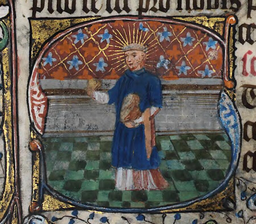
Anyway, this is an overlong introduction to talk about Saint Stephen, whose feast day is today and marks the first of the daily commemorations for the first week of Christmas, through the Feast of the Holy Name (which coincides with our New Years celebrations in the Western Christian tradition). Saint Stephen is the “protomartyr,” the first Christian to be executed for the crime of being Christian. He was among the first deacons in the church (called alongside Saint Philip, among others) and was stoned to death after testifying about Jesus before the high council of Jewish religious leaders (also known as the Sanhedrin).
Different church traditions hold to different dates to commemorate Saint Stephen. In Western traditions (of which the Episcopal Church is part) the custom has been to commemorate him on the day after Christmas, perhaps as a means to mark that his death was a kind of birth itself, the Christian faith beginning to coalesce into a definable movement of its own and not simply a movement happening only within Judaism. Stephen’s death inspires a radicalized rabbi named Saul of Tarsus to begin a process of systemic elimination of “the Way” (as Christians were known back then), thus fostering closer ties among the nascent Christian movement as well as distance between them and their own people (remember, at this time all Christians were Jews). Further, the death of Saint Stephen elucidated our understanding of the Incarnation—not only is Christ enfleshed among and within us, but our flesh is subject to the same violence and suffering experienced by Jesus. The broken flesh and shed blood of the eucharistic bread and wine prefigure our own breaking and shedding-of-blood as well as that of Christ Jesus. As the old Augustinian fraction anthem puts it: “Behold the mystery of your salvation laid out for you; behold what you are, become what you receive.”
This all sets a tone for us Christian that we are often quick to forget: a faith that holds to the Incarnation hardly results in a faith that has guarantees of wealth and comfort. Indeed, the Incarnation expects that we be willing to give up creature comforts and conveniences (said by a Christian who lives quite comfortably in comparison to much of the world).
To invite the Incarnate God into our midst is to invite suffering and rejection.
All of the saints commemorated during these next several days speak to that fact: Saint John the Evangelist, the Holy Innocents, Saint Thomas a Becket. We don’t have official commemorations on the 30th, but we will be exploring the life of Saint Anysia of Thessalonica, a saint in Eastern Christianity that is remembered on that day. These are all either martyrs or exiles, rejected and killed because they accepted that God was born in a manger and that He chose to save us from ourselves.
And much of this begins with Stephen. His testimony in Acts 7 is confrontational, but the major point he tries to make is that God is not relegated to a resplendent temple in Jerusalem. Rather, God has chosen His home among us, among the things He has made. We have God in our midst, but those who claim religious authority tend to miss that fact and use violence to silence those who make that point. These were, in effect, Stephen’s last words before irony was lost and he was killed with rocks.
As we live in the liminal time between Christmas and New Years, spending time with family and friends and perhaps even exchanging gifts still, we would do well to remember that there are those huddled together because bombs are dropping on them in Ukraine, or militants are hunting them in Nigeria or Sudan, or they are cold and starving in Gaza. They are hiding from ICE, or bound together in an internment facility. Such was Stephen, in a jail cell until his interrogation, the day after Christmas.
God came to us incarnate. That incarnation happened among those who suffer. And even in the midst of that suffering, seeing the faces of those who hate us, we might be able to join Saint Stephen and say:
Look! I can see heaven on display and the Human One standing at God’s right side! Lord Jesus, accept my life! Lord, don’t hold this sin against them!
... The Rev. Charles Browning II is the rector of Saint Mary’s Episcopal Church in Honolulu, Hawai’i. He is a husband, father, surfer, and frequent over-thinker. Follow him on Mastodon and Pixelfed.