First Things First: On the Relationship Between Baptism and Communion
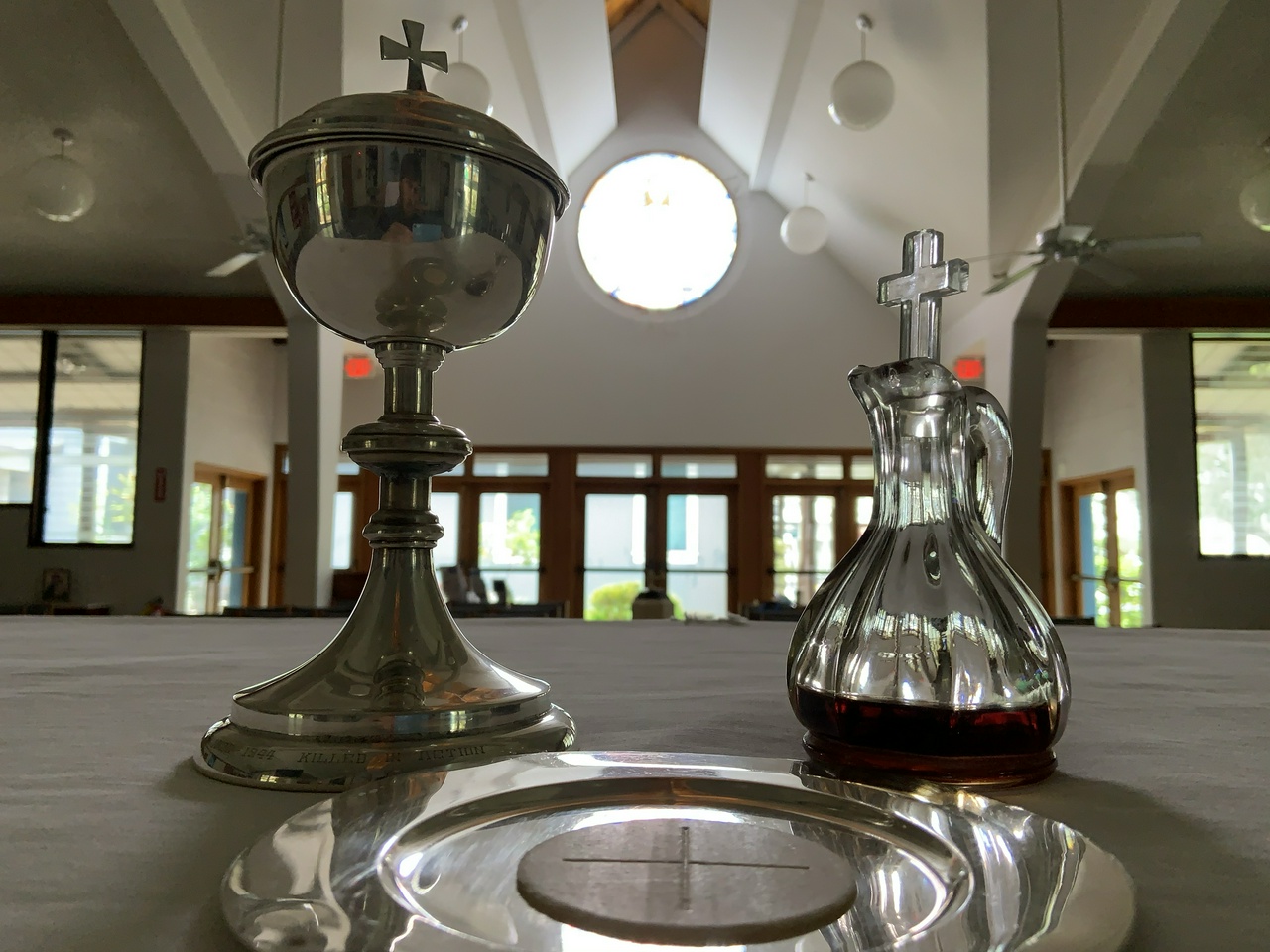
Once a month or so, I’d walk into the large blue carpeted sanctuary of the First Baptist Church of Central Florida and find a stack of trays covered in white cloths looking like a small snow-covered mountain range resting toward the base of the pulpit. They sat on the white and dark wood table I knew as the altar, the words “Do this in remembrance of me” engraved just below the top. This told us all that we’d be observing the “Lord’s Supper” that evening (it was always at the Sunday evening service).
This was the closest to any kind of actual ritual that my independent-leaning Southern Baptist church would observe. There was beauty and even a degree of spirituality on those evenings that I came to relish—even if it meant that church would go extra long and I wouldn’t be able to get home and play with my neighbor Scott. The trays that carried little square chiclets of dried bread and tiny plastic cups of red grape juice were polished metal, silver in color. They would reflect the lights of the church onto the ceiling and I’d watch the dance of that reflection as I’d wait for the trays, starting with the bread and later the grape juice, to come to our pew. It was always an agonizing wait. Typical Baptist custom is for everyone to consume the bread and juice at the same time, so I would have to practice patience as those trays made their way across the laps of well over a hundred people in the room.
I have vivid memories of the first time I sat in church for this ceremony. We had begun attending the First Baptist Church of Central Florida when it was still the First Baptist Church of Pine Hills, right around the time that I had started attending Pine Hills Christian Academy in first grade and my mom had begun work as a church secretary. I’d watch the tray come by and want to take the bread or the grape juice. My mom would block my hand. Once or twice my grandmother would try and offer some of the dregs of her grape juice to me and my mom would scold her, “Momma, he’s not baptized yet.”
My first taste of that stale bread and bitter grape juice would happen around my seventh birthday, shortly after I surprised my mom and grandparents by responding to the weekly altar call, hopping out of the pew and making my way down the balcony steps with my mom rushing to catch up. About a week after “giving my heart to Jesus,” I was baptized in what looked like a small hot tub set into the rear wall of the church, just above where the choir sat, fully immersed while wearing a plastic blue gown.
After that, I could now partake of the Lord’s Supper “worthily.”
***
The question of who gets to take communion is an ongoing and hot-button issue in the Episcopal Church. Every General Convention there’s a movement to change the stated rules and allow those who have not been baptized to receive communion. There are a few terms to this. Some call it “open table” while others refer to is as CWOB (Communion Without Baptism). Tons of ink has been spread on this subject, but the basic gist of all the arguments boils down to this:
On one side are folks who argue that Jesus is an inherently welcoming person who doesn’t put up barriers in order to access Him; therefore, requiring baptism is seen as unwelcoming to the stranger who is drawn to His presence in the Eucharist. The story of Sara Miles, as recounted in her memoir Take This Bread is a good citable example of this: an atheist who walked into an Episcopal parish with a committed policy on offering communion to those who are not baptized (Saint Gregory of Nyssa in San Francisco), had bread put in her hand and a chalice of wine offered to her, and found herself suddenly transformed. As she herself puts it, “I walked into that church not believing in God and walked out having met Him.”
On the other side are those who note that Jesus was a baptizer, following after the ministry of His cousin John the Baptist, and that everyone who sat at the Last Supper (the meal effectively re-enacted every time Christians take communion) were baptized disciples. Further, they might cite—as my former pastor did—Saint Paul’s caution in I Corinthians about participating in the Lord’s Supper in an unworthy manner, a thing that Paul says carries potentially deadly consequences.
It doesn’t help that the canonical scriptures do not contain a clear statement on the matter. If we’d included the Didache in the Bible, we’d have something concrete. In the ninth chapter of that historically important, nearly-in-the-Bible book we read:
But let no one eat or drink of your Eucharist, unless they have been baptized into the name of the Lord; for concerning this also the Lord has said, “Give not that which is holy to the dogs.”
Alas, the discernment of the Holy Spirit has led us to conclude that such a clear statement is not part of the canon.
***
Who gets to receive communion is a subject I’ve gone back-and forth on. When I first read Take This Bread I was convinced of the notion that communion be offered to anyone. For one thing, it’s heartening to see that the argument for the “open table” assumes the actual presence of Jesus in the Eucharist. It takes for granted the idea that He’s actually there in the bread and the wine.
I recall a time in college when I was hungry and thirsty for the actual presence of Jesus. I had suffered through a bad break-up (I was the one who made it bad, to be fair—a story for another time perhaps) and was feeling deeply shaken. I came back to campus after an evening surf session to see that the Catholic student group was having mass and I felt an unavoidable draw to be in the chapel at that time and to receive the holy sacrament. A literal hunger and thirst for God. But I was not Catholic and was not permitted and recall the disappointment I felt at being denied such intimacy with my savior. I was not yet Episcopalian, so I did not know I had other options. But I know the feeling one might have of feeling drawn to the altar but not meeting the “requirements.”
At the same time Saint Paul’s cautionary words hold sway on my conscience. The Eucharist is not something to be treated casually or lightly. It is not to be offered out all willy-nilly.
Another college memory comes to mind. I went to an evangelical Christian university (Palm Beach Atlantic University) and the missions department once hosted a “prayer labyrinth” in one of the large spaces on campus. I was a recent Episcopalian at the time and was quite curious about seeing evangelicals hosting a labyrinth. It was really just a kind of meandering corridor with photos and stats about the various places the summer mission programs were going to visit, with various things one could pray for as the teams prepared. But at the end of the “labyrinth” was a table replete with loaves of bread and cups of grape juice. A sign told the visitor that this was communion and that we were free to participate as we felt led.
I was outraged. First, there was no one monitoring this. The free samples at Costco are treated with more reverence. No, this was given the same amount of respect as one gives those tourist pamphlets in the lobby of hotels or the paint samples at the hardware store. Secondly, I was alone in the “labyrinth” which hardly makes this “communion.” When I expressed my anger at the religious life department I was basically patted on the head and told not to feel offended. Because they didn’t subscribe to a theology of transubstantiation or real presence or whatever, it wasn’t intended to be the same as the sacraments observed in a church. But they called this thing “communion...”
By the time I entered seminary, I held to the established traditional teaching of the Church: baptism is required for communion. Partly, I did this because I trust that there’s a wisdom at play in this traditional teaching. Also, there’s a logic to it: one is born before they eat. Baptism is “new birth” or how one is “born again.” The Eucharist is the food that maintains one in their new life in Christ.
But now, I feel the pendulum swinging in a different direction.
***
In my diocese are some clergy that are quite vocal in their opposition to baptism being a prerequisite to communion. I once overheard one my colleagues say, “the bishop requires you to be baptized to receive; in my church we don’t care.”
This latter statement is, for me, the real problem. We ought to care whether someone is baptized or not. Baptism matters. Indeed, in the Great Commission, Jesus tells to go and “make disciples of all nations, baptizing them in the name of the Father, and of the Son, and of the Holy Spirit.” Baptism is central to our work as the Church. So yes, we absolutely must care if one is baptized or not.
Paul Fromberg and Rick Fabian are the founding clergy of Saint Gregory of Nyssa in San Francisco, mentioned above. It is probably the most important church in the conversation on communion before baptism. Rick Fabian, in particular, has written much on the subject. One thing that he is quite clear on is that the church must be intentional about baptism. For him, communion is a thing that leads to baptism. Baptism is central and any church that treats it as “optional” is being both lazy and ignorant of Jesus’ teachings.
The most typical approach that most clergy take in regards to baptism and communion is somewhat non-committal. “We don’t check membership credentials at the altar.” Basically, we’re told to assume that if someone comes to the altar to receive communion, they are doing so in a worthy manner. If it turns out that they’re not baptized, then we need to have that conversation. Basically, this stance argues that we maintain the established custom of the church but leave room for exceptions.
In a way, I agree with this approach. I’ve come to recognize that stories like that of Sara Miles should be celebrated as unique movements of God, celebrated because they are unique and not necessarily treated as the marker of a new status quo. That we in the Church maintain a sort of normative practice of expecting baptism before communion so that when exceptions happen they get to remain exceptional.
But this is also so stereotypically Episcopalian.
We often use the via media as an excuse for not taking a stand. Are we truly committed to leaving room for God to do something exceptional, or are we being the church of Laodicea from Revelation (not hot and not cold; tepid and at risk of breeding stomach-turning bacteria)?
The vocal “open-table” clergy put this question front and center during the interviews held for the bishop candidates in our diocese. Every candidate indicated that they were open to discussing and discerning this topic, supportive of the possibility of overturning the established canons of the church on this. I was disheartened at the time. I even did a YouTube video on the subject shortly after, while also hearing from some parishioners who felt that the candidates even entertaining the subject should be grounds for all of their disqualification from consideration.
Then something funny happened. While reading the daily chapter of Proverbs I read during my Morning Prayer practice, I came across this passage:
Wisdom has built her house; >she has hewn her seven pillars. She has slaughtered her beasts; she has mixed her wine; >she has also set her table. She has sent out her young women to call from the highest places in the town, “Whoever is simple, let him turn in here!” >To him who lacks sense she says, “Come, eat of my bread >and drink of the wine I have mixed. Leave your simple ways, and live, and walk in the way of insight.” (Proverbs 9:1-6, ESV)
Now, a little back story is required here. Wisdom is not only an idea in the Bible, it’s also a person. Wisdom is depicted as a woman and the language of Wisdom influenced the early theology of Jesus in the New Testament. Not only does Saint John draw from the language of Wisdom in the apocryphal book of Sirach for his famous prologue (compare Sirach 24 and John 1), but we see in I Corinthians where Saint Paul writes that “Jesus has become God’s wisdom” (see I Corinthians 1:30). The early church understood Jesus as the incarnation of God’s Wisdom, the Logos from and for which the universe was created.
Given this, here’s a passage that clearly suggests Jesus offers the holy sacrament to those we in the Church have historically deemed “unworthy”—Jesus, being the Wisdom of God, offers holy things to dogs much to the chagrin of the author of the Didache.
***
I tend to see myself on the “Catholic” spectrum of Anglicanism. I don’t know that I’d define myself strictly as “Anglo-Catholic” but maybe the old term “Reformed Catholic” applies. Regardless, I differ from the Western Anglo-Catholic view of the sacraments in that I don’t believe that there are seven of them. I subscribe to a more Eastern view that there are only two sacraments (Baptism and Eucharist, the ones given to us by Jesus), while there can be a whole plethora of “sacramental rites” that echo and are rooted in the sacraments—things like marriage and unction, all the way to the use of prayer beads and the writing/painting of icons. These are all material things that evoke grace from God and draw us closer to Him but are themselves defined by the “dominical” sacraments (this is all an expanded view of Saint Thomas Aquinas’ view on the sacraments, who saw a clear primacy of Baptism and Eucharist).
So the question remains, must Baptism go before Eucharist?
I think I’m leaning more toward an idea that these are equivocal things. Each informs each, both need each other to be comprehensible. Wisdom invites the simple-minded to enter into the house built by Wisdom and to eat and drink the bread and wine provided, bread and wine that enlightens and illumines. Jesus shares His table with us all as he did Nicodemus. And from this table one arrives at the baptismal font to be born again. At the same time, we encounter the font upon entering the church and are reminded of our need to be reborn. Christ is present in the font as much as He is present at the table, the Eucharist rightly the life-redefining practice of thanksgiving for the new life inaugurated by the washing of Baptism. Both are necessary. Without both the Christian life is incomprehensible.
Jesus commands us to both baptize and participate in the Eucharist. But Jesus never gives an explicit hierarchy to these blessed sacraments. We’re told to observe both. Now, I understand that the traditions of the church are not bound solely to the scriptures but rather are things that run alongside the scriptures and so the long-standing custom of the Church has been to require Baptism before receiving the Eucharist. But as an Anglican we believe that anything deemed “necessary for salvation” must be “proved by Holy writ.” In other words, something like the requirement for Baptism prior to Communion must be proved by the scriptures. Frustratingly, the Bible is not as clear on this as we might like.
The scriptures are clear that the Eucharist is to be observed and received in a worthy manner. Does Baptism inherently make for worthy reception? I’ve been in more than a few contexts where I’d argue a group of baptized people have not observed the Eucharist in a worthy manner and I can say that I’ve definitely done a few rounds of confession over having received the Eucharist in a state of unworthiness.
I want everyone to be baptized and I want everyone to be a communicant. Perhaps it’s time we make both the font and table as open as our Wise Savior’s arms. But making both open is not the same as flippancy. In my thinking, flippancy is the error that Saint Paul cautions about in I Corinthians. Both Baptism and Eucharist are deeply dignified events. Their dignity, however, is not contingent on their reservedness. A thing can be both open and dignified, freely offered but treated with the reverence that is due.
Jesus, God’s Wisdom, has built the house and set the table. We’re invited to participate in God’s life. This requires us to wash and to dine. Maybe both things are meant to be equally offered? After all, we can’t have one without the other.
The Rev. Charles Browning II is the rector of Saint Mary’s Episcopal Church in Honolulu, Hawai’i. He is a husband, father, surfer, and frequent over-thinker. Follow him on Mastodon and Pixelfed.