The Catechetic Converter

theology

a yellow back hoe sits in a dug up field surrounded by trees and grass photo by Brian Statler via UnSplash

When I was a kid I used to dislike driving up to Deltona to visit my aunt and uncle. I generally liked my aunt and uncle, so it wasn’t them. It was the Deltona area at the time that garnered my disdain.

This was the early-to-mid-90s. Deltona is an early exurb of the Orlando, Florida area, really close to Sanford. Both communities were “developed” in the 1980s as a place for “starter homes” for new families. Centex Homes billboards were a regular sight on I-4 in those days, one of the leading companies building cheap houses all over Central Florida. Eddy, who was my youth pastor growing up and a mentor figure for me for many years, was a carpenter by trade and he helped build all the houses in the Deltona area. He said that he’d hop in the back of a truck to ride to the job site, dodging rattlesnakes to then get on a roof and just hop down the line of houses, moving from roof-to-roof. He told me that guys would sometimes attempt to kill rattlesnakes from the back of the truck by using rebar like a spear and throwing it at them.

“You had one shot,” he’d tell me from the driver’s seat of his van as we drove past the Deltona exit on our way to New Smyrna to surf, “a rattlesnake has like an 8-foot striking range, so if you missed there was a real risk that the snake could bite you in the truck bed.”

This story was often accompanied by a phrase I’m sure lots of us have heard before; that, before the houses, there was “nothing out here.”

Nothing.

This was what I didn’t like about Deltona. The surrounding area felt like there was nothing. Just miles and miles of what I would later come to know as “scrub pine”—forests of tall pine trees and small palms, the ground beneath being sand littered with pine needles, cones, and dry sticks. A landscape that seemed boring and banal. Tearing it up for houses and strip-malls seemed like an absolute improvement.

The epitome of land that is “undeveloped.”

My first memories of my mom as a working person were when she worked as the bookkeeper for a real estate developer. The concept of “undeveloped land” is something I unconsciously sublimated from my earliest years.

I remember when my childhood church, the First Baptist Church of Pine Hills, was eyeing its future growth and owned a 50-acre plot of land in the Ocoee area of Central Florida. Eventually this plot of land would become my high school and the main place of worship for the church. But when I was like 8 and we went out for the ground-breaking ceremony for the building that would house classrooms and a gymnasium, the area was a seemingly endless stretch of orange trees. There was one hill, heading West on Highway 50, that when it crested you could see almost all the way to Claremont. In 1990 it was a horizon of green, a single road bifurcating fields of citrus. Everyone who grew up in Florida prior to the 2000s likely has a story about some area that “used to be nothing but orange groves.”

But, to my mind, orange trees were something. Scrub pine was, truly, nothing.

***

When I was in seminary I was first exposed to the theologians of Radical Orthodoxy that would become deeply influential to me. In particular is Catherine Pickstock. A friend of mine had given me a burned CD of an interview she and John Milbank gave (I think to the BBC) and Pickstock said something that has stuck with me ever since: all things were created to worship and so when we look at a tree and see it as a being in worship this changes our relationship with the tree—it is no longer a commodity to be used but a creature that glorifies its creator.

Like I said, I this stuck with me and I think of it often, especially now that I live in Hawaiʻi which is a place that pretty openly celebrates the fellowship and sacred participation of all creatures. In Hawaiian thinking, trees and animals are a “people” who share our spaces with us and it is our kuleana (responsibility) to care for them and treat them as part of our ʻohana (which, as Lilo all taught us, means family). The continued use of valleys and islands for live-fire drills and bombing practice, the sullying of our wai (water), the loss of indigenous agriculture to pineapple and sugar farming to export wealth out of our communities is all seen as actions that hurt our family. The ʻaina (land) is part of us, is something that participates in a sacred life. Hawaiians rightly understand that all of creation worships its creator and so we are not free to casually exploit creation and treat it as a kind of impersonal “resource” for consumption.

Calling land “undeveloped” carries with it an assumption: that turning that land into something that can be monetized is the realized telos (its end or purpose, to use an academic theological term) of that land. The assumed thinking here is that a piece of land is effectively “wasting its potential” by simply existing.

Members of the Church are not innocent here. Centuries of interpreting passages about tilling the land or our God-given “dominion” over creation as though it is our obligation to transform land into something for financial gain have their genesis in various corners of the Church. The truth is that our “dominion” is supposed to look like the Kingdom of God, which is defined by Jesusʻ own humility. A gift that indigenous Christians give back to the Church is the reminder that our relationship with the land is defined by what Hawaiians call pono, which is most closely translated as “righteousness” (but is also deeply related to the concept of sovereignty). We are stewards of a creation that is not ours, set in the midst of a worshipful mosaic of fellow creatures, expected by God to do right by them.

I’m of the mind that Christianity itself has been the victim of a kind of intellectual colonization that has caused it to lose focus on things that Jesus called to our attention. Wealth-hoarders/addicts throughout generations have the habit of forcibly wrenching religious beliefs into something that supports their exploitative vision. Jesus, ever the agrarian, repeatedly directs our attention to the created world in order to teach us about the Kingdom of God—which is to say that the exploitative impulse we see coming from Christian Nationalists and others of their ilk is not something intrinsic to the Christian faith itself, but is the result of the colonizing impulse to rework anything and everything into justifying these actions.

The “undeveloped land” mindset is subtle. What starts as “there was nothing but orange trees” can quickly turn into “there was nothing.” And of course there was never nothing.

***

When I was in Thailand in 2007 I met guys who had grown up in the US while their dads were being educated for ministry. Once they returned to Thailand they took to their Thai culture to a degree that even astounded other Thai people. I went through a similar thing when I returned to Florida after my time in Northern Virginia/DC during seminary. I became extra Floridian.

An author who was important to me at this time was Jeff Klinkenberg. His Seasons of Real Florida should be required reading for anyone moving to the state. It was him who got me to understand that scrub pine land was far from “nothing.”

Turns out that this type of land, ubiquitous and seen as the kind of bland “cookie matrix” between the chocolate chips of “civilization” (to borrow an image from Chuck Palahniuk), is a completely unique ecosystem. It’s a rare example of a “wet desert,” meaning that even though the area gets rain like 200 days out of the year (calling Florida the “Sunshine State” is just the first of many falsehoods about the state that charlatans came up with to sell land starting in the 1800s) because the ground is mostly sand, the water doesn’t stay and runs through down to the aquifer beneath the surface. There are crazy lizards that swim in the sand. And the whole thing has evolved to rely on lightning.

See, scrub pine is sandy because it used to be ocean. Florida was basically an underwater sandbar until relatively recently (in a geological sense). The plants that grow there are opportunistic plants that have adapted to eke out enough moisture from the sand to thrive. That and they can make use of the consistent rain that falls (nearly every day in Central Florida is a thunderstorm starting around 3 pm). These tall and thin pine trees are also perfect lightning rods. The lightning strikes the palms, they catch fire. The fire opens their cones and the rising heat helps carry the seeds. The fire also burns off parasitic plants and over-zealous undergrowth. With Florida being the lightning strike capitol of North America, this is ideal.

Basically, this is an ecosystem that has adapted perfectly to its environment—one could argue that it does so in worshipful response to what God has ordained it to do, moving as it does through the long evolutionary process of God’s creative act. It’s a rare and beautiful thing when one really considers it.

But, it also so happens to be flat and easily transformable land that also just so happens to exist around some of the most active tourist hotspots in the world. Which means that it is not in the best interest for the investors that we see this land for what it is and celebrate it as a means to glorify God and draw us all closer into His love. No, it has to be seen as “undeveloped.” As “nothing.”

This scenario is playing out all over the world. You’ll hear this language as the wealth-addicts eye the construction of yet another data center. Or high-rise that will never be filled. Or shopping center that will put other places out of business. Or agriculture land that will grow corn or beef to be exported elsewhere at the expense of feeding the hungry who live in the detritus of what we might call “post-developed land.”

For us Christians there can be no such thing as “undeveloped land.” No vista contains “nothing.” Rather it is all rife with the creatures of our God and King, living in uninterrupted worship of Him.

“You love all things that exist and loathe none of the things that you have made, for you would not have made anything if you had hated it.” (Wisdom 11:24, ESV)

If God loves it, then we’re meant to love it. It’s not “undeveloped.” It’s something entirely more valuable.

pen and ink drawing of scrub pine forest A pen and ink drawing of a scrub pine forest that I drew after learning to appreciate them


The Rev. Charles Browning II is the rector of Saint Mary’s Episcopal Church in Honolulu, Hawai’i. He is a husband, father, surfer, and frequent over-thinker. Follow him on Mastodon and Pixelfed.

#theology #nature #ecology #Jesus #Episcopal #Anglican #Christian #Bible

photo of Millennium Falcon from Galaxy's Edge by Steven Beyer, via Unsplash

I recently read this quote from Peter Thiel, cited from the New York Times in a recent article in the Guardian:

I like Star Wars way better. I’m a capitalist. Star Wars is a capitalist show (sic). Star Trek is the communist one. There is no money in Star Trek because you just have the transporter (sic) machine that can make anything you need. The whole plot Star Wars starts with Han Solo having this debt that he owes and so the plot in Star Wars is driven by money.

The whole plot of Star Wars starts with Han Solo? Did we forget the entire first act of the film, the nearly half-hour of screen time that takes place before Han Solo shows up? Then, the plot starting with “this debt that he owes.” What?

I have to admit that I am somewhat deeply entrenched in the lore of both Star Trek and Star Wars and so cannot be considered an “average person” when it comes to either franchise. But I also feel like it’s not outside the realm of reason to say that the average person, when thinking about Star Wars, is not under the assumption that those films are about Han Solo and money. Luke Skywalker is the hero of the franchise (sorry, George, you’re wrong in thinking that you could make Star Wars to be about Anakin). His story is about putting others ahead of himself.

Peter Thiel, it seems, conveniently forgets that the opening scenes of Star Wars (what has since been retconned into A New Hope) involve a superior military killing and abducting dissidents in order to silence them. Han Solo’s debt is only a tangential part of the story (it’s the motivation that gets him wrapped up in the whole thing, sure). The plot of Star Wars starts with Princess Leia discreetly sending the plans of a secret super weapon (the Death Star) to a backwater planet where she knows an old Jedi—a religion of essentially space wizards who’ve been eradicated by the Galactic Empire—is in hiding, in the hopes that he’ll get those plans to the leadership of the Rebel Alliance so they can put a stop to mass murder. This happens as Darth Vader, the right-hand enforcer of the Emperor, has boarded her ship and massacres her crew. It is, quite famously, one of the most historically thrilling opening scenes in the history of cinema.

I once knew a couple, youth group leaders at an upstart church in the Orlando area, who did Star Wars cosplay and said “we’re more into the military/tactical part of Star Wars, not so much the mystical/Jedi stuff.” This is only to say that, yes, I get that there are people who enjoy Star Wars who don’t really go for the “Jedi stuff.” But you’d think that the guy who’s recently made it part of his brand to be an expert on the Antichrist would focus on Luke, the messianic figure, and not Han, the greaser who makes no secret of the fact that he believes in nothing.

***

I recently wrote a piece wondering about the phenomenon of me and Christian Nationalist types reading the same Bible but coming away with vastly different views on those texts. This kind of questioning applies to other stories and shared mythologies. In that same aforementioned Guardian article is a note that Stephen Miller, the cruel and ghoulish advisor to the Trump White House, claims to be a fan of Star Trek. Years back we learned that, infamously, Paul Ryan (Mitt Romney’s running mate in the 2012 presidential election) claimed to be a fan of the notoriously anarchist band Rage Against the Machine. This lead to memes involving people wondering what “machine” Paul Ryan thought Zach and Tom were raging against (was it a faulty Maytag?).

Again, how does this happen?

I was recently reminded of a story shared by Dr. Randy Richards and Brandon O’Brien in their truly great book Misreading Scripture with Western Eyes. They recall a story related by Mark Allen Powell in his essay “The Forgotten Famine” where he had different groups read Luke’s account of the Prodigal Son story.

Powell had twelve students in a seminary class read the story carefully from Luke’s Gospel (sic), close their Bibles and then retell the story as faithfully as possible to a partner […] Later, Powell had the opportunity to try [this] again, this time outside the United States. In St. Petersburg, Russia, he gathered fifty participants to read and retell the prodigal son story.

The story goes that Powell noticed that none of the 12 American seminary students mentioned the famine that is referenced in Luke 15:14. He finds this interesting and decides to have a hundred people do this exercise, out of which only six mention the famine.

The group was ethnically, racially, socioeconomically and religiously diverse. The “famine-forgetters,” as Powell calls them, had only one thing in common: they were from the United States.

As already mentioned, he has the opportunity to try this experiment with fifty Russians and out of that group “an overwhelming forty-two of the fifty participants mentioned the famine.”

The authors postulate that for the Russian participants, the memory of the Nazi siege (when St. Petersburg was known as Leningrad), which resulted in three years of famine and around 670,000 deaths, was a key component to the story. The purpose of sharing this story, the authors state, is “to raise this question: if our cultural context and assumptions can cause us to overlook a famine, what else do we fail to notice?”

The details missed seem to be informed by cultural and economic contexts. Those Russian students knew famine, so they were primed to see that detail. We in the US are prone to say “I’m starving” after only a few hours after a meal, so we’re less inclined to pay attention to the detail of the famine. But, regardless, the famine is an essential part of understanding the story. The famine is what prompts the “prodigal” of the story to return home.

As Richards and O’Brien note, American Christians tend to see the story of the Prodigal Son as being about the wasteful kid getting his comeuppance, facing the reality of lying in the bed that he’s made, and being surprised at his father’s mercy. But the Russian readers (and plenty of others outside of the West) see the story differently: “The boy’s problem is not that he is wasteful but that he is lost.” Not noticing the famine changes the tenor of the story quite dramatically.

***

I don’t know Peter Thiel, so I can only speculate about his thoughts. But it seems likely that a man of his wealth is primed to see both Star Trek and Star Wars in particular terms. Namely, he sees both as being about money. In order to do this, Thiel has to ignore basically the entire actual story of Star Wars.

It’s interesting that he views Star Wars as a story about Han Solo when comparing it to Star Trek. I say this because there is an oft-made comparison between Han Solo and James Kirk in popular culture. Both are considered to be “shoot-first” rogue like characters who live and act based on their gut feelings, causing women to swoon and men to fall-in-line behind them. But the reality is that neither image is accurate to either character.

In the actual Star Trek show Kirk is rarely depicted as a swashbuckling womanizer. Rather he’s described as “a walking stack of books” back in Academy days. He strictly adheres to rules and protocol, deviating only when it seems necessary and called for, and gets laid far less in the show than you’d be primed to think if you’ve never watched it. I think marketing execs created this image for Kirk in order to try and sell the show to a world that had never heard of Star Trek and it wound up sticking in people’s minds—to the point that the Kirk of the movies (particularly from Khan onward) is more like the imagined idea of Kirk rather than his actual depiction in the show (and I say this as an avowed lover of the Star Trek films).

Additionally, Han is a kind of comic-relief character. He’s what’s known as the “audience surrogate,” the character who sits on the outside of the main narrative action to help translate the in-universe events for those who aren’t part of it. His line about “hokey religion” being no substitute for a blaster is meant to be a wink for all the 1970s Boomer dads in the audience for whom laser swords and droid banter is a bit too much. Their kids see themselves in the princess and the would-be knight. The guy who owes people money, drinking at the bar, racing around in a junker that he fixes up himself? Pure 1970s dad fantasy.

Han is also kind of an idiot. His entire “shoot-first” approach winds up both condemned and seen as a failure by the end of the film (which further makes George Lucas’ changes to Han’s shooting of Greedo all the more egregious). Han’s arc is literally that of a rambling man out on the road with no one but his dog, looking for quick bucks, coming to the realization that there’s things more important than money and that he is a better man with friends at his side. Lest we forget, Han Solo gets the winning shot against Darth Vader(!) and only after he decides to make a u-turn and deal with the bounty on his head for another day. He makes a selfless decision to save his friends from what he had already acknowledged was a suicide mission. The end of the movie is, in terms of Han Solo, quite overtly a rejection of money. So if money is at all part of what Star Wars is “about” it’s in terms of money’s limits. It’s corny and cliché to say (but George Lucas is openly playing with corny cliches in this series of films) but Han’s story really ends on “the real wealth is the friends we’ve made.”

***

Is Star Trek communist? Communist is a particular thing, so I won’t say that. Star Trek is decidedly socialist though.

The “transporter machine” that Thiel refers to is likely the replicator, a piece of technology that only started to show up in Star Trek: The Next Generation (set a century after the events of Kirk and his crew). What’s interesting to me about the lore of Star Trek is that the utopian vision of the Federation of Planets is something that begins to come into being before there’s been a post-scarcity society. Gene Roddenberry depicted a future where humanity matured beyond the pettiness of political boundaries and wealth-hoarding. Later iterations of the series would depict the catalyzing event of this as humanity’s first contact with alien life, which elevates our consciousness. But the actual original series of Star Trek doesn’t go that deep into the history. Rather it takes for granted that we humans were just simply destined to reach such a place by virtue of our continued growth as a species. Star Trek (the original series) indicates that there are other wars between the Federation years and ours (World War III, the Eugenics Wars), all with the implication that we eventually come to see the absurdity of war among ourselves and choose to work as one species for our betterment.

Thiel cannot imagine a scenario where humanity becomes collaborative and communal without some kind of technological catalyst.

He sees Star Trek as presenting a world where people refuse to accept the monetization of technologies that people like him envision themselves inventing. He’s likely terrified of the idea that he and his friends’ inventions will be taken from them and used in ways that won’t make them both rich and powerful. And so he has to dismiss the relatively hard sci-fi Star Trek as a kind of fantasy while reinventing the decidedly fantasy-set-in-space Star Wars as a more “realistic” story—conveniently ignoring the vast majority of the story in order to do so.

The funny thing is that, everything considered, both Star Wars and Star Trek depict the same thing: once we put aside the pursuit of wealth in exchange for collaboration, community, and working toward a more open future for everyone that’s when we really begin to shine.

That’s when we really get to live among the stars.


The Rev. Charles Browning II is the rector of Saint Mary’s Episcopal Church in Honolulu, Hawai’i. He is a husband, father, surfer, and frequent over-thinker. Follow him on Mastodon and Pixelfed.

#StarWars #StarTrek #Bible #Theology #politics

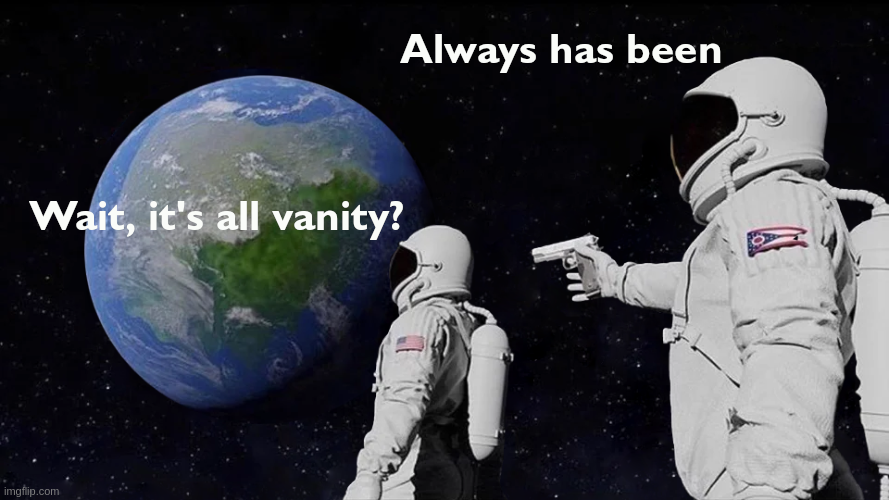
Meme image of two astronauts in space, looking at earth.

I received news that a dearly loved family member was in the emergency room, showing signs of some form of brain trauma that is, as of now, not yet fully diagnosed. I received this news as I was driving in to Saint Mary’s.

My morning routine is, after dropping off two of my kids at their respective schools, to sit in the nave of Saint Mary’s and say Morning Prayer. My practice is consistent: I say the confession, then the absolution (in the plural, praying for absolution on us all—you’re welcome), followed by the Venite (an abbreviated part of Psalm 95), then the selection of the Psalm that’s appointed, followed by the chapter of Proverbs that corresponds to the date (this is a practice that predates my days as an Episcopalian that I have recently revisited), followed by one lesson appointed for the day from the Daily Office Lectionary (currently I’m reading the gospel lessons), then Canticle 18 (“The Song to the Lamb” from the book of Revelation—if I’m ever without a Bible or Prayer Book, I will say this and the Venite as my morning devotion), followed by silence, intercessions, the Lord’s Prayer, and then the closing Collect from the daily devotions for individuals and families).

Today I wasn’t really feeling it. My heart was heavy and so I was going through the motions. I tried to find some wisdom in the dichotomy of saying jubilant words like the Venite or Canticle 18, but I wasn’t quite there.

I kept feeling a pull, perhaps a whisper of the Holy Spirit, to read Ecclesiastes. So, after finishing my usual routine, I opened up Ecclesiastes and, as I felt the Lord prompt me, read the entire thing.

***

Years back I had the chance to see Rob Bell in Orlando. He was touring his Introduction to Joy ...thing. Not exactly a lecture, but not simply performance art. It was like stand-up comedy, but about more than jokes. Anyway, Introduction to Joy is about the book of Ecclesiastes. Rob* refers to Ecclesiastes as a book that represents “deep wisdom” or “the wisdom that applies when conventional wisdom doesn’t pan out.” Books like Proverbs represent conventional wisdom in the sense that they are largely about “do this or that and things will generally work out well.” Ecclesiastes is a book that wades into the waters of what happens when you’ve done the things that Proverbs teaches, but things are not working out well.

Ecclesiastes is the most goth book of the Bible (Revelation is the most metal, if you must know). The refrain of the book is that everything is “vanity and chasing after the wind.” It’s a long checklist of how nothing really matters, everything is empty and destined for the same universal end: to die and wind up forgotten. There’s almost an echo of the life of the Buddha in the book. The “Preacher” (koholeth in Hebrew, which is also the name of the book in that language and is a name that goes hard) is the author and is traditionally held to be Solomon, the wise king and son of David. He talks about how he pursued wealth, and also madness, and folly, and pleasure, and poverty, eventually coming to the conclusion that “vanity” characterizes every pursuit of humanity. Rich, poor, righteous, wicked, wise, fool, human, beast—all will wind up in the grave, all share the same ending. So what’s the point? “Eat, drink, and be merry,” he says. Enjoy the time you have, because all will come to naught.

This word “vanity” is a word that, in Hebrew, refers to a puff of vapor. In a masterful stroke, in Introduction to Joy Rob pulls out a spray bottle and spritzes little clouds of mist instead of saying “vanity.” Everything is [sprays bottle].

Basically, the Preacher states that everything is temporary and pretty hollow. The pursuits of life are a vapor hanging in the air, like chasing after the wind.

What I’ve come to realize about Ecclesiastes is that it represents a sort of bell-curve (if I’m understanding them correctly). The book opens with “vanity, vanity, all is vanity” and ends with the same, but the journey between turns “all is vanity” from a lament into good news.

meme image of a bell curve that says its all vanity in three different phases Not sure if I’m doing this meme format correctly...

***

Understanding that “all is vanity” is pretty liberating.

This is not nihilism, by the way. Nihilism proclaims that nothing matters. Ecclesiastes acknowledges that life and existence, that our time on the earth, is something. It’s just a fragile and temporary something, destined to end. What Ecclesiastes, in my reading, is doing is asking us to consider our existence in the terms of its vaporous nature. Which, in some ways, underscores the preciousness of our time on this earth.

I’m a fan of Eucharistic Prayer C. I’ve mentioned this before, and I’ve mentioned how I’ve suffered degrees of ridicule for this. One of the things I’ve been told is objectionable in Prayer C is the line “this fragile earth, our island home.” One of my colleagues in seminary felt that calling the earth “fragile” is an affront to God, as though God did not make a quality product. My retort to this has always been that fragility can sometimes be a mark of artistry and skill. A Faberge egg, for instance, is a thing of near priceless beauty but is also quite fragile. Indeed, its fragility underscores its preciousness. This is all to say that the “vanity” of it all need not automatically be a bad thing.

The “vanity” of life puts things into perspective. It is an antidote to much of what ails us.

Consider this passage:

So I became far greater than all who preceded me in Jerusalem. Moreover, my wisdom stood by me. I refrained from nothing that my eyes desired. I refused my heart no pleasure. Indeed, my heart found pleasure from the results of my hard work; that was the reward from all my hard work. But when I surveyed all that my hands had done, and what I had worked so hard to achieve, I realized that it was [vanity]—a chasing after wind. Nothing is to be gained under the sun. (Ecclesiastes 2:9-11, Common English Bible, see note below)

Imagine if, say, Elon Musk or Jeff Bezos or Donald Trump were to accept this? That no pursuit of wealth or power is going to actually satisfy them? That they could be liberated from the pursuit of wealth?

I also observed that people work hard and become good at what they do only out of mutual envy. This too is [vanity], just wind chasing. (Ecclesiastes 4:4 CEB)

In other words, don’t take things too seriously.

***

While in my meditative prayers for my family member, various things from Ecclesiastes kept popping into my mind. I was actually using “all is vanity” as a kind of mantra to see how I might be able to grasp that such a thing is good news.

That’s when I thought of my toddler and my young daughter playing with bubbles yesterday afternoon.

Bubbles are a kind of vapor hanging on the air. They are hollow, temporary, and ride the wind. They illustrate every point that the Preacher seeks to make.

And kids go nuts over them.

My toddler begs to play with bubbles. He and my daughter squeal with delight in trying to chase them and catch them. My daughter figured out that if her hands are a bit soapy she actually can catch a bubble, if only for a few moments. My older kids will also go outside and play with bubbles. We all love bubbles.

We love the swirling rainbow patterns on them. We love their fragile beauty. We also probably use them as a catalyst to think about our existence. “Maybe our universe is just a bubble floating around in the sky of a much larger universe,” says my philosopher-in-the-making second-oldest.

Bubbles are vanity. Everything is bubbles. We can waste our time getting overly serious about the bubbles. We can expend time and energy in trying to keep the bubble forever. But, no matter what, that bubble will one day pop. Trying to prevent that pop is to misunderstand the bubble, to fail to see it for what it is.

Everything is vanity. It’s all chasing after bubbles. My God, how much fun that is!


The Rev. Charles Browning II is the rector of Saint Mary’s Episcopal Church in Honolulu, Hawai’i. He is a husband, father, surfer, and frequent over-thinker. Follow him on Mastodon and Pixelfed.

NOTES:

  • I’ve had Rob Bell as a guest back when I had a podcast, so I get to call him Rob. This also means that I have a one-degree separation from Oprah, but I won’t let it get to my head.

  • The CEB tends to translate the word for “vanity” as “pointless” but I’ve amended the translation here and elsewhere because “vanity” is a better word for the concept in that [spritzes bottle] is not exactly “pointless.”

#theology #spirituality #faith #bible #Christianity #Anglican #Episcopal

The Psalter title page from the Alternative Services Book

Do not sweep me away with sinners, nor my life with those who thirst for blood, Whose hands are full of evil plots, and their right hand full of bribes.

Today, in the Daily Office, the term we Anglicans use in reference to our daily morning, noon, and evening prayers, we read from Psalm 26 (quoted above) and Proverbs 15, which I’ll bring up shortly.

One of the things that has struck me in my reading of the Psalms is how poignant they are to our current situation in the United States. They speak consistently of wicked leaders and (in one of my favorite turns of phrase from the Book of Common Prayer translation of the Psalms) the “indolent rich.” It all makes me wonder if a daily regiment of reading and praying the Psalms will have a particular impact on one’s politics.

I mentioned the Proverbs above. One of the simplest daily scripture-reading practices that was ever introduced to me, and something I’ve done off and on since my Baptist days, is reading the chapter of Proverbs that corresponds to the day of the month. So today is the 26th, which means you’d read Proverbs 26. Like I said, simple. The Proverbs, like other instances of the so-termed “wisdom literature” ,of the Bible (like Ecclesiastes, the Song of Songs, Wisdom of Solomon, Sirach/Ecclesiasticus) are partly compiled as a means for instructing men who would be in positions of authority. Sure they contain certain general, reflective examples of conventional wisdom (“the lips of the wise spread knowledge; not so the hearts of fools” from Proverbs 15:7 ESV), but they also give more pointed language to the kinds of men rulers are supposed to be. And in this sense, like the Psalms, the Proverbs sound surprisingly current (all references are from the ESV translation of Proverbs 15, which is appointed reading for today in the Episcopal Church).

A scoffer does not like to be reproved; he will not go to the wise. (verse 12)

A hot-tempered man stirs up strife, but he who is slow to anger quiets contention. (verse 18)

Without counsel plans fail, but with many advisers they succeed. (verse 22)

Whoever is greedy for unjust gain troubles his own household, but he who hates bribes will live. (verse 27)

The heart of the righteous ponders how to answer, but the mouth of the wicked pours out evil things. (verse 28)

Whoever ignores instruction despises himself, but he who listens to reproof gains intelligence. (verse 32)

Reading these verses this morning, as with many mornings, I can’t help but picture the current political figures in the United States (I will not call them leaders). I read the passage of Psalm 26 that heads this post and I think of the Secretary of Defense and I wonder how it is that he and I read the same Bible but come away with very different understandings of the messages contained therein.

But more than this, I ponder at the people who, confessing the name of Jesus as Lord and Savior, voted for this travesty in the first place. Yesterday I read about the new Secretary of the United States Department of Agriculture (USDA) and how she’s a “religious zealot.” Since I grew up as an Evangelical, I can say with some authority that she’s clearly very convinced of her beliefs. She’s wearing her faith on her sleeve and obviously hoping to get people to convert to her brand of the Christian faith. I can sympathize with this. When I was an Evangelical, we would have championed Brooke Rollins as a kind of hero who was “not ashamed of the Gospel” (to quote Saint Paul). Setting aside the issues of the propriety or constitutionality of her sharing such overt Christian messaging on official US government communication platforms, one cannot deny that there’s a sincerity of conviction there. I recognize this because I was once like this. But what I cannot comprehend is how someone so sincerely dedicated to a branch of the Christian faith can excuse and even endorse someone like Donald Trump. How they can see him as the “Christian candidate.”

Either the answer is that they’re not actually reading the Bible (maybe particular selections of it), or there is an active practice of internally suppressing the truth in favor of expedience.

***

Look, I’ll admit something: I actually believe that Donald Trump is God’s will for the United States. But before you start hammering the comments, let me qualify this by saying that there’s a general assumption among Christians that “God’s will” means “positive experience.” The destruction of Sodom and Gomorrah was clearly God’s will and it was hardly a positive experience for the people of those twin cities. Same for the people of Egypt during the first Passover. Same for everyone not boarded up in Noah’s boat.

I believe that God allowed us to have Donald Trump as a kind of mirror for us to look at. As the man himself regularly suggests, he is America and America is him. He is the embodiment of the bits of America a lot of us either pretend doesn’t exist or have tamped down as a kind of “outlier” that doesn’t fit well into the sort of soaring aspirational language we heard at Barack Obama’s first inauguration.

Donald Trump is akin to what Quentin Tarantino was trying to accomplish with his film Django Unchained. Tarantino wanted Americans to be confronted with the evils of slavery in a visceral way. It might not have been strictly historical. It definitely made use of the tropes of exploitation cinema. But in the end it was an effective attempt at getting white America to have some modicum of emotionally connecting with the horrors that Black people faced and continue to face, rooted as the Black experience is in institutional slavery and the attendant white supremacy that fostered it. Donald Trump is like that, the version of America that is inconvenient to us but one that must be seen, acknowledged, and dealt with.

***

My understanding of salvation was deeply transformed by something Bishop Gene Robinson once casually said in a sermon. He was the first openly gay man to be elected and ordained as a bishop in not only the Episcopal Church, but the entire Anglican Communion of churches. He was once a guest at Bethesda-by-the-Sea in Palm Beach, my “home” parish (where I was confirmed and received in the Episcopal Church) and he once said that his election as the first openly gay bishop in the Anglican Communion occasioned the opportunity for the Church to deal with things we had been leaving to simmer. A gay bishop was a disruption, yes, but it demanded that we begin asking tough questions that needed to be asked.

It was from this comment that I realized Jesus does the exact same thing. I’ve spent the last decade plus articulating what I call the “Expository Atonement” of Jesus. The cross of Jesus, in part, exposes the depths of human wickedness, exposes what we’re capable of. The cross subsumes. It defines all actions of human wickedness and gives them a visible sign, an image (icon), upon which we gaze. By doing so, the cross lays bare the parts of human nature that we often pretend are exceptions. The ongoing life of salvation is one that is given to being exposed and laid bare (see Hebrews 4:12-13). This allows us to repent of these things and begin to heal.

I guess what I’m trying to get at with this is that there is a grace to MAGA, if we choose to see it. That grace (if this is the correct term) is that MAGA becomes an opportunity for us to actually confront and repent of our American sins. If we read the scriptures faithfully we cannot but see how the “Christianity” of MAGA is not Christianity at all. It is but another heresy of violence and exploitation that uses the language of Christianity for its own aims. It is a perversion of the faith that allows for the suppression of the clear teaching of the Bible in the name of political expedience or gain.

The cult that is MAGA can be the means to push actual Christianity to the surface.

***

The Psalms and the Proverbs paint a picture of the kinds of people that reflect God’s ideal leaders, people committed to a humble life of pursuing Wisdom. People like Donald Trump and the whole MAGA movement are the antithesis to this. Holding them up next to what is spoken of in the Psalms and Proverbs reveals this. The relief is stark.

It’s not enough to see the contrasts. Not enough to complain or lament. These people are where they are for our good, for our growth. In the same way diseases of the body give off signs in order to effect the healing process, MAGA demands that we begin a course of treatment. That treatment begins with repentance, followed by the gracious life of prayer and participation in the sacraments.

MAGA is a voice of reproof to us all. And as Proverbs this morning tells us, wise people welcome such reproof.


The Rev. Charles Browning II is the rector of Saint Mary’s Episcopal Church in Honolulu, Hawai’i. He is a husband, father, surfer, and frequent over-thinker. Follow him on Mastodon and Pixelfed.

#Theology #Bible #Jesus #Christianity #Anglican #Episcopal #Church #politics

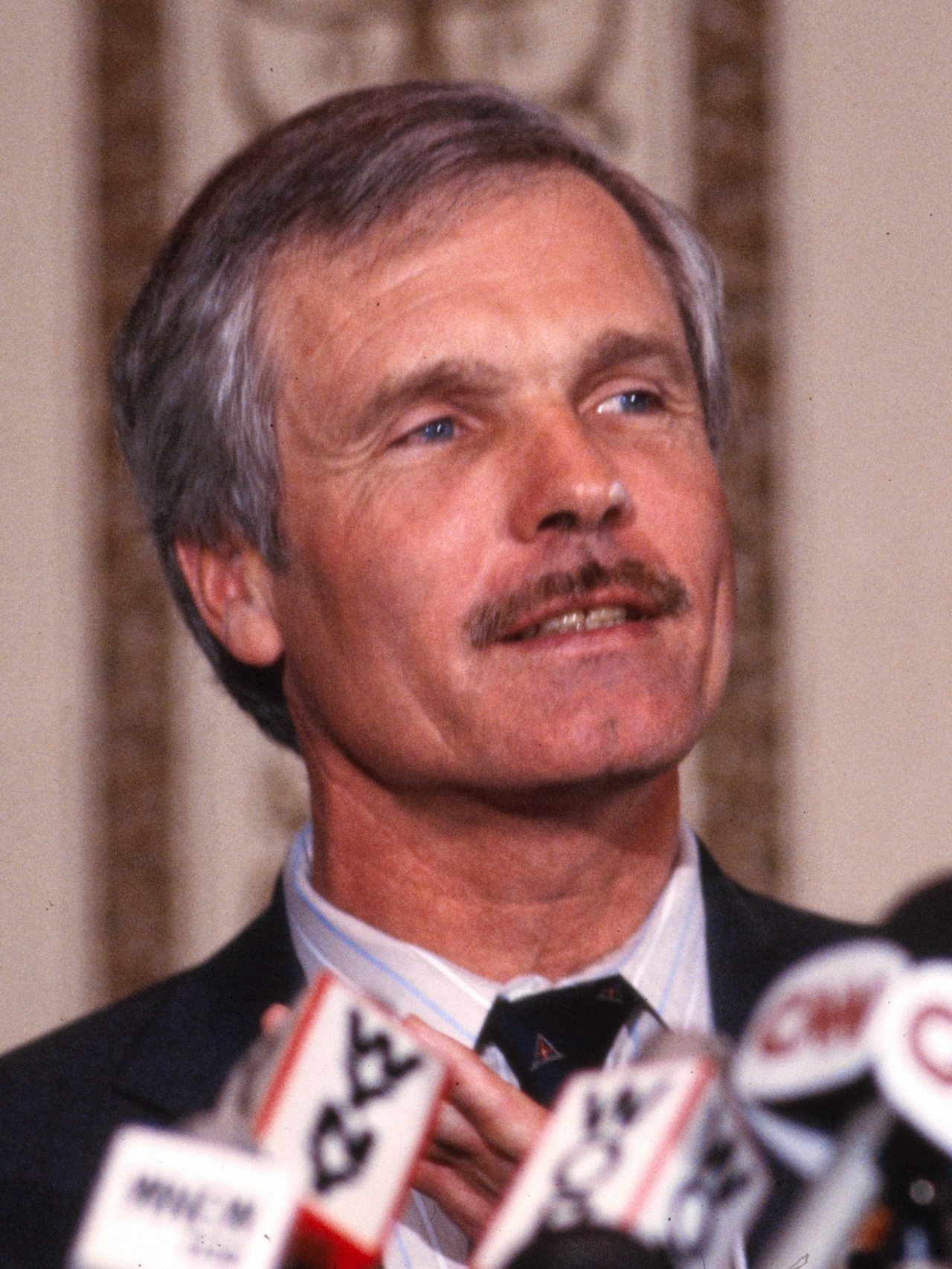
photo of Ted Turner from 1985; image in public domain and taken from Wikipedia

“And he’ll get into heaven. He’s a miracle.”

This is a quote from Jane Fonda, from CNN’s obituary of Ted Turner, who died today at the age of 87. I’m struck by the hope in those words, uttered by a woman deeply hated by conservative “Christians” about a man equally loathed.

But Jane Fonda became a Christian. And Ted Turner did more good than probably any of the pastors occupying pulpits in the megachurches of Atlanta, of which there is no shortage of supply.

On the subject of heaven, my mom—while in the depths of our Southern Baptist days, when she was the employee of our church and during one of those swings where the fundamentalists held sway—once said, “I think we’ll be surprised who’s there and who’s not.”

I’ve long held that bit of wisdom dear to my heart.

***

I actually don’t know much about Ted Turner. The Turner name is ubiquitous in the Atlanta area (seen on the bottom of nearly every billboard you pass when driving on the interstate, in addition to all the television networks). I remember when I first went to Atlanta, sometime in 1994. It was the first time I’d ever seen a “real” city (Orlando’s skyline is low due to its proximity to the airports, and more people visit the theme parks many miles away than the actual city center—at least in those days) and I remember the high tech billboards advertising all the Turner networks. Other than this, I knew Turner was the founder of CNN, married to Jane Fonda, and an outspoken atheist. I also knew that he’d claimed to read the Bible many times and that it didn’t make him into a believer—a fact that pastors and teachers in my youth would use in reference to Satan quoting the Bible to Jesus when He was tempted in the wilderness.

But as a result of the hatred certain members of my childhood church directed at him, I came to suspect that he was a person worth learning more about, since it seemed clear that if it was someone my church didn’t like then they were probably a good person, by virtue of the fact my church didn’t like them. From this I learned that Ted Turner was a committed philanthropist, largely dedicated to animal conservation and environmental causes, most notably the reintroduction of bison to the American West.

***

Ted Turner was indirectly responsible for the fostering of my sense of humor.

I remember when Cartoon Network first aired and I watched it nearly all the time. There was a day where I had stayed home with my grandparents. In those days Cartoon Network was just an endless cycle of obscure Hannah Barbera shows. And on this particular day a single episode of Top Cat aired in a constant loop. I kept it on. I remember text eventually scrolling on the bottom of the screen saying that there was a technical issue. I became convinced that it was intentional.

Years later I would read that the staff at Cartoon Network in the early days were bored as hell. They thought they would be able to create new shows. I can easily see these guys looping a single episode of Top Cat for several hours during the middle of the day when practically no one was watching as either a joke or as a means to slack off.

Anyway, the story goes that these Cartoon Network guys approach Ted Turner, begging him to let them make new stuff. Ted’s reply was “we just bought the entire Hannah Barbera catalog, do something with that.” They were given practically zero money, but at least the green light to develop new programming. For creatives, this is grounds for the opportunity for something truly magical and what resulted was maybe the single most subversive television show on cable TV at the time: Space Ghost: Coast to Coast.

I knew Space Ghost. And Birdman. I knew them because my mom insisted on going to the earliest Sunday morning church service and so I would be awakened before the sun on the Lord’s day. I’d put on the TV and, of course, there was nothing on. Except, for some reason, Ted Turner stuck random installments of Space Ghost/Birdman on TBS at that hour. So I’d watch those while my mom attempted to usher me into a shirt and tie for church.

The moment I saw Space Ghost: Coast to Coast I knew I was watching something made by people like me. Yeah, they were older (I was in like eighth grade when it came out), but we were on a similar wavelength. I’ve heard people like Hal Sparks talk about how seeing Monty Python’s Flying Circus made them feel less weird and less alone. That was what Space Ghost did for me.

That show, of course, gave birth to the entire “Adult Swim” aesthetic and ethos—fifteen minute shows with extremely offbeat humor and janky animation.

Cartoon Network would also play a key role in my love of anime through the Toonami block in the afternoons (where I would fall in love with Robotech), which would put anime alongside American shows like Thundercats and allow me to see the connections (those old shows were made in Japanese animation studios).

So, thanks Ted for being a penny-pincher and giving ground to some truly incredible GenX art.

***

Is Ted Turner in heaven? Well, I don’t think too many people are in heaven (aside from the Lord God, Christ Jesus, and the glorified saints and angels). I also tend to think that we all get to heaven, eventually, since heaven is destined to come to earth and the New Jerusalem features gates that never close.

Is Ted Turner experiencing rest? That’s the real question. I’d like to think so. I’d like to believe that his questions are being answered. That he finally understands why his sister suffered, why his dad was such an asshole and that they are finding reconciliation. If you don’t know what I’m talking about, you can read about it in his many obituaries.

What I find most interesting about Ted Turner’s death is how we have a rare billionaire, one who’s death is the grounds for lauds and accolades. A man who is remembered for all the good he tried to do.

At a time where we decry the billionaire class, where we lament with the psalmist about our having to put up with the “indolent rich,” we have Ted Turner. An atheist who ended his speeches with “God bless.” A driven workaholic who lived in his office for 20 years (by his own estimation), who was the second largest landowner in the United States at one point, owning 28 properties. He owned yachts. He fits the description of so many lamented billionaires, yet defies being held in their peer. He was a man who could have done much evil and instead tried to do much good. Even if his media empire and the 24-hour news cycle he created have been co-opted by capitalist greed to foster much harm, it didn’t seem to be Ted’s intent (and from many accounts he was deeply saddened by losing influence over his companies).

Saint Paul writes in Romans:

Gentiles don’t have the Law. But when they instinctively do what the Law requires they are a Law in themselves, though they don’t have the Law. They show the proof of the Law written on their hearts, and their consciences affirm it. Their conflicting thoughts will accuse them, or even make a defense for them, on the day when, according to my gospel, God will judge the hidden truth about human beings through Christ Jesus. (Romans 2:14-16 CEB)

I think about Ted Turner. Here was a man that did good, even as a non-believer, out of a sense of obligation to the wider world. Saint Paul prefaces this section by noting that it is the ones who do the works of the Law that are justified, not those who simply hear it. So Ted read the Bible and it didn’t lead him to become a practicing Christian. But he was raised in an environment that fostered in him a sense of decency and obligation to his neighbors, to be empathetic to others. That’s got to count for something, yeah? Especially when we contrast it with the selfish wealth-hoarding of so many prominent pastors.

Ted Turner is the rare billionaire that inspires at least one prominent Christian to publicly hope that he is heaven-bound. I share in that hope too.

Rest in peace Ted.


The Rev. Charles Browning II is the rector of Saint Mary’s Episcopal Church in Honolulu, Hawai’i. He is a husband, father, surfer, and frequent over-thinker. Follow him on Mastodon and Pixelfed.

#TedTurner #Faith #Christianity #CartoonNetwork #Theology #death

Surfing saved my life.

That’s an over-dramatic way of putting it. Perhaps the more accurate thing to say is that surfing has played an integral role in the working out of my salvation, a grace from God that helps me better understand His grace overall. But saying “surfing saved my life” grabs one’s attention a little bit better.

I’d grown up a skateboarder, starting in the summer of 1996, which put me adjacent to surfing. Over the next four years or so, I’d be in surfing’s orbit in some form or another—either by being in stores that sold clothing and accessories related to both or because my youth pastor, who taught me a lot about skateboarding, was also a surfer and was trying to get me and my best friend to join him some Saturday.

My mom was not a beach person. So I seldom saw the ocean growing up. We lived in Orlando, which meant a trip to the beach would have been an event (at least an hour’s worth of driving each way). But I was very much into things like snorkeling and SCUBA. My first ever job was at a pet store that specialized in fish and I became borderline obsessed with the little critters to the point that I briefly considered ichthyology as a career. Which is all to say that I had a sort of hunger for the sea.

***

I’ve written about it before, but I was a kind of misfit kid. I didn’t really fit in with a lot of people, except my best friend and his little brother (who were practically family to me). I was too “Christian” for a lot of the cool kids at my school (even though it was a Baptist school), but also too alternative and grungy for the youth group set at the time. I fought with school administrators almost every day and openly rebelled against much of the fundamentalist elements in our church. I got really good at “code-switching” when around certain groups, only really feeling like myself when I was with friends or alone at home.

During my junior year of high school (second-to-last year before graduation, for those readers who might have a different school system) I got kinda tired of fighting with everyone. I watched Office Space for the first time and it opened my mind to a completely different way of thinking: not giving a shit. I decided to just do what I wanted to do. And I decided, after winter break, that I wanted to play baseball.

I worked hard. I carried a baseball with me everywhere like I was Pistol Pete and his basketball. I was throwing and catching after school, going to batting cages. I was hitting solid line drives off the 90 MPH pitching machine. But, I did not make the cut. I have my suspicions about this (my mom worked for the church of which my school was parochial and there had been long-simmering tensions between the two institutions; none of the church staff kids were picked that year). Regardless, this turned out to be a God-send because one day I was skating at the church and my best friend shows up and tells me that he and Eddy (our youth pastor) had gone surfing together and that it was awesome. He told me “my dad is going to take us to the beach tomorrow, you should come.”

That day would have been the date of my first baseball game had I made the team.

We drove to New Smyrna Beach, rented long boards, and waded out into the freezing cold water. I was in a wetsuit (I was taking SCUBA lessons as part of a Marine Biology class, so had acquired one as part of this, thankfully). I don’t remember much about the conditions. All I remember was taking the board to the white water and trying to catch whatever was breaking. New Smyrna, at high tide, has a long flat section of shallow water (which makes it ideal for kids playing at the beach and why it’s a popular family spot) and so I was pushing off the sand and into white water.

I’ll never forget standing up for the first time. The wave was maybe shin-high, and I was basically going straight toward the beach. But the speed and the simple fact that I was being moved by a small amount of water shifted something deep in my mind. I wound up getting hit by my board later that day, which also left an impression (both literally and figuratively):

there was something much bigger than me out there.

***

I was an angry kid. Apparently this is not uncommon for young men who grow up without fathers. My dad left my mom as soon as he found out she was pregnant with me and I never met the man (he died in July of last year). I don’t consider myself someone with “daddy issues” or whatever. But I do agree with something Donald Miller writes about in his book for guys who grow up without dads, entitled To Own A Dragon, where he notes that fathers (or father-figures) are key in helping young men learn to channel their aggressions and frustrations. We have a lot of testosterone, which is necessary for our development, and it begins to mess with us in our teenage to young adult years. Someone who’s been through it can help us navigate the path. I did not have that person.

I had a bunch of anger pent up and I took it out on authority figures, or on people that I felt were hypocritical. It often felt like the world was out to get me somehow. Plus, I was smart in a way that didn’t quite fit with my Baptist school environment (I excelled in creative pursuits; I was also quite good in history and Bible, which did afford me some accolades, but I hated doing homework and so my grades did not reflect, to the school’s eyes, my abilities). I was a self-centered little snot who thought he was smarter and better than everyone else around him. I did not realize it at the time, but I needed to get my ass kicked around a bit, on a kind of spiritual level.

***

One of my favorite surfing stories, one that has woven itself into the fabric of our shared mythology, is the story of Greg Noll’s last wave. The short version of the story is this: during an immense swell that hit the Hawaiian islands during the winter of 1969, Noll paddled out at Makaha (in defiance of law enforcement) and caught what people have said was the largest wave surfed at the time. Noll, known for his bombastic nature, allowed the size of the wave to get bigger in the retelling: first 50 feet, then 70, and so on. Regardless of the size, what’s true is that Greg Noll caught this wave, came in, loaded his board onto the roof of his car, and never surfed again. He continued to shape surfboards and be part of the industry. But he never paddled out again.

There are numerous interviews about this. The reason Noll gives for quitting surfing was that he had reached a point in life where, in his own words, he was begging God to send him a wave that he could not ride. He challenged God and God answered. He said that that wave humbled him and made him realize that he could not continue down this path anymore. Surfing was going to kill him because he did not know how or when to stop. Until that wave made that decision for him.

I love this story because it feels true to my situation. For Greg Noll, it took an eternally-growing wave to put him in his place. For me, it took an ankle-high roller.

I learned from that tiny wave that I was not the center of the universe. I would come to learn that I am a recipient of God’s grace, surfing the waves He sends.

***

That day of surfing set me on my path. I caught a wave that I’m still riding. If not for surfing, I would not be who and where I am today. Surfing would teach me about humility and God’s grace. It would also become a deciding factor in where I went to college, which would put me right in front of the Episcopal parish that would reignite my Christian faith after a few years of faltering. This would, of course, lead to my call to the ordained priesthood. It would also predispose me toward Hawai’i, the birthplace of surfing.

It was in March of 2000 that I first surfed. And it was in March of 2020 that I would begin my life in Hawai’i. There is a fairly straight line between those two points.

Had I remained an angry young man, I might’ve gone down a similar path as my dad. But God had other plans in mind.

So, yeah, surfing saved my life.

***

The Rev. Charles Browning II is the rector of Saint Mary’s Episcopal Church in Honolulu, Hawai’i. He is a husband, father, surfer, and frequent over-thinker. Follow him on Mastodon and Pixelfed.

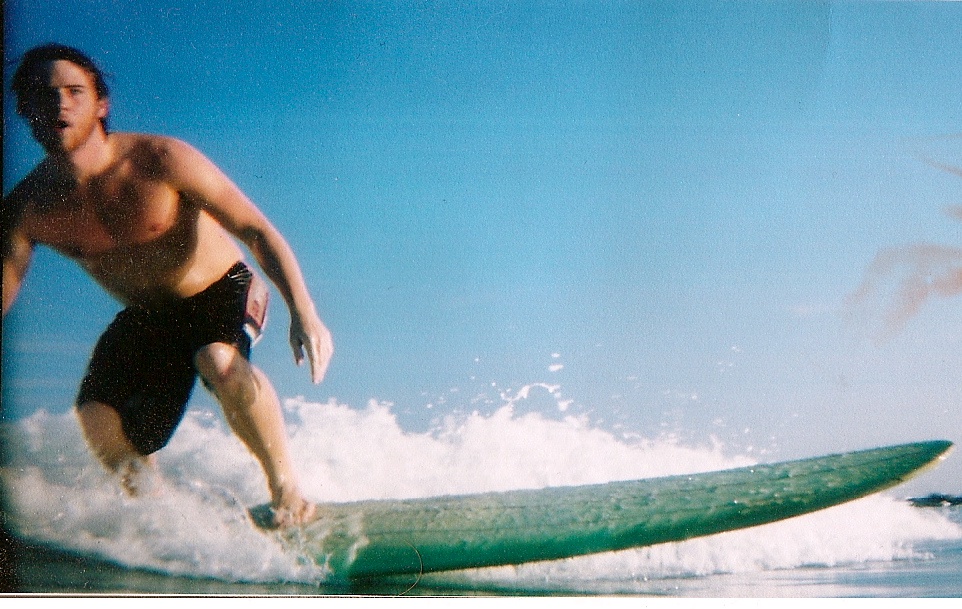
NOTE: The header photo is the only known close-up photo I have of myself surfing. It was taken by my friend Kurt probably in the summer of 2004 when I lived in Fort Pierce Florida. I’m surfing a kinda busted Yater Spoon that I bought on the cheap from Spunky’s Surfshop, a board that would also play an important role in my spiritual life, which I’ll write about some other time.

#Surfing #Spirituality #Christianity #Jesus #Theology

Today, the traffic sucked. I was finishing coffee at home when my wife warned me. So I wound up deciding to work from home. While doing something on the computer, saw that Hackers was playing on YouTube. So, of course I watched it.

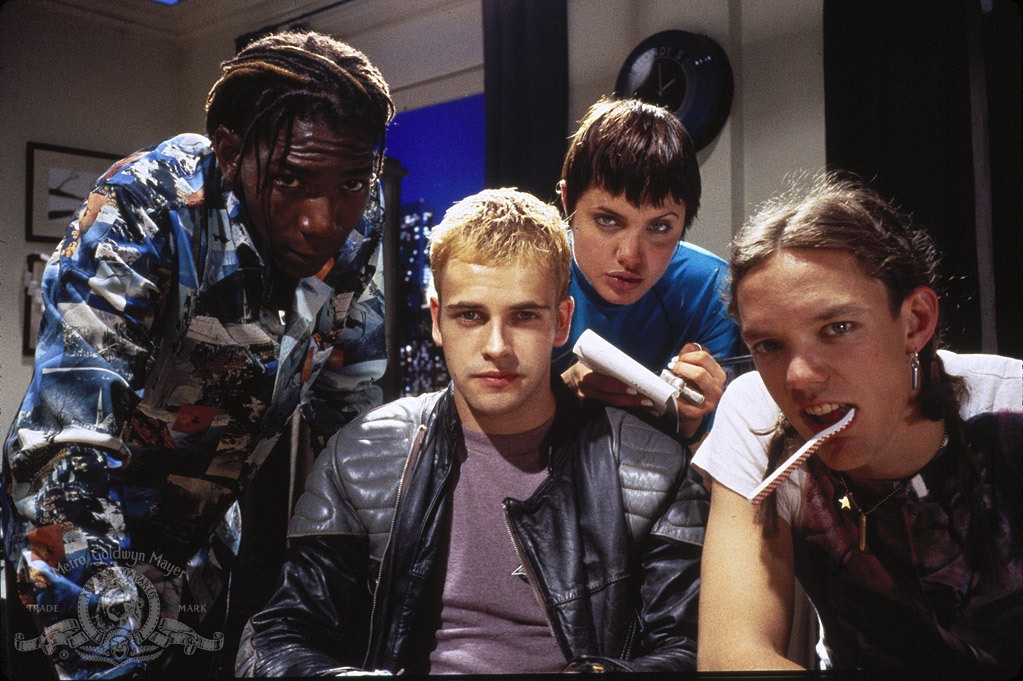
Unironically, Hackers is one of my favorite movies. I only ever caught it on rental from Blockbuster back in the day and have watched it many times since. It was among the first movies that would expose me to a kind of culture that could be considered Queer and “woke.” Even though I was hard-wired as a fundamentalist at the time of my viewing, Hackers sorta dented the shell and began to nudge me into a direction of tolerance. Further, it played a big role in making me into a reader. Matthew Lillard’s character, Cereal Killer, alludes to 1984 and there’s a classic scene where he’s showcasing a bunch of the books used for networking standards and Dade (Johnny Lee Miller’s character) is listing off the vernacular titles to the impressive nods of the other characters (Phreak and Joey). Then there’s the scene in the Advanced English class where Dade shares a (mis)quote of Ginsberg’s “Howl.” I wanted to be like that. I wanted to be seen as cool, but also smart and well-read. But I digress.

What struck me about this viewing of Hackers was how prescient it could be. Yes, it is a film about computer hacking that is made for movie audiences in 1995—which is to say, a time where “average” people thought computers were still mystery machines full of bewildering power on a par with magic. The depiction of super-computers and that hilarious and user-hostile interface on the “Gibson” are corny and comical. But the heart of that movie is in the right place, much like how Point Break gets the spirit of surfing better than most Hollywood films about the sport do. And, as such, the film depicts an intellectual divide among computer nerds that is today coming to fruition.

In one corner we have The Plague, played by Fischer Stevens. There is a suggestion that he’s a bit of a sell-out, a hacker who got a job running information security at a major mineral corporation. Perhaps. But he’s more straightforwardly characterized as a guy who sees himself as a lone-gun, as possessing superior knowledge and intelligence and that these factors grant him the license to do whatever he wants. He tells Dade, our protagonist, that hackers are effectively a different breed of human, that they are “samurai” or “keyboard cowboys” and that the rest of the world are “cattle.” Both the image of the samurai and the cowboy are popularly depicted as loners, traveling the land free from any moorings, obligated only to themselves and their code (which takes on extra meanings from a computer-centered point of view). The Plague seeks to enrich himself at the expense of others, because why not? He sees himself as smarter and anyone not smart enough to do the same as him is a sucker. He is the American idealized individual, remade for the digital age.

In the other corner we have Dade Murphy. Known by two handles throughout the film: Crash Override and Zero Cool, Dade and his friends represent a different sort of computer hacker. Theirs is part of a subculture. At one point in the film, a federal agent reads aloud from “The Conscience of a Hacker” by Lloyd Blankenship, also known as the “Hacker Manifesto:”

This is our world now. The world of the electron and the switch; the beauty of the baud. We exist without nationality, skin color, or religious bias. You wage wars, murder, cheat, lie to us and try to make us believe it's for our own good, yet we're the criminals. Yes, I am a criminal. My crime is that of curiosity. I am a hacker, and this is my manifesto.

This is the exact quote from the film (sourced from IMDB), and is a selection from the actual document itself, likely edited to better summarize the ethos of our protagonists. Dade and his friends see themselves as, primarily, curious explorers (to use a phrase from near the beginning of “The Conscience of a Hacker”) who no longer define themselves by the markers that have conventionally been placed on them. We see this in action in the film whenever Dade is brought into the wider hacker subculture, particularly with the characters of Razor and Blade, two decidedly Queer-coded characters of East Asian ethnicity, who are also seen inhabiting a club full of diverse and varied people. These hackers are presented as the kind of “individual” that was commonplace among subcultures of the mid-90s, but their individuality is not a form of individualism. Rather, they represent a collectivist mentality and tend to see their intelligence and skills as tools for building a better society, using the infrastructure of the old in order to do so. Indeed, seldom is Dade ever pictured alone in the film. He is almost always sharing the screen with his friends, underscoring the collectivist characterization.

The theme of the film is pretty explicitly stated in the beginning when Dade hacks into a TV station in order to take down a Rush Limbaugh type character’s show and replace it with The Outer Limits. This era of the 1990s was an inspired time, where many of us believed that the internet opened up a new avenue for tolerance. It was also a tool for disruption, of bypassing the strictures of unfettered capitalism. Quoting also from “The Conscience of a Hacker,” Razor and Blade (hosts of a kind of “pirate TV” show, who are teaching their audience a form of “blue boxing” using a micro-cassette recorder—a technique that was already out of date by the time the movie premiered) say “this is a service that would be dirt cheap if it wasn't run by profiteering gluttons.” Adding, “remember, hacking is more than just a crime. It’s a survival trait.”

Hackers predicted the kind of world in which we are currently living. One where some hackers became “Tech Bros,” oligarchs seeking to hoard wealth no matter the human and environmental cost (recall that The Plague is fine with causing a worldwide environmental disaster, while also pinning the crime on a bunch of high school students, so long as he gets his money and stays out of jail). The individualist who believes that they are inherently superior and that that superiority obligates them to a life of wealth and leisure.

But the other kind of hacker still remains. Those who still believe that these tools are useful for liberating people, that a better world is still possible. In this sense, Cereal Killer gets to deliver what I think is the most iconic line in the movie:

Listen, we got a higher purpose here, alright? A wakeup call for the Nintendo Generation. We demand free access to data, well, it comes with some responsibility. When I was a child, I spake as a child, I understood as a child, I thought as a child, but when I became a man I put away childish things. (Though it still bugs me that he says “Corinthians one” instead of “First Corinthians” right after this…)

Having access to these tools and this data comes with responsibility. They are not a license for doing whatever we want. They obligate us to look out for each other and help each other. In the film, this line delivery is the catalyst to get Dade and Burn (Angelina Jolie’s character) to end their playful rivalry, which in turn inspires an entire global community of hackers to work together to prevent the wealth hoarding Plague’s criminal actions from causing a global catastrophe.

This collectivist action is done under the call “Hack the Planet,” which is also the tagline for the movie.

This call goes deeper than the usage of network infrastructure to circumvent capitalistic exploitation. Hacking the planet involves a shift in thinking that moves beyond conventional lines of demarcation and into something focused on a common good. It refuses to see the world as a collection of individualists, but as a kind of organic whole. The “profiteering gluttons” want to keep the world divided and stupid in order to achieve their desired ends. But there are those who resist such things and refuse to accept this status quo.

One of the ironies of the internet is that it is a thing built on the protocols for military communication but is also the realm of knee-sock-wearing Queer folk. A tool for war has become a tool for peaceful liberation, a means for people to investigate (indeed even “hack”) their own self-understanding. The result does not have to be some kind of atomized individualism, but a kind of individuality that sees itself as a smaller part of a whole.

The Plague-like Tech Bros have done much to force their vision for the world on us. But another vision still exists. It might not broadcast on pirated TV signals, or rollerblade in the glitching lights of abandoned subway tunnels. It might not play Wipeout in a nightclub with people selling computer parts out front. But it still looks for workarounds. It still likes to play jokes on the Feds. It still sees a common humanity running through the labels and stigmas and geopolitical boundaries.

We can still use these tools to better the world. Because it is our world now. We might be seen as criminals. But so were most people who tried to make things better for us.

Hack the planet.

***

The Rev. Charles Browning II is the rector of Saint Mary’s Episcopal Church in Honolulu, Hawai’i. He is a husband, father, surfer, and frequent over-thinker. Follow him on Mastodon and Pixelfed.

#Hackers #Computers #Philosophy #Theology #Movies #Film

Taken by the humble author; depicts the ocean with paddlers and swimmers, the mountain known as Diamond Head is in the distance on the left hand side.

Today I had an off day of surfing.

The wind was stronger than expected. It was kind of crowded for my spot. Waves were wrapping from the West and peaking, breaking almost perpendicular to shore.

When I first arrived I said a little prayer “Lord, if you want me to surf, give me a parking spot.” I drove around and, what do you know, a really nice spot near the showers opens up. As soon as I get out of the car I feel the breeze briskly picking up speed, starting to blow side-shore. I wasn’t feeling it. But the late-morning was beautiful, a classic looking south shore of O’ahu kind of day. So I grabbed my camera and took some photos of the sun glistening off the water, Diamond Head in the back ground, people paddling and swimming in the foreground—a photo that could have existed over a hundred years ago. Took close-up photos of the rocks, testing out a 25 year old digital camera I got for Christmas, to replace an exact model I had short-sightedly given away years back.

I return to my car and stare at the water. An uncle next to me is gearing up to paddle out. Another uncle, his friend, comes over and they start talking story. I decide to call it and make my way around toward the driver’s side.

“Eh! You going out?!” the other uncle says.

“Nah. Too windy.”

“Can I have your stall, den?”

“Sure.”

“I come back. Get one brown SUV. Eh watch my water bottle while I go gettum.”

As he leaves his water bottle on the curb and walks away I look at his friend and I joke: “he’s very trusting. Gotta watch out for these haoles you know!” I say with a smile. “We known for taking things.”

“Eh,” the first uncle says with a dismissive tone. “All kinds of people can do all kinds of things.”

We get to talking. Richard is his name. I’ve seen him in the water before, but he usually paddles out shortly as I’m heading in. Today I’m at the spot at a later time. He urges me to go out.

“Too crowded. Plus I told your friend I’d give up my spot for him.”

He dismisses this and tells me it’s good and I need to go out. Eventually the brown SUV comes rolling around. I give shakas and say goodbye as I drive away. About five cars down I see another car pulling out. As I drive past I can’t shake the feeling that this is all God’s way of telling me that I need to paddle out. So I loop around and pull into the other spot. This one is actually better because it has more shade. I pull down my 11-foot glider (pretty much my exclusive board for the past three years), sunscreen, wetsuit vest zipped up. And I walk over to the cut between rocks where I can paddle out. I see Richard and I tell him that he convinced me to change my mind. He gives a loud approval.

I make the paddle in good time. The crowd thinned a bit in the interim. Waves have power. I see a few familiar faces, folks I did not expect to see in the water because they’re usually out at my normal time. I see a wave on the horizon, taking shape. I whip my board around and paddle. I feel the momentum taking me so I hop to my feet. The wave is beginning to break in front of me, so I go to fade left and surf on my back-hand. But there’s no face there. The wave is a strict right. So I fade back to front-side and try to get into it. I squat and begin scooping at the water, hoping to pick up more speed, but no dice. So I paddle back out, chuckling to myself.

After a while I see a set forming on the horizon. No one seems to be going for it, so I spin around and start paddling. I easily catch the wave and drop in, going right. I squat a bit in the face and then stand to adjust my position, dropping down the face in order to carve my way back up. But I see that it’s walling up too far ahead and is going to close out. So I fade back left to see another closing section coming behind me. So I turn to go straight and ride out the whitewater. But I get caught between two breaking sections, the foam engulfing my board and I feel the force underneath me. I get knocked off my board and plunged under the foam. I feel the chaos of the colliding waves rolling over me and I surrender to the current. Once the wave fully passes I surface. Another wave is breaking, but I have enough time to take stock of my surroundings and know that my board has made its way toward shore, pretty far from my location.

So I start swimming.

At this point I should probably note that I prefer to surf without a leash. Unless it’s particularly big and/or crowded, I’ll forego having a urethane chord dancing about my feet. Leashes can give us a sense of false security. They can and will fail and so we need to be prepared to swim when that eventually happens. Plus, leash-free surfing forces one to be more intentional in their surfing, as well as cognizant of one’s board.

It’s been awhile since I’ve had a long swim for a board. Since I’m wearing a wet-suit vest, I have some buoyancy and I have better results from flipping on my back and kicking my way toward my board. I hold my breath and descend under white water, wait for the roll of the wave to wash over me, return to the surface, and then kick my way again.

There’s always a threat of panic in the back of my mind when I have to swim for a board. I’m pretty far from the beach where I surf and there’s a lot of water. Also infrequent tiger shark sightings. But I keep myself calm. Eventually I see that an off-duty lifeguard who surfs my spot has retrieved my board. I thank him and grab it. I bob on the inside, considering the time and effort it would take to get my leash. Nah. I’ll paddle back out.

As I’m nearing the outside, I see the lifeguard wipe out. His big yellow board is bouncing among the whitewater, making its way to shore. He, too, is not wearing a leash. So I turn my board around and grab some whitewater and make my way to where his board is bobbing on the shallow reef. I grab it and start paddling in his direction. He gets it. I tell him we’re even. We both laugh and paddle back out.

By the time I make it back outside, I’m getting tired. I tell one of the uncles I know that I got my swim in for the day and he laughs. The wind has significantly picked up and is blowing almost onshore. After a time I see another wave making its way toward me. It’s mine. I paddle and begin to make the drop a bit later than I was expecting. So I grab the rails and decide to ride it on my belly. The speed is unreal. I’m constantly on the verge of being rolled over, but I keep my composure and let myself fly toward the beach. I decide that I’m not about to paddle back out. This will be the ride, for what it’s worth.

The wave peters out in the shallows of the reef. The tide is nearly dead low, which means that I’ll have to be careful not to let my fin hit anything.

I’m a good surfer. I’ve been at it for 26 years. I get long nose rides on the well-formed South Shore faces. I drop in and run my hands along the face of the waves. I’ve even garnered compliments for my ability to hit the lip with an 11-foot board, on occasion. I’ve shaped boards, ridden a variety of designs. I know the mythology and the legends. I know surfing inside and out.

And I still have off days.

Blessed be the off days.

That saying came into my mind as I carefully paddled over the shallow reef. A large honu (sea turtle) popped its head up next to me. “Hey, cuz!” I said. It swam directly under my board.

This past Sunday we heard Jesus give the Beatitudes. There’s a tendency to read the Beatitudes as Jesus giving us a list of rewards: “be a peacemaker, get a blessing; put up with grief and persecution; get a blessing.” But Jesus is actually saying that peace-making, grieving, being persecuted, being poor in spirit, etc. are themselves blessings. In the Greek language that Matthew’s gospel was maybe first written in, the Beatitudes are in what’s called the “indicative mood.” Meaning that the blessings are indicated by the other stuff. The blessings aren’t rewards for doing certain things.

This idea translates broadly. An off-day of surfing is a blessing, if I choose to see it. Blessed be the off days, because they help you appreciate the better days. Or, Blessed be the off days, because they make you a better swimmer.

I didn’t get to have a morning of beautiful glides on my huge board. I didn’t get to run to the nose and hang ten on a perfectly groomed wave face. I didn’t even get to drop in while squatted down, feeling the cool water with my fingers as I experience the thrill of dropping into the face of a wave and setting myself up for an elegant bottom turn to set my rail and just… go.

Nope. I got wiped out. I swam a lot. I got skunked on wind-blown waves that were both somehow mushy and strong.

But I got in the water. I learned that I’m finally mature enough to appreciate even the days where my surfing kinda sucks.

Blessed be the off days, indeed.

***

The Rev. Charles Browning II is the rector of Saint Mary’s Episcopal Church in Honolulu, Hawai’i. He is a husband, father, surfer, and frequent over-thinker. Follow him on Mastodon and Pixelfed.

#Surfing #Reflection #Ocean #Theology #Jesus #Church #Hawaii #Oahu

The altar of Saint Thomas in Canterbury Cathedral, marking the spot where he was martyred.

I’m sorry to say that I was not very familiar with Saint Thomas Becket (also known as Saint Thomas of Canterbury) until recently. He’s quite an important English saint with a famous memorial altar in Canterbury Cathedral that marks the spot of his martyrdom (seen in the header image). His shrine is also the place to which the characters in Chaucer’s Canterbury Tales are traveling and sharing their stories. The liturgist Richard Giles feels that Saint Thomas should be the patron saint of England.

Thomas Becket (sometimes “Thomas a Becket”) was the archbishop of Canterbury in the late 1100s. He was the son of a Norman family and managed, with great ambition, to become a highly valued member of Henry II’s inner court. The king saw an opportunity when Archbishop Theobald Bec died. Henry figured he could appoint a kind of ringer in the senior office of the Church in England, and so he managed to get Thomas appointed—despite the fact that Thomas was not ordained to any clerical office at the time. Within days, Thomas was ordained deacon, priest, then bishop in order to take charge of the archbishopric. He came to this office in the midst of a time when the English monarchy was attempting to both exert further control over the church and gain further independence from Rome. But Thomas had a fairly dramatic conversion experience as a result of his impromptu ordinations and wound up eschewing the vainglory of the royal court in favor of faithfulness to the Church. Once Henry’s close friend, he became a thorn in the side of the king and was regularly opposing him on church-related issues, even threatening excommunication at one point.

The story goes that Henry II, in a fit of frustration (and after Becket had been allowed to return from a multi-year exile in France), exclaimed among some of his advisors and knights “will no one rid me of this troublesome priest” (or some variation of this). Four of his knights took this as an order and made plans to assassinate Saint Thomas in the Cathedral. He was stabbed multiple times while Vespers was being chanted, the events expressed in gory detail by one of the monks wounded in the attack.

There are complicated elements in Saint Thomas’ story that carry overtones we still deal with today. Becket wanted “secular” legal systems to have limited authority over the clergy, preferring that the Church handle its own affairs. Such a practice has come to a head in the early 21st century where we’ve seen that when the Church is left to its own devices in terms of addressing clerical crimes, justice becomes elusive. However, at the same time, we also see the dangers inherent in a system where a government exerts control and influence over the Church. Becket was a champion of the established models of medieval Christendom, where monarchs were understood to be under the authority of the Church, with bishops serving as a kind check on kingly power. Henry II did not want to be held in such check and his frustrations with this idea ultimately led to the death of a beloved archbishop.

Thomas’ assassination is of a piece with other notable Christian leaders who attempted to challenge worldly power with the power of the gospel. Oscar Romero is one example, assassinated during Mass by right-wing political figures. Martin Luther King Jr. is, of course, another—assassinated because he became a more vocal opponent of the war in Vietnam and was beginning to shift his advocacy toward the exploitation of the working poor. Both saw their stances as being rooted in the gospel.

Thomas is a worthy saint for our consideration and devotion in our time. There is much pressure put on the Church (in all her forms) to capitulate to worldly powers. The radical right movements like MAGA and their ilk are the most current (and perhaps most egregious), but I’ve seen such pressure come from the left-side of things as well. Having grown up in a church quite given to right-wing political and social evils, I’m loathe to see a similar thing happen with more “progressive” churches like the Episcopal Church, where subscription to partisan talking points becomes seen as synonymous with “the gospel.” Indeed, I am of the conviction that faithfulness to Jesus Christ and His gospel will result in frustration from all forms of political partisanship. Jesus is one who disturbs worldly power, not one who makes it feel comfortable. If the Venn Diagram of one’s partisan politics and their theology is a circle, there’s a problem.

It is said that Thomas was prayerful and pious even as he was being struck by the swords. When the knights entered the cathedral, the monks wanted to bolt themselves in the sacristy for safety but Thomas would not let them. “It is not right to make a house of prayer into a fortress,” he said. After the third blow with a sword, one of the survivors of the attack recalled Becket as saying: “For the name of Jesus and the protection of the church, I am ready to embrace death.”

Saint Thomas of Canterbury was willing to face death rather than capitulate; choosing the assassin’s blade over easy comforts provided by temporal power. When his body was removed from the nave of the cathedral and his episcopal vestments removed, his fellow monks discovered that Thomas wore a hair shirt underneath it all—a garment of great discomfort and used for spiritual discipline and penance. It was a sign of the deep devotion this man had. Do I have the same level of devotion? Do you? How willing are we to hold to the gospel that’s been handed down to us in the face of pressure, coercion, even death? This is a challenging question.

Faithfulness is not always easy. Saint Thomas, like Saint John and Saint Stephen before him, testifies to this fact. The powers of this world are more than ready to execute anyone in service of their claims to power—the testimony of which Saint Thomas shares with the Holy Innocents.

Again, the Christmas season is not all garlands, tinsel, gifts, and lights. It is also blood and travail. This dichotomy is quite strikingly expressed in the hauntingly gorgeous Christmas hymn “A stable lamp is lighted.” I have us sing this hymn every Christmas Eve as a reminder that Christmas leads us to Easter, but we have Good Friday as an unavoidable stop along the way. The first verse of the hymn is a beautiful exposition on the Nativity story:

A stable lamp is lighted whose glow shall wake the sky; the stars shall bend their voices, and every stone shall cry. And every stone shall cry, and straw like gold shall shine; a barn shall harbour heaven, a stall become a shrine.

But the third verse takes us to Calvary:

Yet he shall be forsaken, and yielded up to die; the sky shall groan and darken, and every stone shall cry. And every stone shall cry for gifts of love abused; God's blood upon the spearhead, God's blood again refused.

The saints of the first week of Christmas embody this tragic element. The babe in the manger will ultimately, despite His dedicated following and popularity, be rejected because He usurps the status quo, overturns the way-things-are. Certain people will “come and adore Him” only to a point. So long as He stays in that manger, things are fine. It’s only when He grows and enters a house of prayer to drive out corruption that certain people begin to reconsider their love and commitment of Him.

The final verse of “A stable lamp is lighted” offers us a powerful closing word:

But now, as at the ending, the low is lifted high; the stars shall bend their voices, and every stone shall cry. And every stone shall cry in praises of the child by whose descent among us the worlds are reconciled.

In the end, as Saint John testified, the way-things-are will ultimately fall away to a world made as new. The sorts of powers that kill innocents and saints will be unmade and the world will be set as it was made to be.

***

The Rev. Charles Browning II is the rector of Saint Mary’s Episcopal Church in Honolulu, Hawai’i. He is a husband, father, surfer, and frequent over-thinker. Follow him on Mastodon and Pixelfed.

#Church #England #Episcopal #Anglican #Christian #Theology #History

Detail of window at Chartes Cathedral showing the Massacre of the Innocents, taken from Wikimedia Commons

I was first really exposed to the Christian commemorations of the Holy Innocents thanks to a church name. Holy Innocents Episcopal Church outside Atlanta, to be exact. I visited that church and liked the architecture and liturgy and it inspired me to learn more about a story I had known since childhood but seldom dwelt on—much less saw as a focus of devotion.

It’s a story that largely gets left out of our Christmas commemorations in the Episcopal Church, partly because it is such a horrible story (and likely partly due to the more modern doubt of the story’s historical accuracy, which we’ll talk about in a bit). No one wants to follow up Christmas morning with a service about the mass-murdering of children.

At the same time, especially this year, this is a highly relevant story. Tragically, all over the world, politicians are playing like Herod and systematically executing anyone they deem a threat—including children.

Holy Innocents, also known Childermas, commemorates an event that, in all likelihood, never happened. Josephus, an important Jewish historian, took great care to showcase the brutalities of the Herodians and never once mentioned a mass slaughter of children. Outside of the gospel of Matthew there are no other historical accounts of this story and it seems likely to be something meant by the evangelist as a means to make connections between Jesus and Moses, a common theme throughout that particular gospel. So what are we to make of this fact? That we not only have a day marked on our calendar but also name churches and schools for an event that probably never happened?

This is one of the tough parts of reading the Bible. It’s not always “factual” in the ways to which we are accustomed today. Nevertheless, elements that we deem “fictional” can have a huge impact on our faith and wind up speaking Truth despite their (in)accuracy.

Consider the typical Christmas pageant. Aside from Mary, Joseph, a baby, angels, and some shepherds most of the story we dramatize is completely fictional and not related to what is written in the Bible. We tend to think of the birth of Jesus as being an event that culminates after Mary and Joseph, alone on a donkey, have gone to every house or inn in Bethlehem and been told “no vacancy” and so set up shop in a nearby stable. But none of the gospels mention a donkey and we’re only told that there was no room in “the inn”—nothing at all about conversations with inn-keepers or a door-to-door journey. Further, given the nature of the census, there was probably a caravan of people traveling to Bethlehem and others taking residence among the livestock because Bethlehem was not prepared for such an influx of extra people. What we think of when we think of the Christmas story is largely fictional, but that doesn’t mean there’s not truth in those elements. We crafted those details over the centuries in order to “flesh out” the story a bit, to give it the sort of texture that it invites. And those added details speak much of the faith and mindset of the church that crafted them.

The same is true of the Massacre of the Innocents. It might not have happened, but it’s very telling that no one finds the story improbable. There might not be any records to back it up, but the story sounds like the sort of thing Herod would have done—indeed, the sort of thing that rulers all over the world and all over our history books have done.

The sort of government that gleefully cancels aid and assistance to poor countries is acting like Herod. The one that uses starvation, particularly of children, as a weapon of retaliation is acting like Herod. The political entities that travel throughout villages to murder women and children are the ones acting like Herod.

The actual Herod may not have ordered a campaign to murder the children of Bethlehem out of some fear of losing power, but Herod for sure murdered plenty of children and other innocents during his reign out of a sense that because he was in charge he could do so—without any fear of God. And in this, Herod is an archetype. Plenty of gilded so-called rulers kill innocents in the name of preserving their name on the side of buildings. If they were honest, they do so out of a desire to kill the God that they are not.

Yesterday’s saint records Jesus saying “If the world hates you, know that it hated me first.” The poet Dianne di Prima says in her poem, “Rant” that “the only war that matters is the war against the imagination, all other wars are subsumed by it.” I tend to think that it’s more the case that all hatred is subsumed in hatred for Jesus and, therefore, all wars are the Battle of Armageddon, the war against Christ Himself.

If the story behind Holy Innocents is fictional, then it is worth asking what it is we’re commemorating this day. I think the answer is simple: Holy Innocents commemorates all children sacrificed on the altar of expedience or inconvenience by those in power attempting to cast themselves as gods. Those killed by starvation from the abrupt end to programs like USAID or in Gaza by the Israeli government. Those killed by radicals in Somalia and Sudan. Those dying thanks to bombs dropped on Ukraine. And that’s only looking at what’s currently happened in the news in recent weeks. These are who we commemorate on Holy Innocents. The gospel story is subsumed in the stories we see right now, and is itself reflective of those stories. The gospel story helps us Christians see the shape of the story happening around us, helps us in remembering where our allegiance lies.

Herod is the one who oversees the death of innocents. Christ is the one who sees them as holy.

***

The Rev. Charles Browning II is the rector of Saint Mary’s Episcopal Church in Honolulu, Hawai’i. He is a husband, father, surfer, and frequent over-thinker. Follow him on Mastodon and Pixelfed.

#Christmas #HolyInnocents #History #Theology #Church #Christianity #War #Gaza #Ukraine