Chasing Bubbles
I received news that a dearly loved family member was in the emergency room, showing signs of some form of brain trauma that is, as of now, not yet fully diagnosed. I received this news as I was driving in to Saint Mary’s.
My morning routine is, after dropping off two of my kids at their respective schools, to sit in the nave of Saint Mary’s and say Morning Prayer. My practice is consistent: I say the confession, then the absolution (in the plural, praying for absolution on us all—you’re welcome), followed by the Venite (an abbreviated part of Psalm 95), then the selection of the Psalm that’s appointed, followed by the chapter of Proverbs that corresponds to the date (this is a practice that predates my days as an Episcopalian that I have recently revisited), followed by one lesson appointed for the day from the Daily Office Lectionary (currently I’m reading the gospel lessons), then Canticle 18 (“The Song to the Lamb” from the book of Revelation—if I’m ever without a Bible or Prayer Book, I will say this and the Venite as my morning devotion), followed by silence, intercessions, the Lord’s Prayer, and then the closing Collect from the daily devotions for individuals and families).
Today I wasn’t really feeling it. My heart was heavy and so I was going through the motions. I tried to find some wisdom in the dichotomy of saying jubilant words like the Venite or Canticle 18, but I wasn’t quite there.
I kept feeling a pull, perhaps a whisper of the Holy Spirit, to read Ecclesiastes. So, after finishing my usual routine, I opened up Ecclesiastes and, as I felt the Lord prompt me, read the entire thing.
***
Years back I had the chance to see Rob Bell in Orlando. He was touring his Introduction to Joy ...thing. Not exactly a lecture, but not simply performance art. It was like stand-up comedy, but about more than jokes. Anyway, Introduction to Joy is about the book of Ecclesiastes. Rob* refers to Ecclesiastes as a book that represents “deep wisdom” or “the wisdom that applies when conventional wisdom doesn’t pan out.” Books like Proverbs represent conventional wisdom in the sense that they are largely about “do this or that and things will generally work out well.” Ecclesiastes is a book that wades into the waters of what happens when you’ve done the things that Proverbs teaches, but things are not working out well.
Ecclesiastes is the most goth book of the Bible (Revelation is the most metal, if you must know). The refrain of the book is that everything is “vanity and chasing after the wind.” It’s a long checklist of how nothing really matters, everything is empty and destined for the same universal end: to die and wind up forgotten. There’s almost an echo of the life of the Buddha in the book. The “Preacher” (koholeth in Hebrew, which is also the name of the book in that language and is a name that goes hard) is the author and is traditionally held to be Solomon, the wise king and son of David. He talks about how he pursued wealth, and also madness, and folly, and pleasure, and poverty, eventually coming to the conclusion that “vanity” characterizes every pursuit of humanity. Rich, poor, righteous, wicked, wise, fool, human, beast—all will wind up in the grave, all share the same ending. So what’s the point? “Eat, drink, and be merry,” he says. Enjoy the time you have, because all will come to naught.
This word “vanity” is a word that, in Hebrew, refers to a puff of vapor. In a masterful stroke, in Introduction to Joy Rob pulls out a spray bottle and spritzes little clouds of mist instead of saying “vanity.” Everything is [sprays bottle].
Basically, the Preacher states that everything is temporary and pretty hollow. The pursuits of life are a vapor hanging in the air, like chasing after the wind.
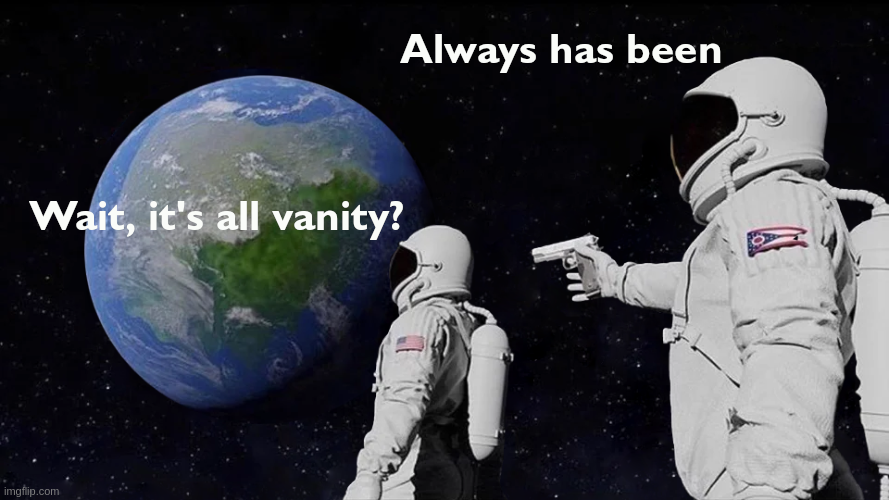
What I’ve come to realize about Ecclesiastes is that it represents a sort of bell-curve (if I’m understanding them correctly). The book opens with “vanity, vanity, all is vanity” and ends with the same, but the journey between turns “all is vanity” from a lament into good news.
 Not sure if I’m doing this meme format correctly...
***
Understanding that “all is vanity” is pretty liberating.
This is not nihilism, by the way. Nihilism proclaims that nothing matters. Ecclesiastes acknowledges that life and existence, that our time on the earth, is something. It’s just a fragile and temporary something, destined to end. What Ecclesiastes, in my reading, is doing is asking us to consider our existence in the terms of its vaporous nature. Which, in some ways, underscores the preciousness of our time on this earth.
I’m a fan of Eucharistic Prayer C. I’ve mentioned this before, and I’ve mentioned how I’ve suffered degrees of ridicule for this. One of the things I’ve been told is objectionable in Prayer C is the line “this fragile earth, our island home.” One of my colleagues in seminary felt that calling the earth “fragile” is an affront to God, as though God did not make a quality product. My retort to this has always been that fragility can sometimes be a mark of artistry and skill. A Faberge egg, for instance, is a thing of near priceless beauty but is also quite fragile. Indeed, its fragility underscores its preciousness. This is all to say that the “vanity” of it all need not automatically be a bad thing.
The “vanity” of life puts things into perspective. It is an antidote to much of what ails us.
Consider this passage:
So I became far greater than all who preceded me in Jerusalem. Moreover, my wisdom stood by me. I refrained from nothing that my eyes desired. I refused my heart no pleasure. Indeed, my heart found pleasure from the results of my hard work; that was the reward from all my hard work. But when I surveyed all that my hands had done, and what I had worked so hard to achieve, I realized that it was [vanity]—a chasing after wind. Nothing is to be gained under the sun. (Ecclesiastes 2:9-11, Common English Bible, see note below)
Imagine if, say, Elon Musk or Jeff Bezos or Donald Trump were to accept this? That no pursuit of wealth or power is going to actually satisfy them? That they could be liberated from the pursuit of wealth?
I also observed that people work hard and become good at what they do only out of mutual envy. This too is [vanity], just wind chasing. (Ecclesiastes 4:4 CEB)
In other words, don’t take things too seriously.
***
While in my meditative prayers for my family member, various things from Ecclesiastes kept popping into my mind. I was actually using “all is vanity” as a kind of mantra to see how I might be able to grasp that such a thing is good news.
That’s when I thought of my toddler and my young daughter playing with bubbles yesterday afternoon.
Bubbles are a kind of vapor hanging on the air. They are hollow, temporary, and ride the wind. They illustrate every point that the Preacher seeks to make.
And kids go nuts over them.
My toddler begs to play with bubbles. He and my daughter squeal with delight in trying to chase them and catch them. My daughter figured out that if her hands are a bit soapy she actually can catch a bubble, if only for a few moments. My older kids will also go outside and play with bubbles. We all love bubbles.
We love the swirling rainbow patterns on them. We love their fragile beauty. We also probably use them as a catalyst to think about our existence. “Maybe our universe is just a bubble floating around in the sky of a much larger universe,” says my philosopher-in-the-making second-oldest.
Bubbles are vanity. Everything is bubbles. We can waste our time getting overly serious about the bubbles. We can expend time and energy in trying to keep the bubble forever. But, no matter what, that bubble will one day pop. Trying to prevent that pop is to misunderstand the bubble, to fail to see it for what it is.
Everything is vanity. It’s all chasing after bubbles. My God, how much fun that is!
The Rev. Charles Browning II is the rector of Saint Mary’s Episcopal Church in Honolulu, Hawai’i. He is a husband, father, surfer, and frequent over-thinker. Follow him on Mastodon and Pixelfed.
NOTES:
I’ve had Rob Bell as a guest back when I had a podcast, so I get to call him Rob. This also means that I have a one-degree separation from Oprah, but I won’t let it get to my head.
The CEB tends to translate the word for “vanity” as “pointless” but I’ve amended the translation here and elsewhere because “vanity” is a better word for the concept in that [spritzes bottle] is not exactly “pointless.”
#theology #spirituality #faith #bible #Christianity #Anglican #Episcopal