The Catechetic Converter

Catholic

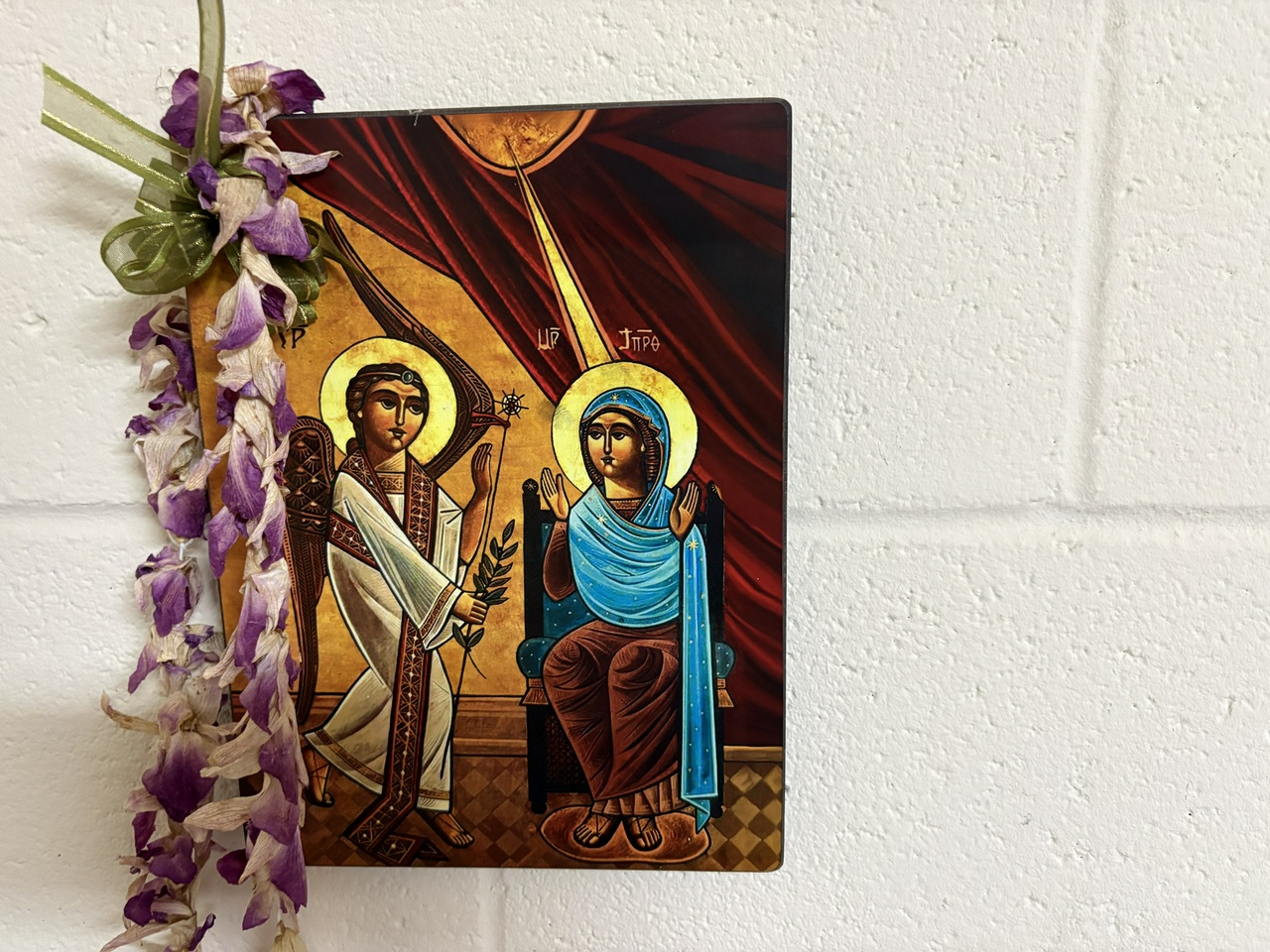
Today is the Feast of the Annunciation, a pretty substantial observance in the Christian world related to the Blessed Virgin Mary.

It is observed on March 25 because it is nine months away from Christmas, which underscores its traditional importance: the Feast of the Annunciation is associated with the Incarnation.

One of my acquaintances from seminary once posted on social media that Christmas is not the “Feast of the Incarnation,” rather the Annunciation is. Because, according to tradition, this is the day that Our Lady, Saint Mary, conceived Jesus—the day that He first took on human flesh, incarnate as God in the womb.

I like this reminder for a variety of reasons (not least my own particular “pro-life” leanings that I seldom talk about; the New Wave Feminists are probably the closest articulation to my convictions on this subject, if you must know). What a powerful notion, that God dwelt in the womb of a woman for nine months and some change. This is even more theologically rich when we consider the traditional Jewish belief that a fetus is not its own life while still in the womb, meaning that Mary herself (for a time) actively participated in the Incarnation of God.

However, I have a bit of a nit to pick with all of this: I’m not convinced that the Annunciation is when the Incarnation happened.

The Church has long observed two key feast days related to Our Lady’s pregnancy: the Annunciation and the Feast of the Visitation. The former recounts the time the Archangel Gabriel announced to Mary that she would be the mother of God; the latter is the story of when Mary visited her cousin, Saint Elizabeth (who herself was already pregnant with Saint John the Baptist), and both recognized Mary as the mother of God and the incarnation of God taking place in her womb.

Both stories are recorded in Saint Luke’s gospel. Now, Luke is a very detailed evangelist (that is, gospel writer). Of all the known gospels, his has the most historical detail. The tradition is that he traveled around and interviewed the surviving disciples of Jesus, while also reviewing other written materials (like, perhaps, Saint Mark’s gospel), in order to give a fuller account of the life of Jesus. As a result, Luke’s gospel is the only one that contains an actual birth narrative for Jesus; it’s also the only one that gives us any real details of Saint Mary. Saint Matthew’s gospel focuses a bit on Saint Joseph (Mary’s husband), but the actual birth of Jesus is merely referenced, not told.

This is all to say that Luke has an eye for detail and tries to give us as much detail as he can. All the major events of the life of Jesus have an actual story in Luke’s gospel. If the Annunciation is meant to be the story of Jesus’ conception, it’s an odd way of telling it because it seems to happen “off camera.”

Take a look:

God sent the angel Gabriel to Nazareth, a city in Galilee, to a virgin who was engaged to a man named Joseph, a descendant of David’s house. The virgin’s name was Mary. When the angel came to her, he said, “Rejoice, favored one! The Lord is with you!” She was confused by these words and wondered what kind of greeting this might be. The angel said, “Don’t be afraid, Mary. God is honoring you. Look! You will conceive and give birth to a son, and you will name him Jesus. He will be great and he will be called the Son of the Most High. The Lord God will give him the throne of David his father. He will rule over Jacob’s house forever, and there will be no end to his kingdom.”

Then Mary said to the angel, “How will this happen since I haven’t had sexual relations with a man?”

The angel replied, “The Holy Spirit will come over you and the power of the Most High will overshadow you. Therefore, the one who is to be born will be holy. He will be called God’s Son. Look, even in her old age, your relative Elizabeth has conceived a son. This woman who was labeled ‘unable to conceive’ is now six months pregnant. Nothing is impossible for God.”

Then Mary said, “I am the Lord’s servant. Let it be with me just as you have said.” Then the angel left her. (Luke 1:26-38, Common English Bible)

Notice that the language is all in the future-tense. It’s the language of expectation. So, right off the bat we can see that, based solely on the text of the Bible itself, the Annunciation does not capture the when of Jesus’ conception.

The next thing to happen in the story is that Mary up and leaves to see Elizabeth, where Elizabeth notes that her baby (the fetal Saint John) “leaps” in her womb at the sound of Mary’s voice. Modern English translations tend to phrase Elizabeth’s greeting to Mary like this: “God has blessed you above all women, and he has blessed the child you carry.” (Luke 1:42, Common English Bible) So, if we follow the tenses of the language we’ve been given, we are led to believe that somewhere between Saint Gabriel’s announcing and Saint Elizabeth’s greeting is when Mary became pregnant. Again, the Annunciation is not the place where the conception of Jesus takes place.

Now, Elizabeth’s greeting is elsewhere enshrined in one of the most beloved prayers in Christianity, the “Hail Mary:”

Hail Mary, full of grace, the Lord is with thee. Blessed art thou among women and blessed is the fruit of thy womb, Jesus. Holy Mary, Mother of God, pray for us sinners now and at the hour of our death. (emphasis mine)

This is actually the literal translation of the Greek words. Why English translations don’t like using figurative language anymore is a topic for another time, but this phrasing does not necessarily imply that Mary is currently pregnant since “fruit of the womb” is not necessarily tied to time the way “the child you carry” is.

So here’s my assertion: it is during the Visitation that Mary conceives Jesus. I base this entirely on the language of the gospel text and what we know of Saint Luke. As already noted, it would seem out of character for Luke to include such foreshadowing language from Gabriel and not give us the pay-off. But I do believe he gives us the pay-off.

Look back to what Gabriel says to Mary when she asks “How will this happen?”

The Holy Spirit will come over you and the power of the Most High will overshadow you.

Luke uses similar language in the first chapter of Acts. In the midst of the risen Jesus giving instructions to His disciples as He is preparing to ascend into Heaven, he tells them:

You will receive power when the Holy Spirit has come upon you. (Acts 1:8 Common English Bible)

In the very next chapter this is fulfilled when tongues of flame alight on the heads of the disciples and they begin to speak in different language, filled with spiritual ecstasy.

So, let’s look again at Mary’s story. She’s been told that she will become a virgin mother, the Mother of God; the sign for this will be when the Holy Spirit comes over her and she is overshadowed by the power of the Most High—language quite evocative of what Luke says about Pentecost in Acts.

Now, consider what happens after Elizabeth’s greeting. We’re told the Holy Spirit has filled Elizabeth, herself uttering an ecstatic proclamation, recalled in that first half of the Hail Mary prayer. So the Spirit is present and what does Mary do? She has an ecstatic Spirit-filled proclamation herself.

We call it the Magnificat.

It is my conviction that the Magnificat is intended by Saint Luke to evoke the moment that Mary conceives Jesus. I also think that it is no coincidence that he has this happen at a moment where there are only two women present, perhaps underscoring the miraculous nature of this. There’s no man to be found, or even suggested (as some like the heretical bishop, the late John Shelby Spong might, with his assertion that Mary was raped, perhaps by a man named Gabriel, and that this is the church’s way of trying to turn tragedy into triumph). Rather, God enters our world in the presence of two women, both enraptured by the Holy Spirit.

So, if this is the case, what are we celebrating today? Why bother with the Annunciation?

Because the Annunciation is still good news. It’s the good news that our sins have not left us abandoned. God still chooses to be born among us, even knowing our wickedness. It is the good news that God has chosen a poor young woman to be the one from which God will take on our flesh. Not a person of wealth and power and influence. But someone of meager means, marginal and innocent.

Today we hear the good news that God refuses to be separate from us.

I think of this old tweet every year on this day. Credit to OP

***

The Rev. Charles Browning II is the rector of Saint Mary’s Episcopal Church in Honolulu, Hawai’i. He is a husband, father, surfer, and frequent over-thinker. Follow him on Mastodon and Pixelfed.

#Jesus #Church #Anglican #Episcopalian #Catholic #Christian #Bible #Mary

Detail of the famous "Space Window" from the National Cathedral--link later in the text--it depicts the cosmos as dark blue and purple swirls, near the center is a glowing white circle; this is where an actual lunar rock was set in the window

I have a confession: I love earnest and even corny religious things. Saints candles, gaudy lenticular reproductions of DaVinci’s The Last Supper, vanilla-scented Virgin Mary statues for the car, the extremely goofy silicone Jesus I bought at a Christian bookstore recently…

Look, give me a Catholic anime mascot character and I. am. in.

Luce, an anime-inspired Catholic mascot, is in the foreground in yellow; her friends are in different colors around her, each holding various symbols of the Catholic Christian faith Though this might have more to do with me being a weeb...

I love it all. It represents a kind of “true-believer” innocence that reminds me not to take my religion too seriously, too academically, too intellectually. Maybe it’s because I grew up hanging around churches and Christian bookstores, but the moment I see something like a full-color Saint Francis lawn statue or even a WWJD bracelet my heart gets “strangely warmed” like that Wesley brother who started Methodism.

This extends even to liturgy sometimes.

While I will avoid the cringe-inducing cheesiness of much Evangelical worship, or the “bless-their-hearts” attempts found among Roman Catholic “folk masses,” I am not immune to some Rich Mullins or even the Gaithers from time-to-time. And it’s not only music, but even the prayers that might make my Anglo-Catholic fellows wince that I sometimes find power in.

Which leads me to make another confession: I love Eucharistic Prayer C. In the Episcopal Church this is frequently derided as “the Star Wars Prayer” because of such celestial language as:

At your command all things came to be: the vast expanse of interstellar space, galaxies, suns, the planets in their courses, and this fragile earth, our island home.

This Eucharistic prayer is right at home with the petition found in the Prayers of the People, bracketed as optional, which asks the Lord to have mercy on those who travel “through outer space” (alongside “those who travel on land, on water, or in the air”). It is also of a piece with the famous “Space Window” at the National Cathedral that features an actual moon rock among the stained glass.

While I do agree that the call-and-response nature of Prayer C is not great (and why I adapted an alternate version of Prayer C to incorporate the responses into what is known as the “anaphora” itself), it is maybe our most “penitential” Eucharistic prayer in the Episcopal Church, contains the most overt declaration our Eucharistic theology (“Risen Lord, be known to us in the breaking of the bread”), and does much to situate the Christian story in both Jewish and global history.

Many in the Episcopal Church do not like Prayer C and choose to omit the line about people traveling through outer space because they find the language of these things corny and embarrassing. But me? I find it earnest and reflective of where we were as a country and a Church when our most recent Book of Common Prayer was assembled.

See, the current Prayer Book of the Episcopal Church is known as the 1979 Book of Common Prayer. It was a landmark development that changed the nature of the Episcopal Church when it was approved. This Prayer Book is most famous for centralizing the Eucharist as the principle act of worship across the Episcopal Church, as well as articulating a renewed theology of Baptism that expected public and active declarations of faith—as opposed to the private family affairs Baptism had been for centuries prior. The 1979 book was the result of a lengthy process that would be seen as a major victory for the so-called “High Church” and “Anglo-Catholic” elements of the Church while also putting the liturgical language of the Church into “contemporary” English. Despite its radical move toward a much more ancient and traditional sacramental theology, the 1979 book contains distinct notes of the hippy counter-culture that had influenced Western Christianity throughout the mid-to-late 20th Century. It was a Prayer Book that would play well in the grand gothic arches of our major cathedrals, while also being right at home in a wood-paneled parish hall.

The previous revision of the American Book of Common Prayer was in 1928. This means that, in addition to revising the Prayer Book to reflect the changes that had taken place within the Episcopal Church, the 1979 book also needed to be usable for at least 50 years (in case you’re wondering, the process toward a new Prayer Book revision is under way—initially for 2030, but we’re not sure if that is still the year, given the interruptions of the Covid-19 pandemic and gestures around). So that meant that the church bodies responsible for the Book of Common Prayer had to imagine what things might be like over the subsequent half-century in the United States.

By the late 70s, the United States had emerged from a major economic recession and the end of a deeply unpopular war. The opening of the decade had seen humans first set foot on the moon, the culmination of an almost miraculously speedy program that served as the greatest non-war governmental program in human history. After the ending of the Apollo program, NASA had placed a functioning space station in orbit with plans for a permanent and international one in the near-future. Then there was the advent of the Space Shuttle, a reusable space-faring vehicle that hinted at the promise of expanded and more affordable human space flight. This time period was known as “the Space Age.”

I was born around three years after the 1979 Prayer Book was published (though I was raised as a Baptist and so the Prayer Book would not become a part of my life for many years). I also grew up in Orlando, Florida. My childhood church included many members who worked for companies like Lockheed-Martin, building components for the space program. Practically every year in school we would take a field trip to Kennedy Space Center. Every Space Shuttle launch occasioned an interruption of our school schedule so we could all go outside, look to the East, and see that glowing vapor trail moving toward the heavens. I came to recognize the sound of sonic booms from the Shuttle’s re-entry on its way to land. Heck, my mother even dated a NASA engineer who worked on Atlantis’ engines and later built Endeavor (the replacement to the ill-fated Challenger, the destruction of which is among my earliest memories). This is all to say that “outer space” was part of the matrix of life.

I remember all those fanciful ideas, where we’d have commercial space flights that would allow us to travel around the globe quickly (while experiencing zero-G for part of the flight)—like the Pan-American space shuttle seen in 2001: A Space Odyssey. Thoughts of orbital hotels, or even lunar hotels. Trips to Mars or even the moons of Jupiter. It was an exciting time.

And it was this same exciting time that the liturgical scholars of the Episcopal Church were assembling the rites and words for God’s people, keeping an eye to the next fifty years. They too were dreaming and praying, imagining a world drastically changed by people traveling outside our atmosphere and seeing Earth among the stars with their own eyes—not just mediated through Time magazine covers or IMAX films at Kennedy Space Center.

In a sense, I like the language of these prayers for the nostalgia they bring, nostalgia for a world we never saw come to fruition. In those nearly fifty years space travel is still only available to a select few (which includes, of course, billionaires taking 11-minute jaunts into the heavens). There are no orbital hotels or lunar colonies. These prayers recall a different world once imagined—a world that some of us still dream about.

Even then, rockets still go up. People live on the International Space Station. So there are those who are traveling through outer space, even beyond the billionaire vanity trips.

A few years back, I was with family at Walt Disney World on vacation. We were at Animal Kingdom and it was night. I use the SkyGuide app on my phone from time to time, and I got an alert that the International Space Station would be traveling overhead in the next few minutes.

If you’ve never seen the ISS, it appears as the brightest light in the night sky (apart from the Moon, of course). It looks either like a moving star or an airplane with no blinking lights. Chances are that you’ve seen it but didn’t know what it was.

So I looked up and pointed it out to my father-in-law. A few other tourists saw what I was doing and asked. After a minute or so, a crowd of maybe 20 or more people had stopped to look up at the ISS flying overhead, all of them in awe. It was clogging up foot-traffic in the park and I was amazed that even among Disney’s multi-billion dollar attractions, people would turn their attention to a bright dot in the sky and marvel.

The Space Age was a time of hope. It still casts a shadow of hope on us. And these corny and embarrassing prayers capture that fact. People actually do travel in outer space and they do need our prayers—perhaps especially the billionaires.

There’s also the fact that maybe some day, we all will be able to truly appreciate “this fragile Earth, our island home,” floating as that pale blue dot among the “vast expanse of interstellar space,” and not only feel the awe of God Himself, but also how small and precious we are and thus how foolish we are to squander and hurt this wholly unique gift on which we live and move and have our being.

*The Rev. Charles Browning II is the rector of Saint Mary’s Episcopal Church in Honolulu, Hawai’i. He is a husband, father, surfer, and frequent over-thinker. Follow him on Mastodon and Pixelfed.

#Christianity #Episcopal #Church #Catholic #Jesus #Space #SpaceTravel #Science #SciFi #liturgy #worship #Retrofuturism #SpaceAge