The Catechetic Converter

Church

by Tomi Saptura, via Unsplash

I'm currently writing a kind of spiritual memoir. Not sure if I'll finish it or even publish it. But this felt like a section worth sharing here. For context, starting at age 10 I was involved with the audio visual crew at the large Baptist church where I grew up. I ran sound boards and other such equipment. This story comes out of that work. —Charles

One of the major events of our year was “the Singing Cross.” So, like several Baptist churches of a certain size, we had a Christmastime play and choral performance known as the “Singing Christmas Tree” which involved the choir dressing up in like colonial-era costumes, positioning themselves inside an enormous multi-story Christmas tree built on the stage area of the church, singing various Christmas carols and hymns while actors (church volunteers) re-enacted the Nativity story. As far as I know, the First Baptist Church of Pine Hills was the only church to apply this same concept to an Easter-time performance that featured a set of wooden risers built into an enormous cross that dominated the stage. Flanking it on either side were sets built to look like an ancient Middle-Eastern town and house interior on one side and the tomb and Calvary of Jesus’ crucifixion and burial on the other.

It was very elaborate. And a tad corny. The choir would wear former bed-sheets turned into Biblical costume, singing medleys and hymns while actors (church volunteers) performed a Passion Play. While the roles of Jesus and Pilate and Mary Magdalene were generally fixed (because the latter two were singing parts, but Jesus was played by a guy who happened to look a lot like the Caucasian images of Jesus one sees; he was one of the only people allowed to have a beard in our church), the other roles were sought after. I kind of always wanted to be one of the performers (I liked the Roman soldier costumes), but because I was one of the “Sound Guys” I always had backstage duty.

When I was around 17, I had been given a bit of a promotion for this performance: I was to be in charge of lighting. The cross itself was trimmed in rope lights and there were lights for the various sets on the stage. My job was to be positioned underneath the cross and run a box. I’d wear a headset and Ed would call out my cues and I’d hit the requisite switches to adjust the lights according to what was happening.

The area under the cross was cozy. It looked like the area underneath bleachers or an unfinished basement with wooden beams all around. Above me were the stepped platforms that our 100-member choir would be occupying during the performance. The wood would creak and crack from the weight, the same sounds as if someone is working on your roof. I had a little puka at the transept area of the cross where I would sit. I pretended that I was in a space ship, receiving commands from mission control in my headset. We had a week of rehearsals and I got very comfortable in my little capsule, the cues becoming second nature.

Day of the first performance I bring my mom backstage to show her everything and to show her where I’d be stationed. My mother is a bit… let’s say “overprotective.” Since I was an only child she worried and fretted over lots of things. I could tell she was uneasy seeing where I was. Are you safe? was the question in her eyes.

Around that time my friend Eric showed up. He was playing one of the thieves crucified next to Jesus, the one who didn’t have any lines. He was 6’2”, lean, and wearing only a white cloth around his waist. He looked around the underside of the cross and said “I wonder what would happen if this collapsed?” My mom’s eyes widened.

Thanks, Eric.

The show was about to begin. The lights dropped, Eric returned to his area off-stage and my mom joined my grandparents in our usual balcony front-row pew. I tucked into my space, donned my headset, and waited for my cue.

The beginning of the performance left me with little to do. There was some narration and then the choir would be processing in and making their way up and into the cross. Once the lights were set for that section, there was a stretch where I had nothing to do but listen. I began to lay down, which had me going long-wise to the cross, my head underneath the stage-right section. But I worried that I might fall asleep and miss my cues, botching the first night of the performance. So I sat up, leaned forward, and cupped my hands to the headset, listening to the music. I could hear the creaks and cracks of Biblically-dressed bodies ascending the hard wood of the cross.

Then there was a different sound. Deep. I felt shaking.

I opened my eyes and instinctively looked to my right, where I had laid my head moments ago. It was there that I saw a mess of splintered wood and a pile of polyester Bible robes writhing around. One guy was dangling from above, holding on to dear life. Not sure if the whole thing was coming down or not, I threw off my headset and ran out from under the cross, stage-left. The side door was blocked by a plywood representation of the Upper Room. There was a gap between that and the cross. I saw a sea of stunned faces. I was about to head out when I heard my boss Ed’s mantra in my head, the mantra of all stage-hands: You are not to be seen. So I went back toward the cross. But there was no getting through the moaning disoriented mass. I decided that Ed’s words did not apply here and so began to make my way toward the stage.

That’s when I heard it. When everyone heard it. What would become a sort of meme that followed me for years and still makes the occasional appearance when I’m around old church friends.

Sharon had stopped playing the organ by the time I made my way to the stage. She was a consummate professional and had continued playing even as maybe thirty people vanished into a cruciform void before her eyes, as she tried to process the event as it transpired. It so happened that we had a camera trained on her at this moment. We recorded the Singing Cross every year and sold tapes of it. The footage of Sharon playing through disaster lives forever in my mind. But even Sharon knew that the performance was over and quit playing, leaving behind the sheerest silence I have ever heard in my life. Interrupted by a single voice, shrill and panicked.

The voice of my mother.

Most people know me as Charles. In school I was Chuck. But at home, to my grandparents and my mother, I was Chuckie. It was this name, screamed out from some primal maternal space within my mother, a scream that still echoes somewhere in the cosmos, emitted from the corner of Pine Hills Road and Powers Drive, that resonated the cavernous silent space that was the sanctuary of the First Baptist Church of Pine Hills.

She stretched out the vowels to their auditory conclusions. That night, the name Chuckie both died and was born anew.

I ran to center stage. To my surprise my mother was already making her way there. I thought she had lept off the balcony. She did not. But she did later admit she considered doing so. I reached out for her, she hugged me then grabbed my hand, squeezing it with adrenaline and making me understand those stories of mothers lifting cars to grab infants from underneath them. The only person who made it down as quickly as her was my grandfather. He was “Chuck.” I’m named after him, receiving the diminutive version of my name only as a matter of clarity and convenience in my family.

“Daddy!” my mother said. “I’ve got him.”

I don’t know if this is accurate, but the image I have of my grandfather from this moment is of him standing next to the pile of fallen choir members. He’s using a wide-leg stance and is holding a Bible robed choir member by the back of their collar and the back of their rope belt, chucking them to the side in a manner fitting of his name as he tried to get to what he believed was his grandson buried under the rubble.

My mother yanked me out the side door, sat me down on a curb outside and demanded that I tell her I was okay.

“I’m okay.”

She was shaking and crying. I can’t blame her. I had just been inches from death. The section of the cross that collapsed was maybe two feet next to me. Had I laid down my kids would not be currently arguing about video games in the next room.

Amazingly, no one died. Some broken bones though. 911 was called. The news showed up. They reported that a large “crucifix” had collapsed. This irritated me at the time, but now I wonder if wasn’t accurate in a way. After all, there were bodies on that cross.

The next day I arrived at the church to help salvage what we could. It was there that we learned what caused the collapse. The cross was kept in storage and reused every year, reassembled according to instructions. Someone had put on a brace backward and so drilled a new hole into it to make it fit. This single hole affected the structural integrity enough to cause a collapse, even though it had been fine for all the rehearsals in the days prior.

The church decided that the show must go on. The choir, of course, did not return to the cross. But it remained on stage for the remaining performances. Empty, broken, a string of lights dangling into the chasm on the left-hand side when viewed from the pews. All the result of a single mistake that compounded. This would turn out to be evocative of things to come, but I’m getting ahead of myself.

***

The Rev. Charles Browning II is the rector of Saint Mary’s Episcopal Church in Honolulu, Hawai’i. He is a husband, father, surfer, and frequent over-thinker. Follow him on Mastodon and Pixelfed.

#Jesus #Church #Anglican #Episcopalian #Christian #Baptist #Orlando #Florida

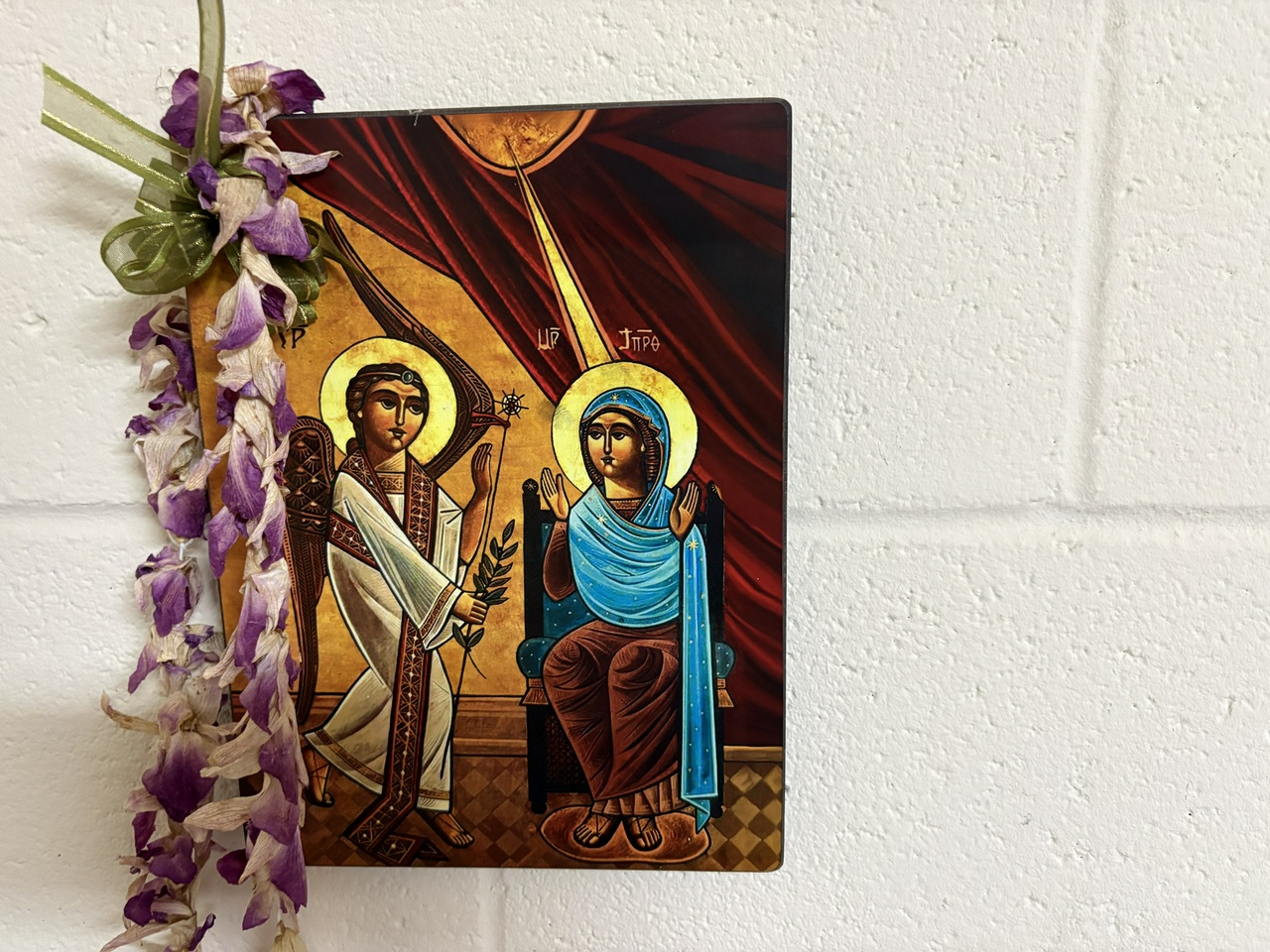
Today is the Feast of the Annunciation, a pretty substantial observance in the Christian world related to the Blessed Virgin Mary.

It is observed on March 25 because it is nine months away from Christmas, which underscores its traditional importance: the Feast of the Annunciation is associated with the Incarnation.

One of my acquaintances from seminary once posted on social media that Christmas is not the “Feast of the Incarnation,” rather the Annunciation is. Because, according to tradition, this is the day that Our Lady, Saint Mary, conceived Jesus—the day that He first took on human flesh, incarnate as God in the womb.

I like this reminder for a variety of reasons (not least my own particular “pro-life” leanings that I seldom talk about; the New Wave Feminists are probably the closest articulation to my convictions on this subject, if you must know). What a powerful notion, that God dwelt in the womb of a woman for nine months and some change. This is even more theologically rich when we consider the traditional Jewish belief that a fetus is not its own life while still in the womb, meaning that Mary herself (for a time) actively participated in the Incarnation of God.

However, I have a bit of a nit to pick with all of this: I’m not convinced that the Annunciation is when the Incarnation happened.

The Church has long observed two key feast days related to Our Lady’s pregnancy: the Annunciation and the Feast of the Visitation. The former recounts the time the Archangel Gabriel announced to Mary that she would be the mother of God; the latter is the story of when Mary visited her cousin, Saint Elizabeth (who herself was already pregnant with Saint John the Baptist), and both recognized Mary as the mother of God and the incarnation of God taking place in her womb.

Both stories are recorded in Saint Luke’s gospel. Now, Luke is a very detailed evangelist (that is, gospel writer). Of all the known gospels, his has the most historical detail. The tradition is that he traveled around and interviewed the surviving disciples of Jesus, while also reviewing other written materials (like, perhaps, Saint Mark’s gospel), in order to give a fuller account of the life of Jesus. As a result, Luke’s gospel is the only one that contains an actual birth narrative for Jesus; it’s also the only one that gives us any real details of Saint Mary. Saint Matthew’s gospel focuses a bit on Saint Joseph (Mary’s husband), but the actual birth of Jesus is merely referenced, not told.

This is all to say that Luke has an eye for detail and tries to give us as much detail as he can. All the major events of the life of Jesus have an actual story in Luke’s gospel. If the Annunciation is meant to be the story of Jesus’ conception, it’s an odd way of telling it because it seems to happen “off camera.”

Take a look:

God sent the angel Gabriel to Nazareth, a city in Galilee, to a virgin who was engaged to a man named Joseph, a descendant of David’s house. The virgin’s name was Mary. When the angel came to her, he said, “Rejoice, favored one! The Lord is with you!” She was confused by these words and wondered what kind of greeting this might be. The angel said, “Don’t be afraid, Mary. God is honoring you. Look! You will conceive and give birth to a son, and you will name him Jesus. He will be great and he will be called the Son of the Most High. The Lord God will give him the throne of David his father. He will rule over Jacob’s house forever, and there will be no end to his kingdom.”

Then Mary said to the angel, “How will this happen since I haven’t had sexual relations with a man?”

The angel replied, “The Holy Spirit will come over you and the power of the Most High will overshadow you. Therefore, the one who is to be born will be holy. He will be called God’s Son. Look, even in her old age, your relative Elizabeth has conceived a son. This woman who was labeled ‘unable to conceive’ is now six months pregnant. Nothing is impossible for God.”

Then Mary said, “I am the Lord’s servant. Let it be with me just as you have said.” Then the angel left her. (Luke 1:26-38, Common English Bible)

Notice that the language is all in the future-tense. It’s the language of expectation. So, right off the bat we can see that, based solely on the text of the Bible itself, the Annunciation does not capture the when of Jesus’ conception.

The next thing to happen in the story is that Mary up and leaves to see Elizabeth, where Elizabeth notes that her baby (the fetal Saint John) “leaps” in her womb at the sound of Mary’s voice. Modern English translations tend to phrase Elizabeth’s greeting to Mary like this: “God has blessed you above all women, and he has blessed the child you carry.” (Luke 1:42, Common English Bible) So, if we follow the tenses of the language we’ve been given, we are led to believe that somewhere between Saint Gabriel’s announcing and Saint Elizabeth’s greeting is when Mary became pregnant. Again, the Annunciation is not the place where the conception of Jesus takes place.

Now, Elizabeth’s greeting is elsewhere enshrined in one of the most beloved prayers in Christianity, the “Hail Mary:”

Hail Mary, full of grace, the Lord is with thee. Blessed art thou among women and blessed is the fruit of thy womb, Jesus. Holy Mary, Mother of God, pray for us sinners now and at the hour of our death. (emphasis mine)

This is actually the literal translation of the Greek words. Why English translations don’t like using figurative language anymore is a topic for another time, but this phrasing does not necessarily imply that Mary is currently pregnant since “fruit of the womb” is not necessarily tied to time the way “the child you carry” is.

So here’s my assertion: it is during the Visitation that Mary conceives Jesus. I base this entirely on the language of the gospel text and what we know of Saint Luke. As already noted, it would seem out of character for Luke to include such foreshadowing language from Gabriel and not give us the pay-off. But I do believe he gives us the pay-off.

Look back to what Gabriel says to Mary when she asks “How will this happen?”

The Holy Spirit will come over you and the power of the Most High will overshadow you.

Luke uses similar language in the first chapter of Acts. In the midst of the risen Jesus giving instructions to His disciples as He is preparing to ascend into Heaven, he tells them:

You will receive power when the Holy Spirit has come upon you. (Acts 1:8 Common English Bible)

In the very next chapter this is fulfilled when tongues of flame alight on the heads of the disciples and they begin to speak in different language, filled with spiritual ecstasy.

So, let’s look again at Mary’s story. She’s been told that she will become a virgin mother, the Mother of God; the sign for this will be when the Holy Spirit comes over her and she is overshadowed by the power of the Most High—language quite evocative of what Luke says about Pentecost in Acts.

Now, consider what happens after Elizabeth’s greeting. We’re told the Holy Spirit has filled Elizabeth, herself uttering an ecstatic proclamation, recalled in that first half of the Hail Mary prayer. So the Spirit is present and what does Mary do? She has an ecstatic Spirit-filled proclamation herself.

We call it the Magnificat.

It is my conviction that the Magnificat is intended by Saint Luke to evoke the moment that Mary conceives Jesus. I also think that it is no coincidence that he has this happen at a moment where there are only two women present, perhaps underscoring the miraculous nature of this. There’s no man to be found, or even suggested (as some like the heretical bishop, the late John Shelby Spong might, with his assertion that Mary was raped, perhaps by a man named Gabriel, and that this is the church’s way of trying to turn tragedy into triumph). Rather, God enters our world in the presence of two women, both enraptured by the Holy Spirit.

So, if this is the case, what are we celebrating today? Why bother with the Annunciation?

Because the Annunciation is still good news. It’s the good news that our sins have not left us abandoned. God still chooses to be born among us, even knowing our wickedness. It is the good news that God has chosen a poor young woman to be the one from which God will take on our flesh. Not a person of wealth and power and influence. But someone of meager means, marginal and innocent.

Today we hear the good news that God refuses to be separate from us.

I think of this old tweet every year on this day. Credit to OP

***

The Rev. Charles Browning II is the rector of Saint Mary’s Episcopal Church in Honolulu, Hawai’i. He is a husband, father, surfer, and frequent over-thinker. Follow him on Mastodon and Pixelfed.

#Jesus #Church #Anglican #Episcopalian #Catholic #Christian #Bible #Mary

Taken by the humble author; depicts the ocean with paddlers and swimmers, the mountain known as Diamond Head is in the distance on the left hand side.

Today I had an off day of surfing.

The wind was stronger than expected. It was kind of crowded for my spot. Waves were wrapping from the West and peaking, breaking almost perpendicular to shore.

When I first arrived I said a little prayer “Lord, if you want me to surf, give me a parking spot.” I drove around and, what do you know, a really nice spot near the showers opens up. As soon as I get out of the car I feel the breeze briskly picking up speed, starting to blow side-shore. I wasn’t feeling it. But the late-morning was beautiful, a classic looking south shore of O’ahu kind of day. So I grabbed my camera and took some photos of the sun glistening off the water, Diamond Head in the back ground, people paddling and swimming in the foreground—a photo that could have existed over a hundred years ago. Took close-up photos of the rocks, testing out a 25 year old digital camera I got for Christmas, to replace an exact model I had short-sightedly given away years back.

I return to my car and stare at the water. An uncle next to me is gearing up to paddle out. Another uncle, his friend, comes over and they start talking story. I decide to call it and make my way around toward the driver’s side.

“Eh! You going out?!” the other uncle says.

“Nah. Too windy.”

“Can I have your stall, den?”

“Sure.”

“I come back. Get one brown SUV. Eh watch my water bottle while I go gettum.”

As he leaves his water bottle on the curb and walks away I look at his friend and I joke: “he’s very trusting. Gotta watch out for these haoles you know!” I say with a smile. “We known for taking things.”

“Eh,” the first uncle says with a dismissive tone. “All kinds of people can do all kinds of things.”

We get to talking. Richard is his name. I’ve seen him in the water before, but he usually paddles out shortly as I’m heading in. Today I’m at the spot at a later time. He urges me to go out.

“Too crowded. Plus I told your friend I’d give up my spot for him.”

He dismisses this and tells me it’s good and I need to go out. Eventually the brown SUV comes rolling around. I give shakas and say goodbye as I drive away. About five cars down I see another car pulling out. As I drive past I can’t shake the feeling that this is all God’s way of telling me that I need to paddle out. So I loop around and pull into the other spot. This one is actually better because it has more shade. I pull down my 11-foot glider (pretty much my exclusive board for the past three years), sunscreen, wetsuit vest zipped up. And I walk over to the cut between rocks where I can paddle out. I see Richard and I tell him that he convinced me to change my mind. He gives a loud approval.

I make the paddle in good time. The crowd thinned a bit in the interim. Waves have power. I see a few familiar faces, folks I did not expect to see in the water because they’re usually out at my normal time. I see a wave on the horizon, taking shape. I whip my board around and paddle. I feel the momentum taking me so I hop to my feet. The wave is beginning to break in front of me, so I go to fade left and surf on my back-hand. But there’s no face there. The wave is a strict right. So I fade back to front-side and try to get into it. I squat and begin scooping at the water, hoping to pick up more speed, but no dice. So I paddle back out, chuckling to myself.

After a while I see a set forming on the horizon. No one seems to be going for it, so I spin around and start paddling. I easily catch the wave and drop in, going right. I squat a bit in the face and then stand to adjust my position, dropping down the face in order to carve my way back up. But I see that it’s walling up too far ahead and is going to close out. So I fade back left to see another closing section coming behind me. So I turn to go straight and ride out the whitewater. But I get caught between two breaking sections, the foam engulfing my board and I feel the force underneath me. I get knocked off my board and plunged under the foam. I feel the chaos of the colliding waves rolling over me and I surrender to the current. Once the wave fully passes I surface. Another wave is breaking, but I have enough time to take stock of my surroundings and know that my board has made its way toward shore, pretty far from my location.

So I start swimming.

At this point I should probably note that I prefer to surf without a leash. Unless it’s particularly big and/or crowded, I’ll forego having a urethane chord dancing about my feet. Leashes can give us a sense of false security. They can and will fail and so we need to be prepared to swim when that eventually happens. Plus, leash-free surfing forces one to be more intentional in their surfing, as well as cognizant of one’s board.

It’s been awhile since I’ve had a long swim for a board. Since I’m wearing a wet-suit vest, I have some buoyancy and I have better results from flipping on my back and kicking my way toward my board. I hold my breath and descend under white water, wait for the roll of the wave to wash over me, return to the surface, and then kick my way again.

There’s always a threat of panic in the back of my mind when I have to swim for a board. I’m pretty far from the beach where I surf and there’s a lot of water. Also infrequent tiger shark sightings. But I keep myself calm. Eventually I see that an off-duty lifeguard who surfs my spot has retrieved my board. I thank him and grab it. I bob on the inside, considering the time and effort it would take to get my leash. Nah. I’ll paddle back out.

As I’m nearing the outside, I see the lifeguard wipe out. His big yellow board is bouncing among the whitewater, making its way to shore. He, too, is not wearing a leash. So I turn my board around and grab some whitewater and make my way to where his board is bobbing on the shallow reef. I grab it and start paddling in his direction. He gets it. I tell him we’re even. We both laugh and paddle back out.

By the time I make it back outside, I’m getting tired. I tell one of the uncles I know that I got my swim in for the day and he laughs. The wind has significantly picked up and is blowing almost onshore. After a time I see another wave making its way toward me. It’s mine. I paddle and begin to make the drop a bit later than I was expecting. So I grab the rails and decide to ride it on my belly. The speed is unreal. I’m constantly on the verge of being rolled over, but I keep my composure and let myself fly toward the beach. I decide that I’m not about to paddle back out. This will be the ride, for what it’s worth.

The wave peters out in the shallows of the reef. The tide is nearly dead low, which means that I’ll have to be careful not to let my fin hit anything.

I’m a good surfer. I’ve been at it for 26 years. I get long nose rides on the well-formed South Shore faces. I drop in and run my hands along the face of the waves. I’ve even garnered compliments for my ability to hit the lip with an 11-foot board, on occasion. I’ve shaped boards, ridden a variety of designs. I know the mythology and the legends. I know surfing inside and out.

And I still have off days.

Blessed be the off days.

That saying came into my mind as I carefully paddled over the shallow reef. A large honu (sea turtle) popped its head up next to me. “Hey, cuz!” I said. It swam directly under my board.

This past Sunday we heard Jesus give the Beatitudes. There’s a tendency to read the Beatitudes as Jesus giving us a list of rewards: “be a peacemaker, get a blessing; put up with grief and persecution; get a blessing.” But Jesus is actually saying that peace-making, grieving, being persecuted, being poor in spirit, etc. are themselves blessings. In the Greek language that Matthew’s gospel was maybe first written in, the Beatitudes are in what’s called the “indicative mood.” Meaning that the blessings are indicated by the other stuff. The blessings aren’t rewards for doing certain things.

This idea translates broadly. An off-day of surfing is a blessing, if I choose to see it. Blessed be the off days, because they help you appreciate the better days. Or, Blessed be the off days, because they make you a better swimmer.

I didn’t get to have a morning of beautiful glides on my huge board. I didn’t get to run to the nose and hang ten on a perfectly groomed wave face. I didn’t even get to drop in while squatted down, feeling the cool water with my fingers as I experience the thrill of dropping into the face of a wave and setting myself up for an elegant bottom turn to set my rail and just… go.

Nope. I got wiped out. I swam a lot. I got skunked on wind-blown waves that were both somehow mushy and strong.

But I got in the water. I learned that I’m finally mature enough to appreciate even the days where my surfing kinda sucks.

Blessed be the off days, indeed.

***

The Rev. Charles Browning II is the rector of Saint Mary’s Episcopal Church in Honolulu, Hawai’i. He is a husband, father, surfer, and frequent over-thinker. Follow him on Mastodon and Pixelfed.

#Surfing #Reflection #Ocean #Theology #Jesus #Church #Hawaii #Oahu

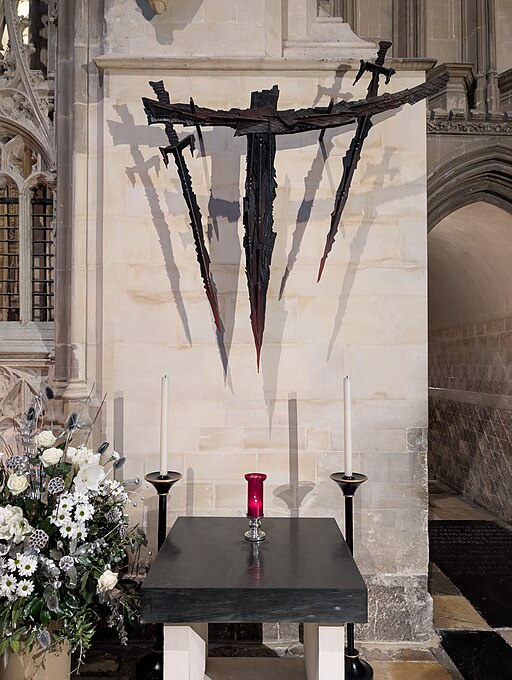
The altar of Saint Thomas in Canterbury Cathedral, marking the spot where he was martyred.

I’m sorry to say that I was not very familiar with Saint Thomas Becket (also known as Saint Thomas of Canterbury) until recently. He’s quite an important English saint with a famous memorial altar in Canterbury Cathedral that marks the spot of his martyrdom (seen in the header image). His shrine is also the place to which the characters in Chaucer’s Canterbury Tales are traveling and sharing their stories. The liturgist Richard Giles feels that Saint Thomas should be the patron saint of England.

Thomas Becket (sometimes “Thomas a Becket”) was the archbishop of Canterbury in the late 1100s. He was the son of a Norman family and managed, with great ambition, to become a highly valued member of Henry II’s inner court. The king saw an opportunity when Archbishop Theobald Bec died. Henry figured he could appoint a kind of ringer in the senior office of the Church in England, and so he managed to get Thomas appointed—despite the fact that Thomas was not ordained to any clerical office at the time. Within days, Thomas was ordained deacon, priest, then bishop in order to take charge of the archbishopric. He came to this office in the midst of a time when the English monarchy was attempting to both exert further control over the church and gain further independence from Rome. But Thomas had a fairly dramatic conversion experience as a result of his impromptu ordinations and wound up eschewing the vainglory of the royal court in favor of faithfulness to the Church. Once Henry’s close friend, he became a thorn in the side of the king and was regularly opposing him on church-related issues, even threatening excommunication at one point.

The story goes that Henry II, in a fit of frustration (and after Becket had been allowed to return from a multi-year exile in France), exclaimed among some of his advisors and knights “will no one rid me of this troublesome priest” (or some variation of this). Four of his knights took this as an order and made plans to assassinate Saint Thomas in the Cathedral. He was stabbed multiple times while Vespers was being chanted, the events expressed in gory detail by one of the monks wounded in the attack.

There are complicated elements in Saint Thomas’ story that carry overtones we still deal with today. Becket wanted “secular” legal systems to have limited authority over the clergy, preferring that the Church handle its own affairs. Such a practice has come to a head in the early 21st century where we’ve seen that when the Church is left to its own devices in terms of addressing clerical crimes, justice becomes elusive. However, at the same time, we also see the dangers inherent in a system where a government exerts control and influence over the Church. Becket was a champion of the established models of medieval Christendom, where monarchs were understood to be under the authority of the Church, with bishops serving as a kind check on kingly power. Henry II did not want to be held in such check and his frustrations with this idea ultimately led to the death of a beloved archbishop.

Thomas’ assassination is of a piece with other notable Christian leaders who attempted to challenge worldly power with the power of the gospel. Oscar Romero is one example, assassinated during Mass by right-wing political figures. Martin Luther King Jr. is, of course, another—assassinated because he became a more vocal opponent of the war in Vietnam and was beginning to shift his advocacy toward the exploitation of the working poor. Both saw their stances as being rooted in the gospel.

Thomas is a worthy saint for our consideration and devotion in our time. There is much pressure put on the Church (in all her forms) to capitulate to worldly powers. The radical right movements like MAGA and their ilk are the most current (and perhaps most egregious), but I’ve seen such pressure come from the left-side of things as well. Having grown up in a church quite given to right-wing political and social evils, I’m loathe to see a similar thing happen with more “progressive” churches like the Episcopal Church, where subscription to partisan talking points becomes seen as synonymous with “the gospel.” Indeed, I am of the conviction that faithfulness to Jesus Christ and His gospel will result in frustration from all forms of political partisanship. Jesus is one who disturbs worldly power, not one who makes it feel comfortable. If the Venn Diagram of one’s partisan politics and their theology is a circle, there’s a problem.

It is said that Thomas was prayerful and pious even as he was being struck by the swords. When the knights entered the cathedral, the monks wanted to bolt themselves in the sacristy for safety but Thomas would not let them. “It is not right to make a house of prayer into a fortress,” he said. After the third blow with a sword, one of the survivors of the attack recalled Becket as saying: “For the name of Jesus and the protection of the church, I am ready to embrace death.”

Saint Thomas of Canterbury was willing to face death rather than capitulate; choosing the assassin’s blade over easy comforts provided by temporal power. When his body was removed from the nave of the cathedral and his episcopal vestments removed, his fellow monks discovered that Thomas wore a hair shirt underneath it all—a garment of great discomfort and used for spiritual discipline and penance. It was a sign of the deep devotion this man had. Do I have the same level of devotion? Do you? How willing are we to hold to the gospel that’s been handed down to us in the face of pressure, coercion, even death? This is a challenging question.

Faithfulness is not always easy. Saint Thomas, like Saint John and Saint Stephen before him, testifies to this fact. The powers of this world are more than ready to execute anyone in service of their claims to power—the testimony of which Saint Thomas shares with the Holy Innocents.

Again, the Christmas season is not all garlands, tinsel, gifts, and lights. It is also blood and travail. This dichotomy is quite strikingly expressed in the hauntingly gorgeous Christmas hymn “A stable lamp is lighted.” I have us sing this hymn every Christmas Eve as a reminder that Christmas leads us to Easter, but we have Good Friday as an unavoidable stop along the way. The first verse of the hymn is a beautiful exposition on the Nativity story:

A stable lamp is lighted whose glow shall wake the sky; the stars shall bend their voices, and every stone shall cry. And every stone shall cry, and straw like gold shall shine; a barn shall harbour heaven, a stall become a shrine.

But the third verse takes us to Calvary:

Yet he shall be forsaken, and yielded up to die; the sky shall groan and darken, and every stone shall cry. And every stone shall cry for gifts of love abused; God's blood upon the spearhead, God's blood again refused.

The saints of the first week of Christmas embody this tragic element. The babe in the manger will ultimately, despite His dedicated following and popularity, be rejected because He usurps the status quo, overturns the way-things-are. Certain people will “come and adore Him” only to a point. So long as He stays in that manger, things are fine. It’s only when He grows and enters a house of prayer to drive out corruption that certain people begin to reconsider their love and commitment of Him.

The final verse of “A stable lamp is lighted” offers us a powerful closing word:

But now, as at the ending, the low is lifted high; the stars shall bend their voices, and every stone shall cry. And every stone shall cry in praises of the child by whose descent among us the worlds are reconciled.

In the end, as Saint John testified, the way-things-are will ultimately fall away to a world made as new. The sorts of powers that kill innocents and saints will be unmade and the world will be set as it was made to be.

***

The Rev. Charles Browning II is the rector of Saint Mary’s Episcopal Church in Honolulu, Hawai’i. He is a husband, father, surfer, and frequent over-thinker. Follow him on Mastodon and Pixelfed.

#Church #England #Episcopal #Anglican #Christian #Theology #History

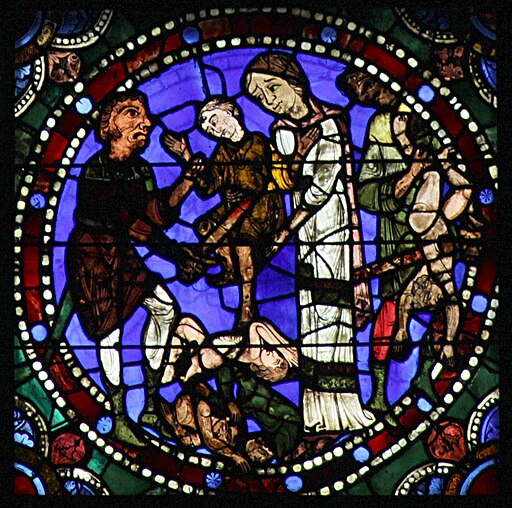
Detail of window at Chartes Cathedral showing the Massacre of the Innocents, taken from Wikimedia Commons

I was first really exposed to the Christian commemorations of the Holy Innocents thanks to a church name. Holy Innocents Episcopal Church outside Atlanta, to be exact. I visited that church and liked the architecture and liturgy and it inspired me to learn more about a story I had known since childhood but seldom dwelt on—much less saw as a focus of devotion.

It’s a story that largely gets left out of our Christmas commemorations in the Episcopal Church, partly because it is such a horrible story (and likely partly due to the more modern doubt of the story’s historical accuracy, which we’ll talk about in a bit). No one wants to follow up Christmas morning with a service about the mass-murdering of children.

At the same time, especially this year, this is a highly relevant story. Tragically, all over the world, politicians are playing like Herod and systematically executing anyone they deem a threat—including children.

Holy Innocents, also known Childermas, commemorates an event that, in all likelihood, never happened. Josephus, an important Jewish historian, took great care to showcase the brutalities of the Herodians and never once mentioned a mass slaughter of children. Outside of the gospel of Matthew there are no other historical accounts of this story and it seems likely to be something meant by the evangelist as a means to make connections between Jesus and Moses, a common theme throughout that particular gospel. So what are we to make of this fact? That we not only have a day marked on our calendar but also name churches and schools for an event that probably never happened?

This is one of the tough parts of reading the Bible. It’s not always “factual” in the ways to which we are accustomed today. Nevertheless, elements that we deem “fictional” can have a huge impact on our faith and wind up speaking Truth despite their (in)accuracy.

Consider the typical Christmas pageant. Aside from Mary, Joseph, a baby, angels, and some shepherds most of the story we dramatize is completely fictional and not related to what is written in the Bible. We tend to think of the birth of Jesus as being an event that culminates after Mary and Joseph, alone on a donkey, have gone to every house or inn in Bethlehem and been told “no vacancy” and so set up shop in a nearby stable. But none of the gospels mention a donkey and we’re only told that there was no room in “the inn”—nothing at all about conversations with inn-keepers or a door-to-door journey. Further, given the nature of the census, there was probably a caravan of people traveling to Bethlehem and others taking residence among the livestock because Bethlehem was not prepared for such an influx of extra people. What we think of when we think of the Christmas story is largely fictional, but that doesn’t mean there’s not truth in those elements. We crafted those details over the centuries in order to “flesh out” the story a bit, to give it the sort of texture that it invites. And those added details speak much of the faith and mindset of the church that crafted them.

The same is true of the Massacre of the Innocents. It might not have happened, but it’s very telling that no one finds the story improbable. There might not be any records to back it up, but the story sounds like the sort of thing Herod would have done—indeed, the sort of thing that rulers all over the world and all over our history books have done.

The sort of government that gleefully cancels aid and assistance to poor countries is acting like Herod. The one that uses starvation, particularly of children, as a weapon of retaliation is acting like Herod. The political entities that travel throughout villages to murder women and children are the ones acting like Herod.

The actual Herod may not have ordered a campaign to murder the children of Bethlehem out of some fear of losing power, but Herod for sure murdered plenty of children and other innocents during his reign out of a sense that because he was in charge he could do so—without any fear of God. And in this, Herod is an archetype. Plenty of gilded so-called rulers kill innocents in the name of preserving their name on the side of buildings. If they were honest, they do so out of a desire to kill the God that they are not.

Yesterday’s saint records Jesus saying “If the world hates you, know that it hated me first.” The poet Dianne di Prima says in her poem, “Rant” that “the only war that matters is the war against the imagination, all other wars are subsumed by it.” I tend to think that it’s more the case that all hatred is subsumed in hatred for Jesus and, therefore, all wars are the Battle of Armageddon, the war against Christ Himself.

If the story behind Holy Innocents is fictional, then it is worth asking what it is we’re commemorating this day. I think the answer is simple: Holy Innocents commemorates all children sacrificed on the altar of expedience or inconvenience by those in power attempting to cast themselves as gods. Those killed by starvation from the abrupt end to programs like USAID or in Gaza by the Israeli government. Those killed by radicals in Somalia and Sudan. Those dying thanks to bombs dropped on Ukraine. And that’s only looking at what’s currently happened in the news in recent weeks. These are who we commemorate on Holy Innocents. The gospel story is subsumed in the stories we see right now, and is itself reflective of those stories. The gospel story helps us Christians see the shape of the story happening around us, helps us in remembering where our allegiance lies.

Herod is the one who oversees the death of innocents. Christ is the one who sees them as holy.

***

The Rev. Charles Browning II is the rector of Saint Mary’s Episcopal Church in Honolulu, Hawai’i. He is a husband, father, surfer, and frequent over-thinker. Follow him on Mastodon and Pixelfed.

#Christmas #HolyInnocents #History #Theology #Church #Christianity #War #Gaza #Ukraine

screenshot of a page from a Common English Study Bible that includes the text of Luke 10:25-34 with some hand-written notes interspersed, the center one saying "moving past distinctions like 'Samaritan'"

When it comes to the parable known as “the Good Samaritan,” we tend to do some weird things. First, we call it “the Good Samaritan” oblivious to the implication that we’re basically calling this “the parable about ‘one of the good ones’” (change “Samaritan” to any other ethnic designation and you’ll see what I mean). Secondly, we conflate the care shown to the unnamed victim with the Samaritan as though Jesus is telling us to extend care even to people we find “unclean.”

The story begins with a lawyer doing a very lawyer-y thing: attempting to clarify terms. This lawyer (in this case, a person dedicated to the study and interpretation of Jewish religious law, perhaps with a focus on its social dimensions rather than its ritual/religious ones) is said to “tempt” or test Jesus by asking Him how he can attain eternal life. Jesus replies with the summary of the Torah that He elsewhere calls “the greatest commandment”: love God with everything and love your neighbor as much as you love yourself.

To which the lawyer asks: “who is my neighbor?”

Jesus then gives a parable about a guy traveling from Jerusalem to Jericho (there’s nothing in the gospel to tell us where Jesus is when He delivers this parable, so I’d like to believe He’s in Jericho and is making a sly reference to the likely-from-Jerusalem lawyer who traveled just to pester Jesus with these questions). The guy gets robbed, beat-up, left for dead. We’re told that a Jewish priest crosses to the other side of the road and ignores the guy. This is followed by a “Levite” (from the historical priestly caste themselves, given prominent roles in the temple) who does the same. Then comes a Samaritan.

Now, I’m not going to assume that you know what a Samaritan is (and I say “is” here because Samaritans are still around). It’s a bit complicated, but they trace their roots to pre-kingdom Israel. They rejected the establishment of worship outside of Mount Gerizim as illegitimate, following developments began by the high priest Eli (the one who adopted Samuel). As a result, they reject many religious and cultural developments during the Kingdom period—including any “scriptures” written beyond the Torah (the “legal” books, the first five books of the Old Testament). This fostered centuries of animosity, made all the more pronounced by the fact that Samaritans never faced the exiles that the two kingdoms of Jews experienced. This led to them being treated as akin to “Gentiles” in many cases. But the two groups share the Torah and many cultural traditions. They also have their own priesthood and interpreters of the Law. Which means that it’s possible Jesus’ fictional Samaritan is a member of the Samaritan clergy, being held alongside his “peers” in the Jewish religion.

What this means is that all three figures who encounter the victim are subscribers to the same legal injunctions. They all would agree that “love God; love neighbor” is the most important commandment. They would also all likely agree that caring for an injured person takes precedent over other ritual/legal issues.

See, the common interpretation of this story is that the priest and Levite are ignoring their obligations to help a person in need because it risks rendering them ritually impure by exposure to blood, etc. And I think that this is where we see the conflation with the victim and the Samaritan because we are conditioned to focus on the “uncleanness” aspects of the story. The Samaritan helps the “unclean” bloodied person because he is already “unclean” himself—he has nothing to lose! But the Samaritan holds to the exact same ritual purity codes as the other priest and Levite. Though those two see him as unclean, he does not. Rather, he’s the one who’s doing a better job of following the Torah’s teachings about mitzvot.

We can only speculate about the reasons for the other two guys’ refusal to help the victim. They could be concerned about ritual purity, but Jesus depicts them as leaving Jerusalem, implying that their ritual duties are over. Martin Luther King, Jr. notes in one of his speeches that this road was a dangerous road and it would not be out of the ordinary for robbers to leave a bloodied victim in order to lure more people into a trap to be robbed. If this is the case, then the priest and Levite are (perhaps justifiably?) concerned for their safety and following a sort of conventional wisdom. Regardless, both views underscore that the Samaritan assumes a degree of risk to help this guy—either ritual purity or personal safety.

He cleans and dresses the guy’s wounds, loads him on his own animal, and takes him to an inn (risking derision by entering a Jewish city to do so). He pays and then offers to pay more until the guy is completely well.

This is when Jesus puts a question back to the lawyer: which of the three was a neighbor?

Notice that Jesus isn’t asking “can you stomach caring for an unclean person?” He’s instead getting the guy to see an example of neighborliness that goes beyond the artificial categories of “priest” and “Levite” and “Samaritan.”

Notice also that Jesus never once uses the word “good.” This isn’t about how to be a good neighbor. This is a story about how to just be a neighbor. There are no degrees when it comes to neighborliness.

Jesus adds the layer of “Samaritan” to the story in order to challenge the guy who claims to know “the rules” but these “rules” have a tendency to bias him toward certain people. And this challenges us because we tend to slap descriptors and adjectives on people in some bullshit quest to define them as deserving of our love and care. Jesus exposes that labels are just labels; actions are what define a person.

The priest and the Levite are guys who are supposed to know the rules better than anyone else. The Samaritan? He plays fast and loose with the rules—to the mind of the priest and Levite and even the lawyer himself, if he took the rules seriously he’d not be a Samaritan. But the priest and Levite, using some unknown excuse, abdicate their responsibility to help a person in need whereas the Samaritan actually takes the rules seriously—he is the one who manages to see himself in the victim and thus fulfill the commandment to “love your neighbor as yourself.”

Who was a neighbor to the victim? “The one who demonstrated mercy toward him,” says the lawyer.

***

I’m writing about this parable because it’s been on my mind since reading about the number of supposedly “Christian” educational institutions expelling kids for various LGBTQ-related things. Either refusing them diplomas days before graduation because they came out or brought a trans-person with them to prom. So many “Christian” individuals and institutions fail to follow Jesus’ simple command about neighborliness. I mean, according to the linked story about the girl expelled for bringing a trans boy to prom, the Georgia Baptist school she attends “claims its core values are “love for God, neighbor, and self” and “respect for people, property, and ideas.” But these are presented as simply a pile of words. Like the lawyer, they seek to define “neighbor” in ways that fit their preconceived notions rather than hear Jesus’ challenge to our arbitrary definitions.

Seriously, swap “Trans-person” in for “Samaritan” and re-read the story. Hell, make it a story about a pastor and a Christian school principle as well. The meaning still stands: who is the neighbor?

The one who demonstrated mercy.

“Go and do likewise,” Jesus says.

#Christian #Theology #Bible #Episcopal #Church #trans #faithfulness #LGBTQ


The Rev. Charles Browning II is the rector of Saint Mary’s Episcopal Church in Honolulu, Hawai’i. He is a husband, father, surfer, and frequent over-thinker. Follow him on Mastodon and Pixelfed.

abstract digital painting in blue-ish white and dark blue; does it depict a view from an airplane wing? A seascape in the morning? You be the judge!

I am deeply blessed to have had the Rev. Dr. Kate Sonderegger as a theology professor in seminary. A woman who is both rigorously academic and richly spiritual is less common than many might think. Her thinking and writing about God is rooted, more than anything else, in her voluminous love for God.

In her long-awaited series Systematic Theology, she articulates something that forever changed my relationship with God. She begins her work from a similar place as the Nicene Creed, though drawing from the supreme commandment of the Hebrew shema: the confession that God is One. But she notes that God’s “One-ness” isn’t simply referring to the number of “gods” in the heavens—it is referring to the fact that God is singularly unique and that this uniqueness indicates something radical. She writes:

Radical oneness, radical uniqueness, demands thought beyond any class, any universal, any likeness. This is an annihilating concreteness. (p. 25)

She goes on to say that God’s radical uniqueness means that He is radically free:

The Lord’s radical Uniqueness frees Him from all comparisons, all genus and likeness. The One God is free from His creatures; more, He in his Unicity is Himself freedom. (p. 27)

And

God is free not so much as being over against another, not so much as being hidden against all that is manifest, not so much as being undetermined by all creaturely rules; but rather God is free simply as being One, this very One. (p. 35)

She also notes the challenge that comes with this uniqueness by writing

This confession of the First Commandment annihilates our thought: we cannot think the absolutely Unique. God is Mystery, Holy Mystery. (p. 25)

So, to try and put this in more everyday terms: God is His own Be-ing. God is His own is-ness (Sonderegger uses the term “Aseity” to refer to this quality). This uniqueness makes God radically free, if for no other reason than God has no peer which means He is never at risk of being obligated to anything or anyone. As I often put it in sermons: God is free to do what God wants because God is God. If God had an equal, then God could have a rival—a second will that might inflict itself upon the will of God, thus rendering God not free. But this radical uniqueness and freedom means that we humans lack the capacity to fully comprehend God, because our minds are limited to think of things in terms of metaphor and comparison. Consider the Avatar films (which I deeply love): James Cameron has spent actual decades developing a uniquely evolved ecosystem, but the creatures and plants—as fanciful as they are—are still pastiches of things we see in our own world. Something truly alien would either be inconceivable (as Kevin Vandermeer suggests in his excellent Southern Reach books), or drive us insane (as H P Lovecraft would articulate).

Even the scriptures themselves acknowledge this reality at times. “No one can see me and live,” says the Lord God to Moses. Prophets are shown hands and feet and hems of robes—bits and pieces of God—because the human mind is not capable of grasping God in God’s Aseity (again, His is-ness).

At the same time, as our scriptures testify and the Christian faith confesses, God chooses to relate to us and His creation and wants for us to related to Him in return. So does this mean that God is setting us up for something futile? Something impossible?

No. It simply suggests that God, being singular and unique, relates to us and the creation in ways that are themselves singular and unique.

God is His own relation to the world, to us.

Think about it this way: we have relationships with all kinds of beings. We relate to our fellow humans in particular ways, ways unique to us as a species. We also relate to various plants and animals in particular ways. And they, in turn, relate to us in their own particular ways.

A sermon illustration that I tend to use too often comes from what Cesar Milan, of The Dog Whisperer fame, says about dog behavior. Cesar frequently notes on his shows that “bad” dog behavior often stems from dog owners treating dogs like people. Dogs don’t know how to be people. They know how to be dogs. Treating them like people fosters anxiety and other mental health issues. And so dog owners need to learn to think like a dog and try to relate to their dog(s) on dog terms—to the extent that they can.

I tend to use this illustration when speaking about sin because, as I see it, sin involves us thinking that we are God, not human, and so we find ourselves afflicted and anxious in a world impacted by us trying to be something that we are not. But this illustration also works to help us think about how God relates to us in that, just as any other being we know has its own means of relating to us, so does God. We just need to learn to see it.

Part of our problems when it comes to belief in God, or even our ideas about God, are rooted in thinking of God as being like us, just writ large. “We are in little what God is in big,” writes the mystic AW Tozer. But that is a one-way street. God is not an “in big” version of us. Perhaps a good way to think of this is in terms of a seed and its tree. A seed and a tree have different relations to the world, even though one grows into the other. A bird, for instance, views a seed and the tree it came from in quite unique terms (eating one and nesting in the other).

The unknown author of the medieval meditation manual known as The Cloud of Unknowing writes

He whom neither men nor angels can grasp by knowledge can be embraced by love.

In other words, God might not be knowable by our minds, but we can touch Him through love. As the ancients and the scriptures teach, God is love. I John 4:16 says “God is love, and those who remain in love remain in God and God remains in them.”

In Hawai’i we have a ubiquitous word: aloha. It often gets mis-understood as only a greeting or farewell. But the word itself means something akin to love and grace and mercy—sometimes all at the same time. Frequently, aloha is seen as equivalent to the concept of love. All things exist in a web of aloha, a relationship of reciprocal offerings. The ‘ō’ō bird’s aloha for the nectar of the ‘ōhia lēhua flower helps spread the seeds. Those seeds are small enough to fit into the tiny holes in freshly cooled lava, where they find protection and a space for capturing rainwater, allowing them to sprout, take root, and begin tilling the lava into dirt. Other birds nest in its branches, dropping guano and other seeds, helping to foster the formation of soil, enabling other plants to sprout and giving rise to the Hawaiian islands themselves. The energy (for lack of a better word) that draws all these things together is aloha, love. And we Christians hold the idea that God is that energy.

God is aloha.

This means that God is always and constantly relating to us, able to be experienced by us. It’s just on terms quite unique to God—but not terms entirely unknown or unknowable to us.

God is His own Being. God is always to be found. Let those who have eyes to see, see.

The Rev. Charles Browning II is the rector of Saint Mary’s Episcopal Church in Honolulu, Hawai’i. He is a husband, father, surfer, and frequent over-thinker. Follow him on Mastodon and Pixelfed. He also “painted” the header image using ProCreate.

#Theology #Bible #film #Godzilla #Jesus #Episcopal #Church

Detail of the famous "Space Window" from the National Cathedral--link later in the text--it depicts the cosmos as dark blue and purple swirls, near the center is a glowing white circle; this is where an actual lunar rock was set in the window

I have a confession: I love earnest and even corny religious things. Saints candles, gaudy lenticular reproductions of DaVinci’s The Last Supper, vanilla-scented Virgin Mary statues for the car, the extremely goofy silicone Jesus I bought at a Christian bookstore recently…

Look, give me a Catholic anime mascot character and I. am. in.

Luce, an anime-inspired Catholic mascot, is in the foreground in yellow; her friends are in different colors around her, each holding various symbols of the Catholic Christian faith Though this might have more to do with me being a weeb...

I love it all. It represents a kind of “true-believer” innocence that reminds me not to take my religion too seriously, too academically, too intellectually. Maybe it’s because I grew up hanging around churches and Christian bookstores, but the moment I see something like a full-color Saint Francis lawn statue or even a WWJD bracelet my heart gets “strangely warmed” like that Wesley brother who started Methodism.

This extends even to liturgy sometimes.

While I will avoid the cringe-inducing cheesiness of much Evangelical worship, or the “bless-their-hearts” attempts found among Roman Catholic “folk masses,” I am not immune to some Rich Mullins or even the Gaithers from time-to-time. And it’s not only music, but even the prayers that might make my Anglo-Catholic fellows wince that I sometimes find power in.

Which leads me to make another confession: I love Eucharistic Prayer C. In the Episcopal Church this is frequently derided as “the Star Wars Prayer” because of such celestial language as:

At your command all things came to be: the vast expanse of interstellar space, galaxies, suns, the planets in their courses, and this fragile earth, our island home.

This Eucharistic prayer is right at home with the petition found in the Prayers of the People, bracketed as optional, which asks the Lord to have mercy on those who travel “through outer space” (alongside “those who travel on land, on water, or in the air”). It is also of a piece with the famous “Space Window” at the National Cathedral that features an actual moon rock among the stained glass.

While I do agree that the call-and-response nature of Prayer C is not great (and why I adapted an alternate version of Prayer C to incorporate the responses into what is known as the “anaphora” itself), it is maybe our most “penitential” Eucharistic prayer in the Episcopal Church, contains the most overt declaration our Eucharistic theology (“Risen Lord, be known to us in the breaking of the bread”), and does much to situate the Christian story in both Jewish and global history.

Many in the Episcopal Church do not like Prayer C and choose to omit the line about people traveling through outer space because they find the language of these things corny and embarrassing. But me? I find it earnest and reflective of where we were as a country and a Church when our most recent Book of Common Prayer was assembled.

See, the current Prayer Book of the Episcopal Church is known as the 1979 Book of Common Prayer. It was a landmark development that changed the nature of the Episcopal Church when it was approved. This Prayer Book is most famous for centralizing the Eucharist as the principle act of worship across the Episcopal Church, as well as articulating a renewed theology of Baptism that expected public and active declarations of faith—as opposed to the private family affairs Baptism had been for centuries prior. The 1979 book was the result of a lengthy process that would be seen as a major victory for the so-called “High Church” and “Anglo-Catholic” elements of the Church while also putting the liturgical language of the Church into “contemporary” English. Despite its radical move toward a much more ancient and traditional sacramental theology, the 1979 book contains distinct notes of the hippy counter-culture that had influenced Western Christianity throughout the mid-to-late 20th Century. It was a Prayer Book that would play well in the grand gothic arches of our major cathedrals, while also being right at home in a wood-paneled parish hall.

The previous revision of the American Book of Common Prayer was in 1928. This means that, in addition to revising the Prayer Book to reflect the changes that had taken place within the Episcopal Church, the 1979 book also needed to be usable for at least 50 years (in case you’re wondering, the process toward a new Prayer Book revision is under way—initially for 2030, but we’re not sure if that is still the year, given the interruptions of the Covid-19 pandemic and gestures around). So that meant that the church bodies responsible for the Book of Common Prayer had to imagine what things might be like over the subsequent half-century in the United States.

By the late 70s, the United States had emerged from a major economic recession and the end of a deeply unpopular war. The opening of the decade had seen humans first set foot on the moon, the culmination of an almost miraculously speedy program that served as the greatest non-war governmental program in human history. After the ending of the Apollo program, NASA had placed a functioning space station in orbit with plans for a permanent and international one in the near-future. Then there was the advent of the Space Shuttle, a reusable space-faring vehicle that hinted at the promise of expanded and more affordable human space flight. This time period was known as “the Space Age.”

I was born around three years after the 1979 Prayer Book was published (though I was raised as a Baptist and so the Prayer Book would not become a part of my life for many years). I also grew up in Orlando, Florida. My childhood church included many members who worked for companies like Lockheed-Martin, building components for the space program. Practically every year in school we would take a field trip to Kennedy Space Center. Every Space Shuttle launch occasioned an interruption of our school schedule so we could all go outside, look to the East, and see that glowing vapor trail moving toward the heavens. I came to recognize the sound of sonic booms from the Shuttle’s re-entry on its way to land. Heck, my mother even dated a NASA engineer who worked on Atlantis’ engines and later built Endeavor (the replacement to the ill-fated Challenger, the destruction of which is among my earliest memories). This is all to say that “outer space” was part of the matrix of life.

I remember all those fanciful ideas, where we’d have commercial space flights that would allow us to travel around the globe quickly (while experiencing zero-G for part of the flight)—like the Pan-American space shuttle seen in 2001: A Space Odyssey. Thoughts of orbital hotels, or even lunar hotels. Trips to Mars or even the moons of Jupiter. It was an exciting time.

And it was this same exciting time that the liturgical scholars of the Episcopal Church were assembling the rites and words for God’s people, keeping an eye to the next fifty years. They too were dreaming and praying, imagining a world drastically changed by people traveling outside our atmosphere and seeing Earth among the stars with their own eyes—not just mediated through Time magazine covers or IMAX films at Kennedy Space Center.

In a sense, I like the language of these prayers for the nostalgia they bring, nostalgia for a world we never saw come to fruition. In those nearly fifty years space travel is still only available to a select few (which includes, of course, billionaires taking 11-minute jaunts into the heavens). There are no orbital hotels or lunar colonies. These prayers recall a different world once imagined—a world that some of us still dream about.

Even then, rockets still go up. People live on the International Space Station. So there are those who are traveling through outer space, even beyond the billionaire vanity trips.

A few years back, I was with family at Walt Disney World on vacation. We were at Animal Kingdom and it was night. I use the SkyGuide app on my phone from time to time, and I got an alert that the International Space Station would be traveling overhead in the next few minutes.

If you’ve never seen the ISS, it appears as the brightest light in the night sky (apart from the Moon, of course). It looks either like a moving star or an airplane with no blinking lights. Chances are that you’ve seen it but didn’t know what it was.

So I looked up and pointed it out to my father-in-law. A few other tourists saw what I was doing and asked. After a minute or so, a crowd of maybe 20 or more people had stopped to look up at the ISS flying overhead, all of them in awe. It was clogging up foot-traffic in the park and I was amazed that even among Disney’s multi-billion dollar attractions, people would turn their attention to a bright dot in the sky and marvel.

The Space Age was a time of hope. It still casts a shadow of hope on us. And these corny and embarrassing prayers capture that fact. People actually do travel in outer space and they do need our prayers—perhaps especially the billionaires.

There’s also the fact that maybe some day, we all will be able to truly appreciate “this fragile Earth, our island home,” floating as that pale blue dot among the “vast expanse of interstellar space,” and not only feel the awe of God Himself, but also how small and precious we are and thus how foolish we are to squander and hurt this wholly unique gift on which we live and move and have our being.

*The Rev. Charles Browning II is the rector of Saint Mary’s Episcopal Church in Honolulu, Hawai’i. He is a husband, father, surfer, and frequent over-thinker. Follow him on Mastodon and Pixelfed.

#Christianity #Episcopal #Church #Catholic #Jesus #Space #SpaceTravel #Science #SciFi #liturgy #worship #Retrofuturism #SpaceAge

Stormy clouds lit orange by, presumably, the setting sun; photo by Michael and Diane Weidner, via Unsplash

Yesterday at the Hands Off demonstrations in downtown Honolulu, I had (at least) two encounters that felt like they might be blessings from God. One was when I was handed a trans pride flag (which I wrote about already). The other was when a guy wearing a Trump hat yelled at me (and my clergy colleagues) something about illegal immigrants and then told me to “go back to the mainland.” I know that last one probably doesn’t sound much like a blessing to you. So, let me try to explain.

I’m trying to shift my understanding of the concept of blessing. In the Matthew Beatitudes, Jesus notes that blessings do not always skew toward what we might consider “positive.” For instance, Jesus refers to mourning and persecution as blessings. He says things like:

Blessed are people who are hopeless…

Blessed are people who grieve…

Blessed are people whose lives are harassed because they are righteous…

Blessed are you when people insult you and harass you and speak all kinds of bad and false things about you, all because of me… (see Matthew 5:1-12*)

So having people wave and be welcoming to see a priest carrying a trans pride flag is a great thing and feels like a “typical” blessing (even though this is the sort of thing that Jesus cautions us about in Luke 6:26). But I have to consider the possibility that being yelled at is also a kind of blessing. I mean, consider the words of Job:

Shall we indeed accept good from God and not accept adversity? (Job 2:10, NASB)

In the Hawaiian Bible, this verse reads:

Eiʻa, e loaʻa anei iā kākou ka maikaʻi mai ke Akua mai, ʻaʻole anei e loaʻa iā kākou ka ʻino kekahi?

I put the two key words in bold. Maika‘i is a word that means “good, handsome, delightful.” It is the root for the Hawaiian term for “blessed,” pōmaikaʻi (the word is a word that refers to “thickness” and works here as an intensifier, indicating a “state of goodness,” thus “blessed”). The other word, ka ‘ino, (ka is the article, so “the”), is a word often used for “evil” and “wickedness,” also used for “spoiled” or “gone bad.” It is also a word used to refer to a storm. In this sense, we get an interesting read from Job: do we accept only the good, maika‘i weather as being from God? Do we not also have to accept that He sends ka ‘ino, stormy weather as well? Or as Jesus Himself puts it, right after He gives us the Beatitudes:

[God] makes the sun rise on both the evil and the good and sends rain on both the righteous and the unrighteous. (Matthew 5:45 CEB)

Both clear weather and stormy weather can be both “good” and “bad”—even at the same time. So it is my (and our) duty to accept both as blessings, to find the blessedness in even what we might call “bad.”

So what’s the blessing in having an angry Trump supporter yell at me to “go back to the mainland?” Well, before I get to that, allow me to unpack the baggage of that statement for haoles (a Hawaiian term for “foreigner” that has turned into a phrase and sometimes epithet for exclusively Caucasian people). Hawai‘i is one of the few places in the United States where Caucasians are not a majority and don’t hold outsized cultural power, and, thus, one of the few places where they can experience the sort of discrimination usually experienced by people of color in other parts of the country. So being haole is already a touchy thing. It carries with it an assumption that one does not belong here. Darker skinned Hawaiians will sometimes call light-skinned Hawaiians “haole” as an insult. As a Caucasian myself, there is the automatic assumption that I am on vacation, or am clearly from somewhere else—frequently expressed as being given a fork and spoon at a restaurant and not chopsticks**. One of my friends once referred to a guy as “he wasn’t a haole, he was a local-looking guy”—as though there aren’t “local” haoles. So, being told to “go back to the mainland” is about the closest I can get to the experience of being told something like “go back to Africa.” It’s telling me that I do not belong here. That I belong on the “mainland” of the United States (what we here prefer to call “the continent” since, from the Hawaiian perspective, the Hawaiian islands are the mainland).

This is something of which I’m very sensitive. While I am from the continental US, I’m here in Hawai‘i by invitation—I was invited by the Saint Mary’s to be their priest. I never held dreams of living in Hawai‘i, never once vacationed here. My first time ever on Hawaiian soil was for a job interview. Further, the Episcopal Church here in Hawai‘i has its roots in the Hawaiian Reformed Catholic Church, which resulted from King Kamehameha IV and Queen Emma inviting Church of England clergy to come and establish a church here in Hawai‘i because they felt that it offered a vision of Christianity better reflective of the Hawaiian people. So, I am not following a colonizing trajectory. But I also understand that I look an awful lot like the sort of people who have colonized this place. So, while it hurts to be lumped in with the people who continue to pillage this place for profit, I do understand the reasons why it happens. Doesn’t make it any easier, though.

Now, this guy said his piece after reading the sign I was holding. Which, I must confess, was not my choice. A friend asked me to hold his sign while he was taking care of something else. It said “Hands Off!” followed by a list of things that included public lands, Social Security, and immigrants. We were standing adjacent to a pedestrian crosswalk and the light was red. This guy was staring us down, and I saw the red Trump hat on his head. So I gave him a shaka. His eyes scanned my sign and that’s when he yelled something about illegal immigrants. I couldn’t really understand him, except when he yelled about “going back.” Which leads me, finally, to talk about how this is a blessing.

The guy saw on my sign and in my Caucasian appearance something that, to him, screamed “mainland” and not, to him, “Hawai‘i.” I am going to assume that this guy might have been “local.” One of the interesting quirks about Hawaiian politics is that, one, we are a very “blue” state, but tend to skew “conservative” on some issues. And, second, the Native Hawaiian (Kanaka Maoli) population leaned heavily toward Trump in the last two elections. Why? Because the Democrats in Hawai‘i have had political dominance since the end of World War II, but Native Hawaiians have continually been marginalized in their own homeland. Their sacred lands are being used for various military, scientific, and recreational purposes. They continue to be priced out of the housing market (to the point where Las Vegas has become a sort of second home for Hawaiians). And their cultural concerns are treated as obstacles to be overcome rather than legitimate issues to be listened to and honored. Further, there are ten times more tourists on the islands per year than residents, but residents are taxed in order to support the tourist industry and not the other way around—on top of the plague of “income properties” that are built here for tourism purposes while beach parks are rife with Native Hawaiians living in tents and barely making ends meet. Because of this, the logic among many is to either “give the other guys a try” or to vote for someone that they think will break the system so that something better might be built from its ruins. As a Kanaka Maoli friend of mine put it at the protest: “That’s the logic. It’s not great logic, but that’s what they’re thinking in supporting Trump.”

So I have to wonder: did this guy see the sign I was holding and see it as reflective of trying to maintain a status quo that has continued to marginalize local people? Are these positions signaling to him a desire to further a kind of political system that will continue to offer soaring rhetoric about being on the “right side of history” while quietly lining the pockets of (different) billionaires who see Hawai‘i as a golden goose to squeeze of all it can offer to people who only want to take take take?

That is the question we all have to ask. And this is why his anger was a blessing to me: it’s causing me to ask what I’m aiming to do as part of such demonstrations. We’re all mad right now. What we’re doing at the moment is collectively yelling A‘ole!, no!

A‘ole to gutting the government programs that the poor rely on.

A‘ole to ignoring our environment and the unabashed pillaging of Earth’s resources.

A‘ole to sending human beings to what are effectively gulags and concentration camps.

A‘ole to disappearing students for no reason other than their political views regarding the genocide happening to the Palestinian people does not line up with the preferred narrative.

A‘ole to the path toward fascism this administration is on.

But that a‘ole cannot simply be about putting things back the way they were. We must demand something more. As a Christian, I want to see something that more closely resembles the Kingdom of God—where no one is lost, all have enough, and we reject the mechanism of death—used to provide a sense of “peace” to our people at the expense of others. To do that, we have to put a stop to what we see happening now—while also advocating for something better to be built in its place.

Hands off, yes. But also, hands on to the tools and materials for making a better world to come.

Blessed are people when they are handed pride flags, they are giving hope to often hopeless people.

Blessed are people when Trump-supporters yell at them to go back to the mainland, it gives them pause to consider how a better future is possible through Christ Jesus.

The Rev. Charles Browning II is the rector of Saint Mary’s Episcopal Church in Honolulu, Hawai’i. He is a husband, father, surfer, and frequent over-thinker. Follow him on Mastodon and Pixelfed.

_*Note: This is from the Common English Bible translation, which follows an odd modern English translation custom to change “blessed” into something like “happy.” It reads weird and doesn’t exactly correlate with what Jesus is recorded as saying, so I correct the translation to “blessed” for that reason._

**Note 2: My wife and I refer to this as “getting haole-d.” I can’t express to you, reader, how awesome it feels to have someone just give us chopsticks without asking first.

#Theology #Bible #Jesus #Episcopal #Church #Politics #HandsOff #Hawaii

A trans pride flag with the words “Trans Rights = Human Rights” written on it; in the background is my office with all my books and doodads and Godzilla toys maybe out of focus

I just sat at my desk after an eventful day. In the Episcopal Church in Hawai'i, our custom is to observe the annual Chrism Mass and Renewal of Ordination Vows on a Saturday about two weeks prior to the start of Holy Week (this is typically a Holy Tuesday observance throughout much of the Church, but given that we are spread among an island archipelago, moving to the aforementioned Saturday works to better accommodate “neighbor island” clergy). This also just happened to coincide with the April 5 “Hands Off” protests/demonstrations. The service is held at the Cathedral of Saint Andrew, which is practically across the street from the state capitol building—where the demonstrations were taking place.

A number of us clergy (and laity) decided that being present at the demonstrations only made sense, given the spirit of renewing our commitment to minister to God’s people and to participate in the proclamation of the good news of liberation, especially among people feeling the squeeze from those who claim the name of Christian as they support genocide, cuts to aid starving children both home and abroad, etc. etc. And so we walked over to the capitol building to “come and see” what was going on.

a crowd of demonstrators on two sides of a road, cars passing between; people are holding signs; there are trees and buildings visible beneath a blue, but cloudy sky

A view from the event

Now, I’m a rare (read: weird) Episcopal priest in that I pretty much always wear a black cassock (the fancy name for long black dress that you sometimes see priests wearing: I look like Neo or Snape or Kylo Ren, depending on your generation). So I stood out. People wanted a few selfies. Some thought it was a costume and were genuinely surprised that an honest-to-God priest was out there among them. I gave people blessings (including the Trump hat wearing dude in a car that tried to cuss me out and told me to “go back to the mainland”). Mostly I was there to be a presence, to minister and pray. I learned from my participation in the George Floyd demonstrations back in 2020 that folks are warmed to seeing representation from the Church—which speaks to the idea that (some) folks want the Church, but often feel like it is concerned with things quite disconnected from their lives.

We call this the ministry of presence, and is something we clergy also offer in times of hurt and anguish (like an illness or loss of a loved one). This refers to those times where we’re not going to offer answers, just responses, and trust that the Lord God is working through us simply being there.

While walking among the crowd, a little subset of three people saw me and said “here, now you have a sign” and handed me the trans pride flag that appears at the head of this post. I said “mahalo” and carried it with me as I walked. Something about a cassock-clad priest holding a trans pride flag garnered a few responses and I caught a number of people taking sneaky pictures of me.

Here’s the thing: that flag ministered to me.

I grew up deeply Southern Baptist, leaning toward Independent Baptist (these are the fundamentalists who think that Southern Baptists aren’t “conservative” enough). I was incubated in a very Queer-phobic environment. Our attention was mostly on gay men, but all the other letters of the alphabet were just there, slightly off camera. My views on same-sex attraction and Queer love changed while in my twenties. I was attending an Evangelical university in West Palm Beach at the time, while also working retail to help pay my bills. I had gay co-workers and I came to realize that homophobia is an exercise in abstraction. Once I met actual, open, flesh-and-blood gay people it caused me to reconsider many things. And I was doing this while part of a Biblical Studies program at my university. I began the process of trying to reconcile my religious convictions with what I was seeing “on the ground” as it were. And this all was happening alongside my conversion to the Episcopal Church.

But that’s probably a story for another time.

Suffice it to say, my journey from hating Queer people to seeing compatibility between traditional Christianity and Queer “identities” was a hard-fought battle. But along the way I continued to wrestle with reconciling Trans identities and some aspects of Christian belief, as I understand them. And, to be completely honest, I’m still doing this work (but given the current state of things, I won’t be sharing this at this point—I worry that my thinking will be misconstrued and potentially used for hateful purposes by those with ill-intent; there’s nuance there that I don’t think we’re in a place to appreciate at the moment). But one thing is absolutely certain: Trans people are human beings, created in the image of God. They are gifts, blessings to the world, and to deny them this is to deny a work of God.

I needed this reminder. It is easy to get caught up in the abstractness of ideas and beliefs, and removing them from the flesh-and-blood people that are affected or reflected by these ideas and beliefs. But people aren’t just ideas and beliefs. People live. People sweat in the heat and come home tired from work. People go to protests, or roll their eyes at protests as they drive by. People fall in love and break-up. People want to be free to pursue happiness.

When I was in seminary, a little axiom came to me one Sunday: the minister is always on the other side of the altar rail. From the perspective of the laity, the minister is the one at the altar, or giving communion. But from the perspective of the clergy, the ministers are those who sit in the pews and who come up to receive communion. This is the balance of the ministerial life. God speaks to me through the wider community as I am ordained to try and allow God to speak to you all through me.

In the midst of ministering, I was ministered to. It came in the form of a small polyester flag with marker writing on it. And so now, through these words, I hope to minister to you all in return. Trans lives are human lives. Trans people aren’t just an abstraction, aren’t just an idea. Whatever we might think about them, they are flesh-and-blood people wanting what everyone wants: a life where they are free to pursue happiness and discover who they are in the grand web of the earth and universe, who they are in light of the God who lovingly made them.

The Rev. Charles Browning II is the rector of Saint Mary’s Episcopal Church in Honolulu, Hawai’i. He is a husband, father, surfer, and frequent over-thinker. Follow him on Mastodon and Pixelfed.

#Theology #Bible #Jesus #Episcopal #Church #TransRights #Politics #HandsOff