Why Godzilla, Why Now?
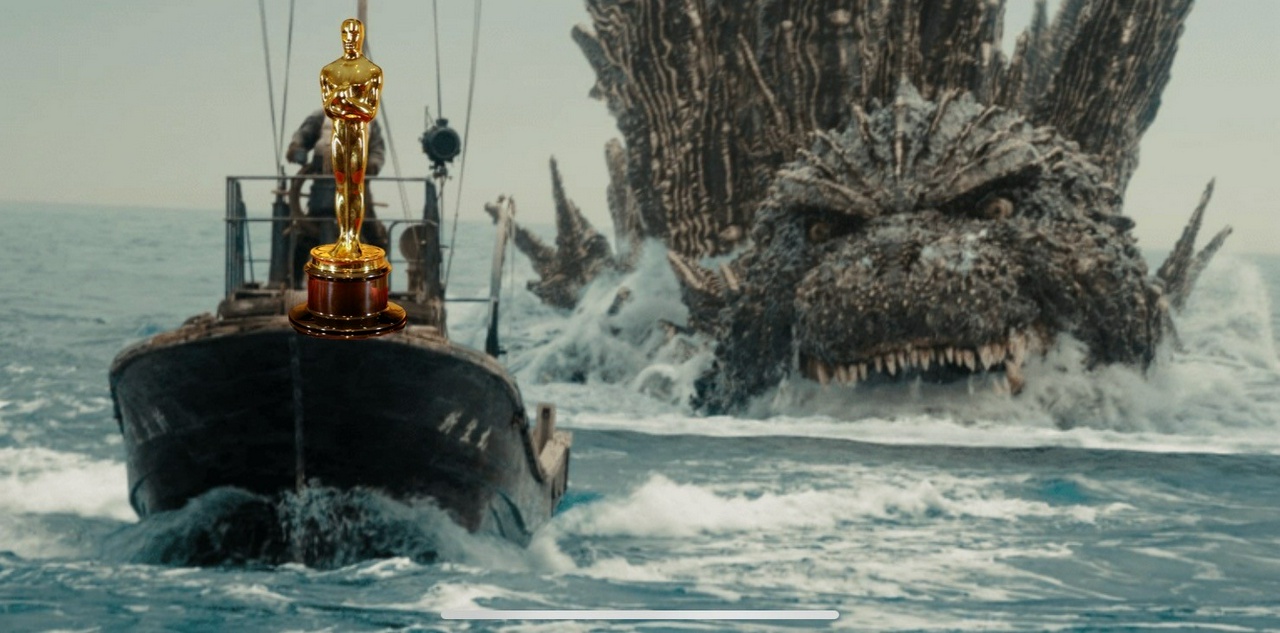
Somewhere, long ago, I read someone note the distinction between American and Japanese giant monster movies: American giant monsters climb on buildings whereas Japanese ones walk through them.
I was just exposed, via Mastodon, to this article about the current wave of popularity kaiju are receiving (kaiju is the Japanese term for “monsters,” often used to denote daikaiju, or “giant monsters,” those specifically cut from a similar cloth to Godzilla). Which got me thinking about the genre itself and why I think it’s managed to become mainstream in the US. And which brought the above quote to mind.
A little background: I’ve been a Godzilla fan since I was maybe four. I had an obsession with dinosaurs and my mom grabbed a bunch of discount VHS from a bin at K-Mart that included 1962’s King Kong vs. Godzilla and 1975’s The Terror of Mechagodzilla. My first memory of a film moving me to tears is from the former, where I openly wept to my mother that Godzilla lost to Kong (and established a life-long disdain for the giant monkey). The latter film remains one of my favorites. Tomoko Ai’s Katsura Mifune still makes me swoon and Titanosaurus remains my favorite non-Godzilla monster—I have an almost Mel-Gibson-in-Conspiracy-Theory compulsion to purchase Titanosaurus toys whenever I see one, likely owing to my disappointment over not being able to find one at Toys-R-Us as a child.
Which sort of leads me to my next point: Godzilla faltered in popularity in the US until 2014. I rediscovered Godzilla by accident while at an enormous toy show in Orlando in 1995 when I found myself face to face with a GIANT poster for Godzilla vs. Space Godzilla and, slack-jawed, I asked the dude selling the merch “they still make Godzilla movies?”
I came across G-Fan magazine shortly thereafter, sitting on a shelf at Sci-Fi World, a collectibles shop on International Drive in Orlando (it happened to be the first glossy cover issue). From those two moments I became a die-hard Godzilla fan. My middle-school friend Paul was the only other person I knew who liked Godzilla. My best-friend, Josh, did not share in my interest (one of the only interests we did not share). Godzilla was truly “mine”—but this also made me feel kind of weird. No one else knew about it and so I kind of had to keep it low-key.
Being a Godzilla fan in those days involved a degree of piracy. Toho, the company who produced Godzilla films, refused to distribute to the US. So, in order to see any of the films after Godzilla 1985 I had to track down bootleg VHS. My first viewing of Godzilla vs. Destroyer (see NOTE at end) was on a VHS made by a straight up Sony Handicam held in the theater. It wasn’t until the 2000s that I ever saw Godzilla vs. Space Godzilla or Godzilla vs. Destroyer with English subtitles (G-Fan always ran plot synopses of new releases for just the reason). Godzilla toys had to be imported—Central Florida was not a hot-spot of Godzilla collectibles at the time and so I made an annual pilgrimage to Sideshow Collectibles outside of Atlanta, Georgia when we’d visit family (I still have their Godzilla collectibles guide, which I had Sean Linkenbeck, the author and shop owner, sign). It was a small miracle that the Trendmasters toy company released a line of US-made Godzilla toys at the time (but they never got around to making a Titanosaurus, natch).
This is all to say that being a Godzilla fan in those days was super niche and super nerdy. Then 1998 happened.
This was the year that Godzilla was getting an official, big-budget Hollywood adaptation. It was, pretty famously, terrible. But the film’s terribleness inspired Toho to make “real” Godzilla films again, starting a new series (the Millennium series), including a US theatrical release of Godzilla 2000. It did not do well. But thanks to the agreement with Sony over the 1998 film, the 1990s and 2000s Godzilla films did get DVD releases, finally.
But Godzilla remained a kind of joke. “Dude in a rubber suit.” Kids stuff. No one in the US was making actual giant monster films, even though the technology existed to do so and even though “nerd” properties were making bank at the box-office. It wouldn’t be until 2014 that we’d get a “proper” US-made Godzilla film, one that treated the monster with respect and awe.
What changed?
Here’s my theory: the US could not appreciate Godzilla—or kaiju in general—until we’d experienced the destruction of one of our iconic cities.
See, Godzilla was born out of the rubble and fires of postwar Japan. Godzilla is punishment for war. In some ways he embodies the guilt that some in Japan feel over their involvement in WWII, in others he is an incarnation of the US’ use of nuclear weapons, in others he is a kind of kami (a sort of god) awakened to punish humanity. Godzilla has a few different origin stories, but the most common is that he is some kind of dormant prehistoric creature awakened by the use of nuclear weapons. He’s only here because of the kinds of weapons we’ve built, an embodiment of our capacity to destroy.
Japan is a place that knows destruction well. The place is geologically active and also prone to typhoons. Traditional Japanese construction techniques are rooted in things falling apart and being rebuilt. My personal theory is that Japanese religion embraced zen the way it did because it spoke powerfully to the Japanese experience: all things are temporary.
The United States, on the other hand, is rooted in triumphalist attitudes. We’ve long employed the language of Rome (“the eternal city”) in our rhetoric, filtering it through (Protestant) Christian imagery. During the economic booms of the 1980s, Ronald Reagan referred to the United States in eschatological terms, calling us the “shining city on a hill”—heaven adjacent language that would have caused Saint Augustine’s eye to twitch. As a result, we tend to fetishize our cities and treat them as eternal.
King Kong climbs the Chrysler building. Godzilla destroys Tokyo Tower.
In the 1998 American film, Godzilla climbs the Empire State building. The only previous example of Godzilla being in the US was in 1966’s Destroy All Monsters (a Japanese-made film), where he destroys the UN building.
So, America depicts its buildings as eternal, resilient. Japan understands better.
We wouldn’t learn this lesson until the morning of September 11, 2001. I watched the North and South towers of the World Trade Center collapse on live television and, I have to confess, I immediately made Godzilla comparisons in my mind.
It took us a few years, but the United States got its first proper kaiju in 2008, with the film Cloverfield. In the same way that 1954’s Gojira (which would be re-branded a year later in the US as Godzilla: King of the Monsters) employed the imagery of Hiroshima, Nagasaki, and the burning of Tokyo in order to help process the horrors of what had happened, Cloverfield would do the same with the terrorist attacks. Clover is as close to a true “American” equivalent to Godzilla that we’re likely to get.
It’s telling that only six years later we’d finally get a US Godzilla film that sees Godzilla destroy a US city (even if he’s kinda sorta the hero—I personally love the ambivalence that Gareth Edwards gives Godzilla in that film). And this after Pacific Rim primed the pump.
It’s only now that US audiences can appreciate Godzilla because Godzilla exposes something that we intrinsically know, but tend to not articulate: our cities are not buildings, but people. The resilience of places like New York come about as a result of New Yorkers themselves, not the quality of the buildings that make up the skyline.
While Godzilla is connected to nuclear war, at heart Godzilla is a force of nature. 2016’s Shin Godzilla employed the imagery of the Fukushima earthquake and tsunami (while also satirizing the government’s response to these things), which helps us recall this fact. 2014’s Godzilla captured the sense of hopelessness a triumphalist West feels when confronted with the fact that there are forces beyond our ability to control. Both it and its sequel, 2018’s Godzilla: King of the Monsters, use the imagery and backdrop of climate change (resulting from governmental and corporate meddling) to express how many of us feel in the face of such drastic change. The resulting “Monsterverse” films and shows are about humanity adapting to a new normal, a radically changed world where we are more subjects to nature than its dominants.
I was reminded of this kind of resilience just the other day. We here in Hawai’i experienced a strong storm system, what we know as a Kona Low. It knocked out power across much of O’ahu. As a result, in the midst of wind and rain, I had to acquire food for my family and so I drove on dark streets. I was not the only one. And I was struck by the general sense of togetherness we all felt. Folks were courteous at traffic stops. At the grocery store (which was running on generators), people were orderly and helpful. We were resilient.
We in the West now know that our buildings will tumble, that nature will reclaim her home. We are not masters of creation—we are stewards, at best; mostly we are subjects. There are monstrous forces at work and at battle all around us. But we are at our best when we confront these realities together, survive them together.
We can appreciate Godzilla now because we understand Godzilla now.
***
POST SCRIPT
2016’s Shin Godzilla ends on a much-discussed shot: the camera pans closer and closer to Godzilla, rendered inert through a complicated chemical process. The final shot is of the tip of Godzilla’s tail, where humanoid/Godzilla skeletons are frozen in the midst of emergence. For folks who know the work of Hideaki Anno (of Evangelion fame, who wrote and co-directed the film), this is the kind of thought-provoking teaser that will bug fans for years to come.
Somewhere along the way I read a theory about this that I love. Throughout the film, Godzilla is seen as adapting to whatever humans throw at it. What defeats Godzilla in the end is the co-operative work of a group of people. The theory is that Godzilla recognizes this and was about to evolve into a group himself.
And therein lies the theme: our resilience, our resistance, comes about from us working together. Despite the grand things we’ve built, in the end we will only survive by working together.
***
The Rev. Charles Browning II is the rector of Saint Mary’s Episcopal Church in Honolulu, Hawai’i. He is a husband, father, surfer, and frequent over-thinker. Follow him on Mastodon and Pixelfed.
(NOTE: yes, I know that, due to trademarking issues, the technical name of the movie is Godzilla vs. Destoroyah but I’ve long considered that silly)

