The Catechetic Converter

Film

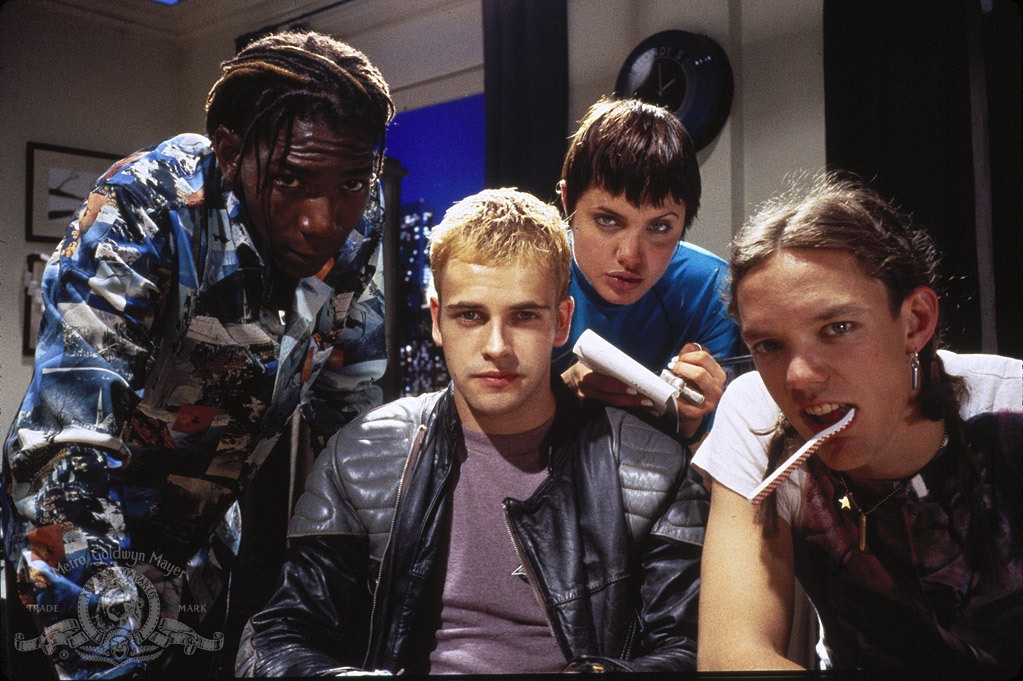
Today, the traffic sucked. I was finishing coffee at home when my wife warned me. So I wound up deciding to work from home. While doing something on the computer, saw that Hackers was playing on YouTube. So, of course I watched it.

Unironically, Hackers is one of my favorite movies. I only ever caught it on rental from Blockbuster back in the day and have watched it many times since. It was among the first movies that would expose me to a kind of culture that could be considered Queer and “woke.” Even though I was hard-wired as a fundamentalist at the time of my viewing, Hackers sorta dented the shell and began to nudge me into a direction of tolerance. Further, it played a big role in making me into a reader. Matthew Lillard’s character, Cereal Killer, alludes to 1984 and there’s a classic scene where he’s showcasing a bunch of the books used for networking standards and Dade (Johnny Lee Miller’s character) is listing off the vernacular titles to the impressive nods of the other characters (Phreak and Joey). Then there’s the scene in the Advanced English class where Dade shares a (mis)quote of Ginsberg’s “Howl.” I wanted to be like that. I wanted to be seen as cool, but also smart and well-read. But I digress.

What struck me about this viewing of Hackers was how prescient it could be. Yes, it is a film about computer hacking that is made for movie audiences in 1995—which is to say, a time where “average” people thought computers were still mystery machines full of bewildering power on a par with magic. The depiction of super-computers and that hilarious and user-hostile interface on the “Gibson” are corny and comical. But the heart of that movie is in the right place, much like how Point Break gets the spirit of surfing better than most Hollywood films about the sport do. And, as such, the film depicts an intellectual divide among computer nerds that is today coming to fruition.

In one corner we have The Plague, played by Fischer Stevens. There is a suggestion that he’s a bit of a sell-out, a hacker who got a job running information security at a major mineral corporation. Perhaps. But he’s more straightforwardly characterized as a guy who sees himself as a lone-gun, as possessing superior knowledge and intelligence and that these factors grant him the license to do whatever he wants. He tells Dade, our protagonist, that hackers are effectively a different breed of human, that they are “samurai” or “keyboard cowboys” and that the rest of the world are “cattle.” Both the image of the samurai and the cowboy are popularly depicted as loners, traveling the land free from any moorings, obligated only to themselves and their code (which takes on extra meanings from a computer-centered point of view). The Plague seeks to enrich himself at the expense of others, because why not? He sees himself as smarter and anyone not smart enough to do the same as him is a sucker. He is the American idealized individual, remade for the digital age.

In the other corner we have Dade Murphy. Known by two handles throughout the film: Crash Override and Zero Cool, Dade and his friends represent a different sort of computer hacker. Theirs is part of a subculture. At one point in the film, a federal agent reads aloud from “The Conscience of a Hacker” by Lloyd Blankenship, also known as the “Hacker Manifesto:”

This is our world now. The world of the electron and the switch; the beauty of the baud. We exist without nationality, skin color, or religious bias. You wage wars, murder, cheat, lie to us and try to make us believe it's for our own good, yet we're the criminals. Yes, I am a criminal. My crime is that of curiosity. I am a hacker, and this is my manifesto.

This is the exact quote from the film (sourced from IMDB), and is a selection from the actual document itself, likely edited to better summarize the ethos of our protagonists. Dade and his friends see themselves as, primarily, curious explorers (to use a phrase from near the beginning of “The Conscience of a Hacker”) who no longer define themselves by the markers that have conventionally been placed on them. We see this in action in the film whenever Dade is brought into the wider hacker subculture, particularly with the characters of Razor and Blade, two decidedly Queer-coded characters of East Asian ethnicity, who are also seen inhabiting a club full of diverse and varied people. These hackers are presented as the kind of “individual” that was commonplace among subcultures of the mid-90s, but their individuality is not a form of individualism. Rather, they represent a collectivist mentality and tend to see their intelligence and skills as tools for building a better society, using the infrastructure of the old in order to do so. Indeed, seldom is Dade ever pictured alone in the film. He is almost always sharing the screen with his friends, underscoring the collectivist characterization.

The theme of the film is pretty explicitly stated in the beginning when Dade hacks into a TV station in order to take down a Rush Limbaugh type character’s show and replace it with The Outer Limits. This era of the 1990s was an inspired time, where many of us believed that the internet opened up a new avenue for tolerance. It was also a tool for disruption, of bypassing the strictures of unfettered capitalism. Quoting also from “The Conscience of a Hacker,” Razor and Blade (hosts of a kind of “pirate TV” show, who are teaching their audience a form of “blue boxing” using a micro-cassette recorder—a technique that was already out of date by the time the movie premiered) say “this is a service that would be dirt cheap if it wasn't run by profiteering gluttons.” Adding, “remember, hacking is more than just a crime. It’s a survival trait.”

Hackers predicted the kind of world in which we are currently living. One where some hackers became “Tech Bros,” oligarchs seeking to hoard wealth no matter the human and environmental cost (recall that The Plague is fine with causing a worldwide environmental disaster, while also pinning the crime on a bunch of high school students, so long as he gets his money and stays out of jail). The individualist who believes that they are inherently superior and that that superiority obligates them to a life of wealth and leisure.

But the other kind of hacker still remains. Those who still believe that these tools are useful for liberating people, that a better world is still possible. In this sense, Cereal Killer gets to deliver what I think is the most iconic line in the movie:

Listen, we got a higher purpose here, alright? A wakeup call for the Nintendo Generation. We demand free access to data, well, it comes with some responsibility. When I was a child, I spake as a child, I understood as a child, I thought as a child, but when I became a man I put away childish things. (Though it still bugs me that he says “Corinthians one” instead of “First Corinthians” right after this…)

Having access to these tools and this data comes with responsibility. They are not a license for doing whatever we want. They obligate us to look out for each other and help each other. In the film, this line delivery is the catalyst to get Dade and Burn (Angelina Jolie’s character) to end their playful rivalry, which in turn inspires an entire global community of hackers to work together to prevent the wealth hoarding Plague’s criminal actions from causing a global catastrophe.

This collectivist action is done under the call “Hack the Planet,” which is also the tagline for the movie.

This call goes deeper than the usage of network infrastructure to circumvent capitalistic exploitation. Hacking the planet involves a shift in thinking that moves beyond conventional lines of demarcation and into something focused on a common good. It refuses to see the world as a collection of individualists, but as a kind of organic whole. The “profiteering gluttons” want to keep the world divided and stupid in order to achieve their desired ends. But there are those who resist such things and refuse to accept this status quo.

One of the ironies of the internet is that it is a thing built on the protocols for military communication but is also the realm of knee-sock-wearing Queer folk. A tool for war has become a tool for peaceful liberation, a means for people to investigate (indeed even “hack”) their own self-understanding. The result does not have to be some kind of atomized individualism, but a kind of individuality that sees itself as a smaller part of a whole.

The Plague-like Tech Bros have done much to force their vision for the world on us. But another vision still exists. It might not broadcast on pirated TV signals, or rollerblade in the glitching lights of abandoned subway tunnels. It might not play Wipeout in a nightclub with people selling computer parts out front. But it still looks for workarounds. It still likes to play jokes on the Feds. It still sees a common humanity running through the labels and stigmas and geopolitical boundaries.

We can still use these tools to better the world. Because it is our world now. We might be seen as criminals. But so were most people who tried to make things better for us.

Hack the planet.

***

The Rev. Charles Browning II is the rector of Saint Mary’s Episcopal Church in Honolulu, Hawai’i. He is a husband, father, surfer, and frequent over-thinker. Follow him on Mastodon and Pixelfed.

#Hackers #Computers #Philosophy #Theology #Movies #Film

abstract digital painting in blue-ish white and dark blue; does it depict a view from an airplane wing? A seascape in the morning? You be the judge!

I am deeply blessed to have had the Rev. Dr. Kate Sonderegger as a theology professor in seminary. A woman who is both rigorously academic and richly spiritual is less common than many might think. Her thinking and writing about God is rooted, more than anything else, in her voluminous love for God.

In her long-awaited series Systematic Theology, she articulates something that forever changed my relationship with God. She begins her work from a similar place as the Nicene Creed, though drawing from the supreme commandment of the Hebrew shema: the confession that God is One. But she notes that God’s “One-ness” isn’t simply referring to the number of “gods” in the heavens—it is referring to the fact that God is singularly unique and that this uniqueness indicates something radical. She writes:

Radical oneness, radical uniqueness, demands thought beyond any class, any universal, any likeness. This is an annihilating concreteness. (p. 25)

She goes on to say that God’s radical uniqueness means that He is radically free:

The Lord’s radical Uniqueness frees Him from all comparisons, all genus and likeness. The One God is free from His creatures; more, He in his Unicity is Himself freedom. (p. 27)

And

God is free not so much as being over against another, not so much as being hidden against all that is manifest, not so much as being undetermined by all creaturely rules; but rather God is free simply as being One, this very One. (p. 35)

She also notes the challenge that comes with this uniqueness by writing

This confession of the First Commandment annihilates our thought: we cannot think the absolutely Unique. God is Mystery, Holy Mystery. (p. 25)

So, to try and put this in more everyday terms: God is His own Be-ing. God is His own is-ness (Sonderegger uses the term “Aseity” to refer to this quality). This uniqueness makes God radically free, if for no other reason than God has no peer which means He is never at risk of being obligated to anything or anyone. As I often put it in sermons: God is free to do what God wants because God is God. If God had an equal, then God could have a rival—a second will that might inflict itself upon the will of God, thus rendering God not free. But this radical uniqueness and freedom means that we humans lack the capacity to fully comprehend God, because our minds are limited to think of things in terms of metaphor and comparison. Consider the Avatar films (which I deeply love): James Cameron has spent actual decades developing a uniquely evolved ecosystem, but the creatures and plants—as fanciful as they are—are still pastiches of things we see in our own world. Something truly alien would either be inconceivable (as Kevin Vandermeer suggests in his excellent Southern Reach books), or drive us insane (as H P Lovecraft would articulate).

Even the scriptures themselves acknowledge this reality at times. “No one can see me and live,” says the Lord God to Moses. Prophets are shown hands and feet and hems of robes—bits and pieces of God—because the human mind is not capable of grasping God in God’s Aseity (again, His is-ness).

At the same time, as our scriptures testify and the Christian faith confesses, God chooses to relate to us and His creation and wants for us to related to Him in return. So does this mean that God is setting us up for something futile? Something impossible?

No. It simply suggests that God, being singular and unique, relates to us and the creation in ways that are themselves singular and unique.

God is His own relation to the world, to us.

Think about it this way: we have relationships with all kinds of beings. We relate to our fellow humans in particular ways, ways unique to us as a species. We also relate to various plants and animals in particular ways. And they, in turn, relate to us in their own particular ways.

A sermon illustration that I tend to use too often comes from what Cesar Milan, of The Dog Whisperer fame, says about dog behavior. Cesar frequently notes on his shows that “bad” dog behavior often stems from dog owners treating dogs like people. Dogs don’t know how to be people. They know how to be dogs. Treating them like people fosters anxiety and other mental health issues. And so dog owners need to learn to think like a dog and try to relate to their dog(s) on dog terms—to the extent that they can.

I tend to use this illustration when speaking about sin because, as I see it, sin involves us thinking that we are God, not human, and so we find ourselves afflicted and anxious in a world impacted by us trying to be something that we are not. But this illustration also works to help us think about how God relates to us in that, just as any other being we know has its own means of relating to us, so does God. We just need to learn to see it.

Part of our problems when it comes to belief in God, or even our ideas about God, are rooted in thinking of God as being like us, just writ large. “We are in little what God is in big,” writes the mystic AW Tozer. But that is a one-way street. God is not an “in big” version of us. Perhaps a good way to think of this is in terms of a seed and its tree. A seed and a tree have different relations to the world, even though one grows into the other. A bird, for instance, views a seed and the tree it came from in quite unique terms (eating one and nesting in the other).

The unknown author of the medieval meditation manual known as The Cloud of Unknowing writes

He whom neither men nor angels can grasp by knowledge can be embraced by love.

In other words, God might not be knowable by our minds, but we can touch Him through love. As the ancients and the scriptures teach, God is love. I John 4:16 says “God is love, and those who remain in love remain in God and God remains in them.”

In Hawai’i we have a ubiquitous word: aloha. It often gets mis-understood as only a greeting or farewell. But the word itself means something akin to love and grace and mercy—sometimes all at the same time. Frequently, aloha is seen as equivalent to the concept of love. All things exist in a web of aloha, a relationship of reciprocal offerings. The ‘ō’ō bird’s aloha for the nectar of the ‘ōhia lēhua flower helps spread the seeds. Those seeds are small enough to fit into the tiny holes in freshly cooled lava, where they find protection and a space for capturing rainwater, allowing them to sprout, take root, and begin tilling the lava into dirt. Other birds nest in its branches, dropping guano and other seeds, helping to foster the formation of soil, enabling other plants to sprout and giving rise to the Hawaiian islands themselves. The energy (for lack of a better word) that draws all these things together is aloha, love. And we Christians hold the idea that God is that energy.

God is aloha.

This means that God is always and constantly relating to us, able to be experienced by us. It’s just on terms quite unique to God—but not terms entirely unknown or unknowable to us.

God is His own Being. God is always to be found. Let those who have eyes to see, see.

The Rev. Charles Browning II is the rector of Saint Mary’s Episcopal Church in Honolulu, Hawai’i. He is a husband, father, surfer, and frequent over-thinker. Follow him on Mastodon and Pixelfed. He also “painted” the header image using ProCreate.

#Theology #Bible #film #Godzilla #Jesus #Episcopal #Church

A lotus flower in a pond, photo by Jay Castor, via Unsplash

I am a Godzilla fan and have been since childhood. Godzilla is for me what Star Wars and Star Trek are to others (though I am a fan of both of those franchises as well). My office is replete with Godzilla toys...

my office shelf with a number of colorful Godzilla toys Proof!

… and I used to be a subscriber to a variety of Godzilla-related fanzines, the most famous of which (in North America, at least) is G-Fan. Older Godzilla fans like myself may recall a years-long debate that took place in the Letters section (which I believe was called “G-Mail” now that I think about it) regarding the mechanics of time travel in the 1990 film Godzilla vs. King Ghidorah.

Screen grab from Godzilla vs. King Ghidorah, where Godzilla fights Mecha King Ghidorah. It’s awesome. This movie is preposterous and amazing at the same time

The film’s plot involves a convoluted plan concocted by people from the future to travel back in time in order to ruin Japan’s economy, because Japan has become too rich in the future and other, notably Western, countries want to put a stop to this. As you can imagine, this film was a bit controversial in its day.

This plan involves the “Futurians” traveling first to 1990 to let Japan know that there are time-travelers and that they want to help Japan solve its Godzilla problem. Which then involves the Futurians taking a handful of 1990 Japanese with them to the Bikini Atoll in the late 1940s, where they encounter a “Godzillasaurus” (Godzilla before he is mutated by atomic bomb tests—and who helps entrenched Japanese kill a bunch of American soldiers), and teleport the Godzillasaurus to a different location so that the dinosaur will never turn into Godzilla. The Futurians then secretly leave behind three critters called “Drats.”

Three golden winged cat things in the grass, I don’t know. These things

Which are then exposed to the nuclear radiation and become the fearsome, three-headed golden dragon known as King Ghidorah. Thus granting the Futurians their own city-destroying monster that they can control.

The implications of this is that the original 1954 Godzilla film never happens, and thus none of the previous films in the so-called “Heisei Era” happened either.

Screen grab of Godzilla vs. Biollante, where Godzilla is being nearly eaten by a giant plant monster with an alligator mouth; it is also awesome not even the one where Godzilla fights a Monsanto creation

Given that later films in the series will refer back to Godzilla having been around since 1954, Godzilla vs. King Ghidorah is notorious for being a lore-breaking film. Which inspired one of those great nerd pastimes: writing letters to fan publications attempting to patch plot holes and make sense of the lore.

Basically, the debate surrounded the “rules” of time travel. Much like the discussion in the film Avengers: Endgame, different movies and stories were cited as the basis for the “rules” of traveling through time, Back to the Future being the most common one. The debate went on for a few months and then vanished for a couple of years, until one letter-writer chimed in and made a claim that has affected my thinking on a lot of things over the years:

Given that we have never seen a real-world example of time travel, we have to assume that time travel “behaves” as depicted in the film as presented.

In other words, claiming that Back to the Future or The Terminator or The Time Machine serve as “the rules” for time travel is to import a narrative framework onto a film like Godzilla vs. King Ghidorah, as silly as it is, thus refusing to accept the story on its own terms. It is to insert an outside set of rules into a story, thus affecting the understanding of the story and attempting to view it according to a different standard.

It’s a refusal to let the story be. It’s an attempt to view one story through the lens of another, thus rendering it as a different story altogether.

Two other examples come to mind: the first is James Cameron’s reaction to the infamous discussion about whether Jack could fit on that floating door with Rose at the end of Titanic. In an interview, Cameron once said that the reason Jack couldn’t fit on the door with Rose is that “on page 147 that Jack dies. Very simple.” In other words, this is the story that Cameron wanted to tell: the grand ship as a symbol of class-divide and hubris is reduced down to a single piece of wood which becomes the catalyst for an act of self-sacrificial love.

Blue-tinted image of a man in water holding on to a floating door, with a woman laying atop I think I just wrote my Good Friday sermon.

The other example comes from the theologian Gerard Loughlin. In his excellent book about reading the Bible, entitled Telling God’s story, he challenges the “liberal” reading of figures like John Shelby Spong who deny the virgin birth of Jesus on the grounds that it doesn’t make rational sense, who argue that we are left with a choice between a Mary who was raped or who conceived by way of “parthenogenesis”. To this, Loughlin writes:

Of course the choice is not between parthenogenesis or rape; it is between the story we have, which mentions neither, or some other story. (see footnote 48 on page 121, emphasis mine)

Loughlin, like Cameron, invites us to consider stories on their own terms and merits. This includes the Bible. For Christians, traditionally, the scriptures present the story of the world. In those writings were/are the connective narrative tissues that reveal the meaning and purpose to what we see happening in the cosmos around us. But even in the Church, Christians have seemed to forget this relationship and now see the story of the Bible and the story of the cosmos as two separate stories, often inverting the relationship. As Loughlin later writes

The biblical story is to be fitted into the story of the world, rather than the world into the story of the Bible.

When we consider the long arc of the Bible, we see that the Bible tells us that God called forth a creation out of chaos, thus establishing a trajectory, a narrative. In the course of that creative work, something gave shape to nothing (as in, nothing being the place beyond the boundaries of something), and thus the possibility of us humans opting for an alternative trajectory—moving toward the nothing.

The Chinese theologian and spiritual writer Watchman Nee speaks of this, in his tiny but rich book Sit, Walk, Stand:

Since the day that Adam took the fruit of the tree of knowledge, man (sic) has been engaged in deciding what is good and what is evil. The natural man has worked out his own standards of right and wrong, justice and injustice, and striven to live by them.

What Nee is getting at is that, as a result of humanity’s giving into temptation in the garden, we fostered a trajectory that moves apart from God’s trajectory, thus giving space to impose a different narrative onto the world. The reason why the world feels so given to “wrong” and injustice is because we are experiencing the long-gestating outworking of a sense of rightness and justice that comes from an ultimately empty narrative—“some other story.”

Nee goes on

Christ is for us the Tree of Life. We do not begin from the matter of ethical right and wrong. We do not start from that other tree. We begin from him; and the whole question for us is one of Life.

Nee builds on this to say that we have a tendency to seek out even good things like love, but defined apart from Christ Jesus, thus rendering them lifeless and void. “If we only try to do the right thing,” he writes, “surely we are very poor Christians. We have to do something more than what is right.” Elsewhere he puts it “With [Christ] it is a question of his grace and not of right and wrong.”

This notion of grace is crucial because grace, by its God-defined nature, is effortless. Grace is the fabric of creation, the force that guides the trajectory of the cosmos. When we attempt to impose our own narrative, we deny grace and wind up doing violence to the story of the universe.

This explains, I believe, how we got ourselves into the mess we see today. People professing the name Christian are embracing fascist ideas because they’ve allowed another story to be the definitive story, a story rooted in the void of chaos, the nothingness that exists beyond the bounds of the something that God called into being. And it is this story—not the story rightly told in the scriptures—that has stirred the ire and rage of people who now hate Christianity. Because it is some other story, told under the banner of Christ.

Nee writes

Nothing has done greater damage to our Christian testimony than our trying to be right and demanding right of others. We become preoccupied with what is what is not right[…] But that is not our standard. The whole question for us is one of cross-bearing.

Those in the MAGA movement who use the title Christian got that way because they came to believe that theirs was a story of being right. Being right involves drawing lines in the sand and building walls and closing borders. Being right involves deporting those who don’t look or act the way one has determined is “right.” But the actual, biblical story is one of grace. A story of love.

A graceful story is a story that is open to emergence, of allowing things to unfold and being open to the discovery what comes next.

Once, about twenty years ago, I had gone snorkeling with friends in Fort Pierce, Florida. It was early in the morning and we were riding the outgoing tide alongside the jetty at the state park there. I was taking lead. The water was fairly clear, but there was still a limit to our visibility—which was maybe fifteen feet or more. As the current pulled me along I saw a large, dark shadow immediately in front of me. It was oblong and gray, at least seven feet in length. My mind went to exactly one place:

Shark.

I tried to slow my movement, but the current was strong. I was moving inexorably toward a tooth-filled death, helpless.

As I got closer, things began to come into focus. The gray creature was awfully still, and definitely more rotund than any shark I’d ever seen. Plus I couldn’t make out a dorsal fin. Then suddenly, everything became clear and I realized:

Manatee.

Face of manatee in blue water, photo by Meagan Luckiesh, via Unsplash *Sup?*

In front of me was not God’s perfect seafaring killing machine. It was instead maybe the most gentle creature on earth. We all watched in awe as it rolled over on its back and swam alongside us before departing into the murk.

Was I “right” in thinking this was a shark? When I only had limited knowledge, sure. My fear and rising panic were entirely justified because I was working off of both limited data—which in turn caused me to impart a different story onto what I was seeing. But grace allowed the story to unfold, to emerge, and I received new data and the realization that I didn’t need to panic. If I had stopped moving and jumped out of the water, claiming that this was a shark, I would have been “right” so far as anyone knew. But my “rightness” was exposed as “wrong” as more things unfolded in the story.

What has happened for a lot of us in the world is that we’ve determined was is “right” or “wrong” based off the experience of the world as we see it. We foster a note of willful ignorance because our being right has maybe served us.

But grace moves us past arbitrary lines of “right” and “wrong,” and allows us to accept the story as it unfolds. It lets the story be. Having to be “right” risks us telling some other story, of foisting the rules of a different story onto the story as it is.

The world is God’s story. Let the story speak.

The Rev. Charles Browning II is the rector of Saint Mary’s Episcopal Church in Honolulu, Hawai’i. He is a husband, father, surfer, and frequent over-thinker. Follow him on Mastodon and Pixelfed.

#Theology #Bible #film #Godzilla #Jesus #Episcopal #Church