The Catechetic Converter

Philosophy

Somewhere, long ago, I read someone note the distinction between American and Japanese giant monster movies: American giant monsters climb on buildings whereas Japanese ones walk through them.

I was just exposed, via Mastodon, to this article about the current wave of popularity kaiju are receiving (kaiju is the Japanese term for “monsters,” often used to denote daikaiju, or “giant monsters,” those specifically cut from a similar cloth to Godzilla). Which got me thinking about the genre itself and why I think it’s managed to become mainstream in the US. And which brought the above quote to mind.

A little background: I’ve been a Godzilla fan since I was maybe four. I had an obsession with dinosaurs and my mom grabbed a bunch of discount VHS from a bin at K-Mart that included 1962’s King Kong vs. Godzilla and 1975’s The Terror of Mechagodzilla. My first memory of a film moving me to tears is from the former, where I openly wept to my mother that Godzilla lost to Kong (and established a life-long disdain for the giant monkey). The latter film remains one of my favorites. Tomoko Ai’s Katsura Mifune still makes me swoon and Titanosaurus remains my favorite non-Godzilla monster—I have an almost Mel-Gibson-in-Conspiracy-Theory compulsion to purchase Titanosaurus toys whenever I see one, likely owing to my disappointment over not being able to find one at Toys-R-Us as a child.

Which sort of leads me to my next point: Godzilla faltered in popularity in the US until 2014. I rediscovered Godzilla by accident while at an enormous toy show in Orlando in 1995 when I found myself face to face with a GIANT poster for Godzilla vs. Space Godzilla and, slack-jawed, I asked the dude selling the merch “they still make Godzilla movies?”

I came across G-Fan magazine shortly thereafter, sitting on a shelf at Sci-Fi World, a collectibles shop on International Drive in Orlando (it happened to be the first glossy cover issue). From those two moments I became a die-hard Godzilla fan. My middle-school friend Paul was the only other person I knew who liked Godzilla. My best-friend, Josh, did not share in my interest (one of the only interests we did not share). Godzilla was truly “mine”—but this also made me feel kind of weird. No one else knew about it and so I kind of had to keep it low-key.

Being a Godzilla fan in those days involved a degree of piracy. Toho, the company who produced Godzilla films, refused to distribute to the US. So, in order to see any of the films after Godzilla 1985 I had to track down bootleg VHS. My first viewing of Godzilla vs. Destroyer (see NOTE at end) was on a VHS made by a straight up Sony Handicam held in the theater. It wasn’t until the 2000s that I ever saw Godzilla vs. Space Godzilla or Godzilla vs. Destroyer with English subtitles (G-Fan always ran plot synopses of new releases for just the reason). Godzilla toys had to be imported—Central Florida was not a hot-spot of Godzilla collectibles at the time and so I made an annual pilgrimage to Sideshow Collectibles outside of Atlanta, Georgia when we’d visit family (I still have their Godzilla collectibles guide, which I had Sean Linkenbeck, the author and shop owner, sign). It was a small miracle that the Trendmasters toy company released a line of US-made Godzilla toys at the time (but they never got around to making a Titanosaurus, natch).

This is all to say that being a Godzilla fan in those days was super niche and super nerdy. Then 1998 happened.

This was the year that Godzilla was getting an official, big-budget Hollywood adaptation. It was, pretty famously, terrible. But the film’s terribleness inspired Toho to make “real” Godzilla films again, starting a new series (the Millennium series), including a US theatrical release of Godzilla 2000. It did not do well. But thanks to the agreement with Sony over the 1998 film, the 1990s and 2000s Godzilla films did get DVD releases, finally.

But Godzilla remained a kind of joke. “Dude in a rubber suit.” Kids stuff. No one in the US was making actual giant monster films, even though the technology existed to do so and even though “nerd” properties were making bank at the box-office. It wouldn’t be until 2014 that we’d get a “proper” US-made Godzilla film, one that treated the monster with respect and awe.

What changed?

Here’s my theory: the US could not appreciate Godzilla—or kaiju in general—until we’d experienced the destruction of one of our iconic cities.

See, Godzilla was born out of the rubble and fires of postwar Japan. Godzilla is punishment for war. In some ways he embodies the guilt that some in Japan feel over their involvement in WWII, in others he is an incarnation of the US’ use of nuclear weapons, in others he is a kind of kami (a sort of god) awakened to punish humanity. Godzilla has a few different origin stories, but the most common is that he is some kind of dormant prehistoric creature awakened by the use of nuclear weapons. He’s only here because of the kinds of weapons we’ve built, an embodiment of our capacity to destroy.

Japan is a place that knows destruction well. The place is geologically active and also prone to typhoons. Traditional Japanese construction techniques are rooted in things falling apart and being rebuilt. My personal theory is that Japanese religion embraced zen the way it did because it spoke powerfully to the Japanese experience: all things are temporary.

The United States, on the other hand, is rooted in triumphalist attitudes. We’ve long employed the language of Rome (“the eternal city”) in our rhetoric, filtering it through (Protestant) Christian imagery. During the economic booms of the 1980s, Ronald Reagan referred to the United States in eschatological terms, calling us the “shining city on a hill”—heaven adjacent language that would have caused Saint Augustine’s eye to twitch. As a result, we tend to fetishize our cities and treat them as eternal.

King Kong climbs the Chrysler building. Godzilla destroys Tokyo Tower.

In the 1998 American film, Godzilla climbs the Empire State building. The only previous example of Godzilla being in the US was in 1966’s Destroy All Monsters (a Japanese-made film), where he destroys the UN building.

So, America depicts its buildings as eternal, resilient. Japan understands better.

We wouldn’t learn this lesson until the morning of September 11, 2001. I watched the North and South towers of the World Trade Center collapse on live television and, I have to confess, I immediately made Godzilla comparisons in my mind.

It took us a few years, but the United States got its first proper kaiju in 2008, with the film Cloverfield. In the same way that 1954’s Gojira (which would be re-branded a year later in the US as Godzilla: King of the Monsters) employed the imagery of Hiroshima, Nagasaki, and the burning of Tokyo in order to help process the horrors of what had happened, Cloverfield would do the same with the terrorist attacks. Clover is as close to a true “American” equivalent to Godzilla that we’re likely to get.

It’s telling that only six years later we’d finally get a US Godzilla film that sees Godzilla destroy a US city (even if he’s kinda sorta the hero—I personally love the ambivalence that Gareth Edwards gives Godzilla in that film). And this after Pacific Rim primed the pump.

It’s only now that US audiences can appreciate Godzilla because Godzilla exposes something that we intrinsically know, but tend to not articulate: our cities are not buildings, but people. The resilience of places like New York come about as a result of New Yorkers themselves, not the quality of the buildings that make up the skyline.

While Godzilla is connected to nuclear war, at heart Godzilla is a force of nature. 2016’s Shin Godzilla employed the imagery of the Fukushima earthquake and tsunami (while also satirizing the government’s response to these things), which helps us recall this fact. 2014’s Godzilla captured the sense of hopelessness a triumphalist West feels when confronted with the fact that there are forces beyond our ability to control. Both it and its sequel, 2018’s Godzilla: King of the Monsters, use the imagery and backdrop of climate change (resulting from governmental and corporate meddling) to express how many of us feel in the face of such drastic change. The resulting “Monsterverse” films and shows are about humanity adapting to a new normal, a radically changed world where we are more subjects to nature than its dominants.

I was reminded of this kind of resilience just the other day. We here in Hawai’i experienced a strong storm system, what we know as a Kona Low. It knocked out power across much of O’ahu. As a result, in the midst of wind and rain, I had to acquire food for my family and so I drove on dark streets. I was not the only one. And I was struck by the general sense of togetherness we all felt. Folks were courteous at traffic stops. At the grocery store (which was running on generators), people were orderly and helpful. We were resilient.

We in the West now know that our buildings will tumble, that nature will reclaim her home. We are not masters of creation—we are stewards, at best; mostly we are subjects. There are monstrous forces at work and at battle all around us. But we are at our best when we confront these realities together, survive them together.

We can appreciate Godzilla now because we understand Godzilla now.

***

POST SCRIPT

2016’s Shin Godzilla ends on a much-discussed shot: the camera pans closer and closer to Godzilla, rendered inert through a complicated chemical process. The final shot is of the tip of Godzilla’s tail, where humanoid/Godzilla skeletons are frozen in the midst of emergence. For folks who know the work of Hideaki Anno (of Evangelion fame, who wrote and co-directed the film), this is the kind of thought-provoking teaser that will bug fans for years to come.

Somewhere along the way I read a theory about this that I love. Throughout the film, Godzilla is seen as adapting to whatever humans throw at it. What defeats Godzilla in the end is the co-operative work of a group of people. The theory is that Godzilla recognizes this and was about to evolve into a group himself.

And therein lies the theme: our resilience, our resistance, comes about from us working together. Despite the grand things we’ve built, in the end we will only survive by working together.

***

The Rev. Charles Browning II is the rector of Saint Mary’s Episcopal Church in Honolulu, Hawai’i. He is a husband, father, surfer, and frequent over-thinker. Follow him on Mastodon and Pixelfed.

(NOTE: yes, I know that, due to trademarking issues, the technical name of the movie is Godzilla vs. Destoroyah but I’ve long considered that silly)
#Godzilla #Film #Philosophy #Culture #Monsters

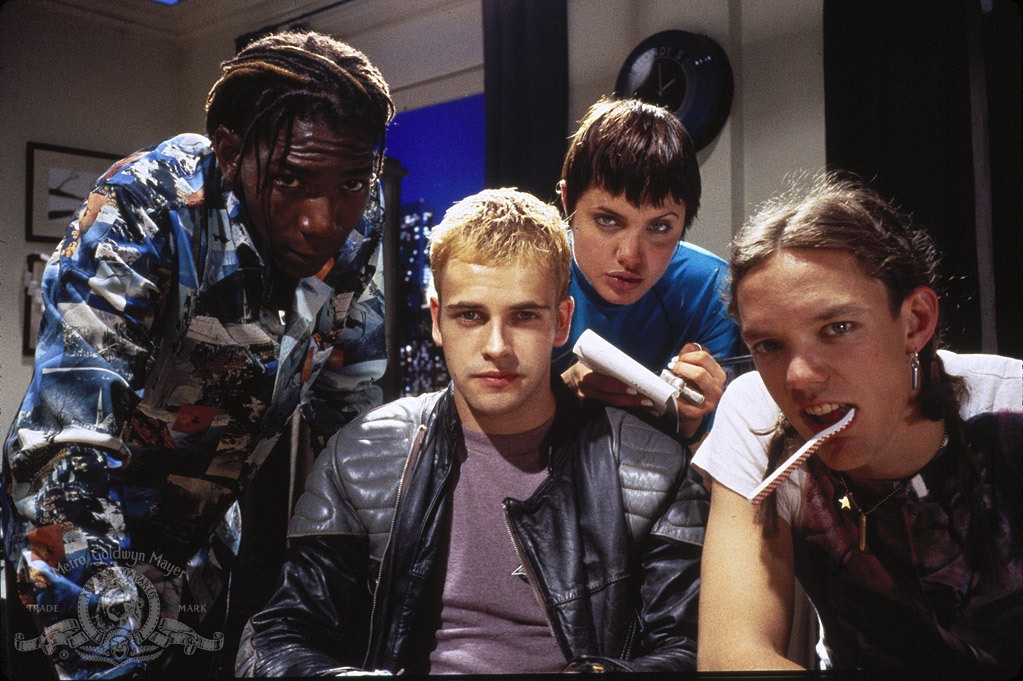
Today, the traffic sucked. I was finishing coffee at home when my wife warned me. So I wound up deciding to work from home. While doing something on the computer, saw that Hackers was playing on YouTube. So, of course I watched it.

Unironically, Hackers is one of my favorite movies. I only ever caught it on rental from Blockbuster back in the day and have watched it many times since. It was among the first movies that would expose me to a kind of culture that could be considered Queer and “woke.” Even though I was hard-wired as a fundamentalist at the time of my viewing, Hackers sorta dented the shell and began to nudge me into a direction of tolerance. Further, it played a big role in making me into a reader. Matthew Lillard’s character, Cereal Killer, alludes to 1984 and there’s a classic scene where he’s showcasing a bunch of the books used for networking standards and Dade (Johnny Lee Miller’s character) is listing off the vernacular titles to the impressive nods of the other characters (Phreak and Joey). Then there’s the scene in the Advanced English class where Dade shares a (mis)quote of Ginsberg’s “Howl.” I wanted to be like that. I wanted to be seen as cool, but also smart and well-read. But I digress.

What struck me about this viewing of Hackers was how prescient it could be. Yes, it is a film about computer hacking that is made for movie audiences in 1995—which is to say, a time where “average” people thought computers were still mystery machines full of bewildering power on a par with magic. The depiction of super-computers and that hilarious and user-hostile interface on the “Gibson” are corny and comical. But the heart of that movie is in the right place, much like how Point Break gets the spirit of surfing better than most Hollywood films about the sport do. And, as such, the film depicts an intellectual divide among computer nerds that is today coming to fruition.

In one corner we have The Plague, played by Fischer Stevens. There is a suggestion that he’s a bit of a sell-out, a hacker who got a job running information security at a major mineral corporation. Perhaps. But he’s more straightforwardly characterized as a guy who sees himself as a lone-gun, as possessing superior knowledge and intelligence and that these factors grant him the license to do whatever he wants. He tells Dade, our protagonist, that hackers are effectively a different breed of human, that they are “samurai” or “keyboard cowboys” and that the rest of the world are “cattle.” Both the image of the samurai and the cowboy are popularly depicted as loners, traveling the land free from any moorings, obligated only to themselves and their code (which takes on extra meanings from a computer-centered point of view). The Plague seeks to enrich himself at the expense of others, because why not? He sees himself as smarter and anyone not smart enough to do the same as him is a sucker. He is the American idealized individual, remade for the digital age.

In the other corner we have Dade Murphy. Known by two handles throughout the film: Crash Override and Zero Cool, Dade and his friends represent a different sort of computer hacker. Theirs is part of a subculture. At one point in the film, a federal agent reads aloud from “The Conscience of a Hacker” by Lloyd Blankenship, also known as the “Hacker Manifesto:”

This is our world now. The world of the electron and the switch; the beauty of the baud. We exist without nationality, skin color, or religious bias. You wage wars, murder, cheat, lie to us and try to make us believe it's for our own good, yet we're the criminals. Yes, I am a criminal. My crime is that of curiosity. I am a hacker, and this is my manifesto.

This is the exact quote from the film (sourced from IMDB), and is a selection from the actual document itself, likely edited to better summarize the ethos of our protagonists. Dade and his friends see themselves as, primarily, curious explorers (to use a phrase from near the beginning of “The Conscience of a Hacker”) who no longer define themselves by the markers that have conventionally been placed on them. We see this in action in the film whenever Dade is brought into the wider hacker subculture, particularly with the characters of Razor and Blade, two decidedly Queer-coded characters of East Asian ethnicity, who are also seen inhabiting a club full of diverse and varied people. These hackers are presented as the kind of “individual” that was commonplace among subcultures of the mid-90s, but their individuality is not a form of individualism. Rather, they represent a collectivist mentality and tend to see their intelligence and skills as tools for building a better society, using the infrastructure of the old in order to do so. Indeed, seldom is Dade ever pictured alone in the film. He is almost always sharing the screen with his friends, underscoring the collectivist characterization.

The theme of the film is pretty explicitly stated in the beginning when Dade hacks into a TV station in order to take down a Rush Limbaugh type character’s show and replace it with The Outer Limits. This era of the 1990s was an inspired time, where many of us believed that the internet opened up a new avenue for tolerance. It was also a tool for disruption, of bypassing the strictures of unfettered capitalism. Quoting also from “The Conscience of a Hacker,” Razor and Blade (hosts of a kind of “pirate TV” show, who are teaching their audience a form of “blue boxing” using a micro-cassette recorder—a technique that was already out of date by the time the movie premiered) say “this is a service that would be dirt cheap if it wasn't run by profiteering gluttons.” Adding, “remember, hacking is more than just a crime. It’s a survival trait.”

Hackers predicted the kind of world in which we are currently living. One where some hackers became “Tech Bros,” oligarchs seeking to hoard wealth no matter the human and environmental cost (recall that The Plague is fine with causing a worldwide environmental disaster, while also pinning the crime on a bunch of high school students, so long as he gets his money and stays out of jail). The individualist who believes that they are inherently superior and that that superiority obligates them to a life of wealth and leisure.

But the other kind of hacker still remains. Those who still believe that these tools are useful for liberating people, that a better world is still possible. In this sense, Cereal Killer gets to deliver what I think is the most iconic line in the movie:

Listen, we got a higher purpose here, alright? A wakeup call for the Nintendo Generation. We demand free access to data, well, it comes with some responsibility. When I was a child, I spake as a child, I understood as a child, I thought as a child, but when I became a man I put away childish things. (Though it still bugs me that he says “Corinthians one” instead of “First Corinthians” right after this…)

Having access to these tools and this data comes with responsibility. They are not a license for doing whatever we want. They obligate us to look out for each other and help each other. In the film, this line delivery is the catalyst to get Dade and Burn (Angelina Jolie’s character) to end their playful rivalry, which in turn inspires an entire global community of hackers to work together to prevent the wealth hoarding Plague’s criminal actions from causing a global catastrophe.

This collectivist action is done under the call “Hack the Planet,” which is also the tagline for the movie.

This call goes deeper than the usage of network infrastructure to circumvent capitalistic exploitation. Hacking the planet involves a shift in thinking that moves beyond conventional lines of demarcation and into something focused on a common good. It refuses to see the world as a collection of individualists, but as a kind of organic whole. The “profiteering gluttons” want to keep the world divided and stupid in order to achieve their desired ends. But there are those who resist such things and refuse to accept this status quo.

One of the ironies of the internet is that it is a thing built on the protocols for military communication but is also the realm of knee-sock-wearing Queer folk. A tool for war has become a tool for peaceful liberation, a means for people to investigate (indeed even “hack”) their own self-understanding. The result does not have to be some kind of atomized individualism, but a kind of individuality that sees itself as a smaller part of a whole.

The Plague-like Tech Bros have done much to force their vision for the world on us. But another vision still exists. It might not broadcast on pirated TV signals, or rollerblade in the glitching lights of abandoned subway tunnels. It might not play Wipeout in a nightclub with people selling computer parts out front. But it still looks for workarounds. It still likes to play jokes on the Feds. It still sees a common humanity running through the labels and stigmas and geopolitical boundaries.

We can still use these tools to better the world. Because it is our world now. We might be seen as criminals. But so were most people who tried to make things better for us.

Hack the planet.

***

The Rev. Charles Browning II is the rector of Saint Mary’s Episcopal Church in Honolulu, Hawai’i. He is a husband, father, surfer, and frequent over-thinker. Follow him on Mastodon and Pixelfed.

#Hackers #Computers #Philosophy #Theology #Movies #Film

photo of translucent circuitry; photo credit is of Adi Goldstein, via unsplash

People sometimes call me a techie. There was a time where this was true, and is something that I’m getting back into.

See, what I’ve come to realize about the phrase “techie” is that it often means “uses gadgets.” Using an iPad for preaching, or wearing an Apple Watch, knowing my way around social media or the features of my phone, these have garnered the techie designation, but, really, this is just me being a consumer who uses purchased products. Yes, they are “tech,” but my utilization of them was pretty much in accord with standard use. To use a microwave is a “techie” as using a tablet or phone in this case.

But being a proper “techie” is, to me, someone who navigates the concepts around their devices, who seeks to grasp an understanding of their innermost parts, to turn a biblical phrase. In that sense, I was a proper techie in my younger years, when I was learning computing from Mrs. Vincent, my math teacher. This extended into my late teens when I discovered 2600 magazine (which turned me on to the political dimensions of technology) and began to understand hardware integration and decided that I wanted to develop video games. So I convinced my mom that we needed a new PC and that me building one was an important educational opportunity. I acquired the parts (including an ASUS motherboard that I thought was legit but I’m pretty sure turned out to be stolen—I discovered this when I went to boot my machine for the first time and was greeted with an HP logo where there shouldn’t have been one; if not for Mrs. Vincent teaching me about BIOS and DOS, I would have been completely lost) and assembled my machine while watching Hackers, a machine that I would later try to learn C programming on (I wrote a calculator!), even if my ulterior motive was to have a gaming rig that could support the brand new VooDoo 2 graphics card so that EverQuest would play better. I even attempted to use chat rooms as a means to evangelize (which one pastor at the time said was not legit) and I even talked about the possibility of sticking a webcam in the church and streaming the sermon with a chat box underneath the stream (which people didn’t seem to understand then—now every church is doing this!) But my time as a techie began to fizzle out shortly after, the moment my grasp of BASIC vanished during a class at the local community college. After that, I just became a gadget-consumer.

I’ve since gotten back into my techie interests thanks in part to my dropping big-corporate social media in favor of the Fediverse, followed by the installation of Ubuntu Linux on an old mid-2011 Mac that has breathed considerable new life into that machine (as well as me). I’ve since started this blog, where I’ve actually learned a degree of coding through the use of MarkDown and CSS, and I’m now very much into the Free Open Source Software movement that is absolutely suppressed by the big corporations.

All of this is simply a prelude to say that, as a priest, I’ve begun reflecting theologically on technology and our (Christian) relationship to it. If being a proper techie is to seek to understand the conceptual and philosophical underpinnings of technology, then it is inevitable that one will bump up against the theological aspects of technology as well.

God And The Machines

Popularly, the term technology is often applied to gizmos. Things with integrated circuits that utilize electricity. We often fail to remember that things like bread and windows and legal pads and gel pens and roads and chairs and cast iron skillets are all forms of technology. According to Wikipedia technology is “the application of conceptual knowledge to achieve practical goals, especially in a reproducible way.” Technology is, more simply, the practical application of ideas (in addition to also being a term applying to the tools or results of that application). This definition is, to me, an interesting thing to consider in regards to humanity’s relationship with technology in the Bible.

The first piece of technology that humans make, according to the mythological account found in Genesis, is a form of rudimentary clothing. The story goes that Eve and Adam, the first people, were naked and unashamed. But the moment they decided to listen to a talking snake and his advice about whether or not to eat a piece of forbidden fruit, the couple become aware of their nakedness and get to work using fig leaves as means to cover up (there’s a very funny old English translation of the Bible called the “Breeches Bible” because it says that Eve and Adam used the fig leaves to make “breeches” for themselves—leafy britches!). This is technology. Eve and Adam had the conceptual knowledge—the idea—that they were naked and so went about making use of resources to apply that knowledge in a practical way. Then God, once He confronts them over their disobedience (which He figures out because they’re wearing the aforementioned britches), He introduces the technology of hide-based clothing, by killing two lambs and using their skins to cover Eve and Adam.

This story sets up the complicated relationship we have with technology. It is both borne out of our foibles and limitations, as well as being evidence perhaps of divine mercy. Both death and life are intertwined in the advent of human ingenuity.

At the same time, technology becomes a means of mediating God’s own self-revelation to humanity. God gives a law to His people through the use of the technology of writing, in which He also instructs them to build a box that symbolizes His presence among them, to be kept housed in a tent that is designed for portability. Later, that tent is upgraded to a building called a temple, itself situated amidst the technology known as a city, the language of which God also uses to refer to His own home/realm. Once we get to the beginning of the Common Era, we have Jesus (God incarnate) utilizing a whole range of technologies as a means to both communicate things about God, but also to serve as mediators of His presence and grace. The manger, the fishnet, bread, wine, a cross and a tomb are but a few of the technological examples put to use by God Incarnate to reveal His full plan to the world. And in the case of the bread and wine, these are said to become the body and blood of Jesus—and not in some notion of symbol or metaphor, no these are God-ordained technologies of grace, what we today call “sacraments.”

In a sense, these sacramental signs are a kind of machine, things that use power to perform a specific action. In this case, it is both the power of God and the power of the entire creation that is behind these technologies, mediating God’s grace and moving us toward the restoration of the world. As the Orthodox theologian Michael J. Oleska writes:

Eastern Christians believe in sacred materialism. God uses physical objects and visible elements to communicate with His People. The created universe is the means by which we enter into communion with Him. He chose food as the most perfect way to enter our lives. And what is the bread? Flour, yeast and water, baked to a certain temperature? No, it is much more, for to create bread, one needs the whole world. The earth must turn, the rain must fall, the soil must be fertile, the sun must shine, night must come, the wind blow. If all this is in harmony, and humans interact with it appropriately, tending the garden as God originally planned, bread can be baked, communion with God restored [...]

It is all Christ. He chose to make water into wine as his first miracle, but He is always doing that, every vineyard since time began [...] The Word made Flesh only does in His Incarnate Form what the Word, embodied in the whole creation, has always done. (from “The Alaskan Orthodox Mission and Cosmic Christianity,” The Chant of Life: Inculturation and the People of the Land p. 188)

We Are God’s Technology

I have to admit, the idea that technology is “applied conceptual knowledge” sounds a bit like what Saint John the Evangelist writes in his gospel:

In the beginning was the Word, and the Word was with God, and the Word was God [...] The Word became flesh and made his home among us.

The “Word” there is the English rendering of a Greek concept known as “Logos.” It’s a fairly difficult concept to translate directly into English, to be honest. The best I’ve come up with is that the “Logos” is akin to the “kernel” in a program like Linux, the core element around which everything else is built/based.

a three-panel comic of the Visitation of the Magi, but using playing cards; Jesus is revealed as the “Rules for Draw and Stud Poker” card Honestly, this image is probably the actual best representation of what “the Logos made his home among us” means. (from the Perry Bible Fellowship)

Basically, the idea is that God looked out at timeless time and decided that He wanted to create a universe where He would come to live, and so He built a universe around the “kernel” of Himself as human. So when Genesis says that humanity is made “in God’s image,” we Christians are saying that we are built to look like what Jesus (that is, God-in-flesh) is. Yes, I understand that this does not make sense when we think of time linearly—but there’s really nothing that says time is linear; plus we Christians affirm that God does not exist within time as we comprehend it.

Anyway, Saint John speaks of this notion as “Everything came into being through the Word, and without the Word nothing came into being.” The “Word” (Logos) is the anchor around which everything exists. One of the Episcopal Church’s Eucharistic prayers puts it as “In your infinite love you made us for yourself.” In other words, we are made by God to do what God intends us to do.

Which means we are God’s technology.

This might sound weird at first. Especially if we still associate technology with machines or gadgets. But when we recall that we are “fearfully and wonderfully made” (as the Psalmist declares) we realize that our “being made” is a confession that to be created means that we fall into the realm of technology. Saint Paul articulates this when he writes that we are “God’s building.” This is overt technological language, applied to us as created beings. We, and the whole universe, are an application of God’s conceptual knowledge—indeed THE conceptual knowledge—reproducible and with particular intention.

And what is that intention? To love God.

I know that sounds selfish on God’s part. Is God so insecure that He felt the need to create an entire universe so that it could foster sapient life on (perhaps) a single planet with the express purpose of giving Him worship and adoration? When we think of God as lacking in love, then yes it does sound like He’s insecure. But when we consider that God is a complete and perfect Being lacking in nothing, then it changes the idea of why God created.

God did not need to create, not in the sense of an obligation (as in filling a lack). Instead God chose to create as an outgrowth of His ever-flowing love. Love demands an object. And if, as Jesus tells us, God is Love, then the only logical conclusion we can reach is that the universe was created to be an object of that Love, borne as a consequence of an eternally radiating love emanating from a complete Being who has love to spare. And if that Being is the originator of all that is, then the love poured into us finds its most worthwhile expression when directed back at the One who graced us with everything that is—out of His love.

But notice what Jesus says about how we apply that love ourselves. He doesn’t tell us to do what all of the other religious practices of His time were doing, which was to direct love at God/the gods in order to win their favor, as though God needed this love. No, Jesus tells us that our love of God is demonstrated best when we love our neighbor—which Jesus defines as everyone and anyone. We are to mediate God’s love among ourselves and in so doing it is directed toward God, who is the One most worthy of receiving love. This is what He designed us to do.

This post is long enough without getting into the programming bug we know as sin (I’ll take that up in a later post). Instead I’ll leave us here to ponder what it all means that we are God’s technology of love, given the gift of technology ourselves that can serve as a mediating factor for receiving God’s love in order to spread it around—by which we show God how much we love Him in return.

The Rev. Charles Browning II is the rector of Saint Mary’s Episcopal Church in Honolulu, Hawai’i. He is a husband, father, surfer, and frequent over-thinker. Follow him on Mastodon and Pixelfed.

#Theology #Technology #Linux #Computers #Philosophy #Christianity #Bible #Church #Jesus