The Catechetic Converter

Hawaii

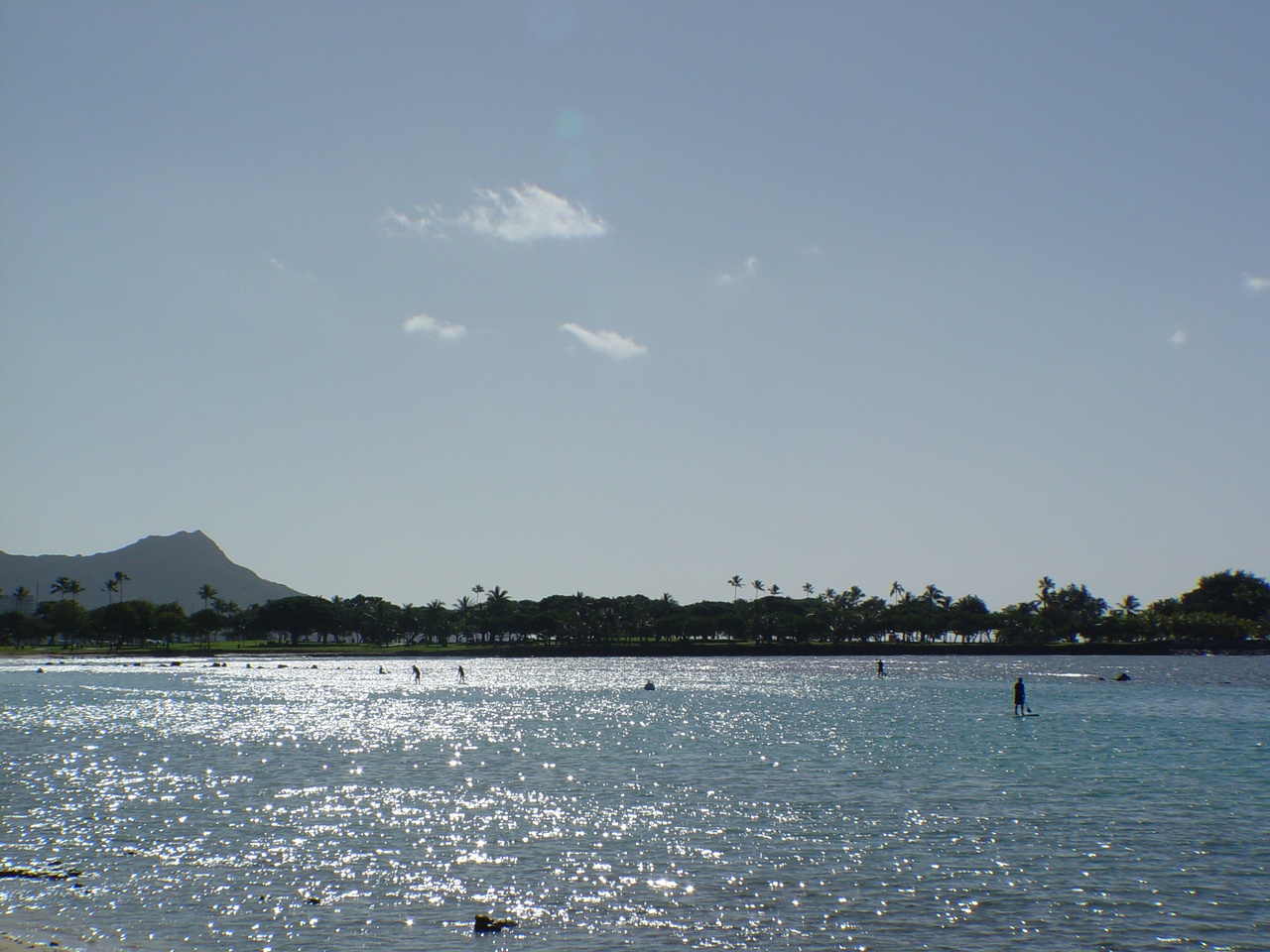
Taken by the humble author; depicts the ocean with paddlers and swimmers, the mountain known as Diamond Head is in the distance on the left hand side.

Today I had an off day of surfing.

The wind was stronger than expected. It was kind of crowded for my spot. Waves were wrapping from the West and peaking, breaking almost perpendicular to shore.

When I first arrived I said a little prayer “Lord, if you want me to surf, give me a parking spot.” I drove around and, what do you know, a really nice spot near the showers opens up. As soon as I get out of the car I feel the breeze briskly picking up speed, starting to blow side-shore. I wasn’t feeling it. But the late-morning was beautiful, a classic looking south shore of O’ahu kind of day. So I grabbed my camera and took some photos of the sun glistening off the water, Diamond Head in the back ground, people paddling and swimming in the foreground—a photo that could have existed over a hundred years ago. Took close-up photos of the rocks, testing out a 25 year old digital camera I got for Christmas, to replace an exact model I had short-sightedly given away years back.

I return to my car and stare at the water. An uncle next to me is gearing up to paddle out. Another uncle, his friend, comes over and they start talking story. I decide to call it and make my way around toward the driver’s side.

“Eh! You going out?!” the other uncle says.

“Nah. Too windy.”

“Can I have your stall, den?”

“Sure.”

“I come back. Get one brown SUV. Eh watch my water bottle while I go gettum.”

As he leaves his water bottle on the curb and walks away I look at his friend and I joke: “he’s very trusting. Gotta watch out for these haoles you know!” I say with a smile. “We known for taking things.”

“Eh,” the first uncle says with a dismissive tone. “All kinds of people can do all kinds of things.”

We get to talking. Richard is his name. I’ve seen him in the water before, but he usually paddles out shortly as I’m heading in. Today I’m at the spot at a later time. He urges me to go out.

“Too crowded. Plus I told your friend I’d give up my spot for him.”

He dismisses this and tells me it’s good and I need to go out. Eventually the brown SUV comes rolling around. I give shakas and say goodbye as I drive away. About five cars down I see another car pulling out. As I drive past I can’t shake the feeling that this is all God’s way of telling me that I need to paddle out. So I loop around and pull into the other spot. This one is actually better because it has more shade. I pull down my 11-foot glider (pretty much my exclusive board for the past three years), sunscreen, wetsuit vest zipped up. And I walk over to the cut between rocks where I can paddle out. I see Richard and I tell him that he convinced me to change my mind. He gives a loud approval.

I make the paddle in good time. The crowd thinned a bit in the interim. Waves have power. I see a few familiar faces, folks I did not expect to see in the water because they’re usually out at my normal time. I see a wave on the horizon, taking shape. I whip my board around and paddle. I feel the momentum taking me so I hop to my feet. The wave is beginning to break in front of me, so I go to fade left and surf on my back-hand. But there’s no face there. The wave is a strict right. So I fade back to front-side and try to get into it. I squat and begin scooping at the water, hoping to pick up more speed, but no dice. So I paddle back out, chuckling to myself.

After a while I see a set forming on the horizon. No one seems to be going for it, so I spin around and start paddling. I easily catch the wave and drop in, going right. I squat a bit in the face and then stand to adjust my position, dropping down the face in order to carve my way back up. But I see that it’s walling up too far ahead and is going to close out. So I fade back left to see another closing section coming behind me. So I turn to go straight and ride out the whitewater. But I get caught between two breaking sections, the foam engulfing my board and I feel the force underneath me. I get knocked off my board and plunged under the foam. I feel the chaos of the colliding waves rolling over me and I surrender to the current. Once the wave fully passes I surface. Another wave is breaking, but I have enough time to take stock of my surroundings and know that my board has made its way toward shore, pretty far from my location.

So I start swimming.

At this point I should probably note that I prefer to surf without a leash. Unless it’s particularly big and/or crowded, I’ll forego having a urethane chord dancing about my feet. Leashes can give us a sense of false security. They can and will fail and so we need to be prepared to swim when that eventually happens. Plus, leash-free surfing forces one to be more intentional in their surfing, as well as cognizant of one’s board.

It’s been awhile since I’ve had a long swim for a board. Since I’m wearing a wet-suit vest, I have some buoyancy and I have better results from flipping on my back and kicking my way toward my board. I hold my breath and descend under white water, wait for the roll of the wave to wash over me, return to the surface, and then kick my way again.

There’s always a threat of panic in the back of my mind when I have to swim for a board. I’m pretty far from the beach where I surf and there’s a lot of water. Also infrequent tiger shark sightings. But I keep myself calm. Eventually I see that an off-duty lifeguard who surfs my spot has retrieved my board. I thank him and grab it. I bob on the inside, considering the time and effort it would take to get my leash. Nah. I’ll paddle back out.

As I’m nearing the outside, I see the lifeguard wipe out. His big yellow board is bouncing among the whitewater, making its way to shore. He, too, is not wearing a leash. So I turn my board around and grab some whitewater and make my way to where his board is bobbing on the shallow reef. I grab it and start paddling in his direction. He gets it. I tell him we’re even. We both laugh and paddle back out.

By the time I make it back outside, I’m getting tired. I tell one of the uncles I know that I got my swim in for the day and he laughs. The wind has significantly picked up and is blowing almost onshore. After a time I see another wave making its way toward me. It’s mine. I paddle and begin to make the drop a bit later than I was expecting. So I grab the rails and decide to ride it on my belly. The speed is unreal. I’m constantly on the verge of being rolled over, but I keep my composure and let myself fly toward the beach. I decide that I’m not about to paddle back out. This will be the ride, for what it’s worth.

The wave peters out in the shallows of the reef. The tide is nearly dead low, which means that I’ll have to be careful not to let my fin hit anything.

I’m a good surfer. I’ve been at it for 26 years. I get long nose rides on the well-formed South Shore faces. I drop in and run my hands along the face of the waves. I’ve even garnered compliments for my ability to hit the lip with an 11-foot board, on occasion. I’ve shaped boards, ridden a variety of designs. I know the mythology and the legends. I know surfing inside and out.

And I still have off days.

Blessed be the off days.

That saying came into my mind as I carefully paddled over the shallow reef. A large honu (sea turtle) popped its head up next to me. “Hey, cuz!” I said. It swam directly under my board.

This past Sunday we heard Jesus give the Beatitudes. There’s a tendency to read the Beatitudes as Jesus giving us a list of rewards: “be a peacemaker, get a blessing; put up with grief and persecution; get a blessing.” But Jesus is actually saying that peace-making, grieving, being persecuted, being poor in spirit, etc. are themselves blessings. In the Greek language that Matthew’s gospel was maybe first written in, the Beatitudes are in what’s called the “indicative mood.” Meaning that the blessings are indicated by the other stuff. The blessings aren’t rewards for doing certain things.

This idea translates broadly. An off-day of surfing is a blessing, if I choose to see it. Blessed be the off days, because they help you appreciate the better days. Or, Blessed be the off days, because they make you a better swimmer.

I didn’t get to have a morning of beautiful glides on my huge board. I didn’t get to run to the nose and hang ten on a perfectly groomed wave face. I didn’t even get to drop in while squatted down, feeling the cool water with my fingers as I experience the thrill of dropping into the face of a wave and setting myself up for an elegant bottom turn to set my rail and just… go.

Nope. I got wiped out. I swam a lot. I got skunked on wind-blown waves that were both somehow mushy and strong.

But I got in the water. I learned that I’m finally mature enough to appreciate even the days where my surfing kinda sucks.

Blessed be the off days, indeed.

***

The Rev. Charles Browning II is the rector of Saint Mary’s Episcopal Church in Honolulu, Hawai’i. He is a husband, father, surfer, and frequent over-thinker. Follow him on Mastodon and Pixelfed.

#Surfing #Reflection #Ocean #Theology #Jesus #Church #Hawaii #Oahu

Stormy clouds lit orange by, presumably, the setting sun; photo by Michael and Diane Weidner, via Unsplash

Yesterday at the Hands Off demonstrations in downtown Honolulu, I had (at least) two encounters that felt like they might be blessings from God. One was when I was handed a trans pride flag (which I wrote about already). The other was when a guy wearing a Trump hat yelled at me (and my clergy colleagues) something about illegal immigrants and then told me to “go back to the mainland.” I know that last one probably doesn’t sound much like a blessing to you. So, let me try to explain.

I’m trying to shift my understanding of the concept of blessing. In the Matthew Beatitudes, Jesus notes that blessings do not always skew toward what we might consider “positive.” For instance, Jesus refers to mourning and persecution as blessings. He says things like:

Blessed are people who are hopeless…

Blessed are people who grieve…

Blessed are people whose lives are harassed because they are righteous…

Blessed are you when people insult you and harass you and speak all kinds of bad and false things about you, all because of me… (see Matthew 5:1-12*)

So having people wave and be welcoming to see a priest carrying a trans pride flag is a great thing and feels like a “typical” blessing (even though this is the sort of thing that Jesus cautions us about in Luke 6:26). But I have to consider the possibility that being yelled at is also a kind of blessing. I mean, consider the words of Job:

Shall we indeed accept good from God and not accept adversity? (Job 2:10, NASB)

In the Hawaiian Bible, this verse reads:

Eiʻa, e loaʻa anei iā kākou ka maikaʻi mai ke Akua mai, ʻaʻole anei e loaʻa iā kākou ka ʻino kekahi?

I put the two key words in bold. Maika‘i is a word that means “good, handsome, delightful.” It is the root for the Hawaiian term for “blessed,” pōmaikaʻi (the word is a word that refers to “thickness” and works here as an intensifier, indicating a “state of goodness,” thus “blessed”). The other word, ka ‘ino, (ka is the article, so “the”), is a word often used for “evil” and “wickedness,” also used for “spoiled” or “gone bad.” It is also a word used to refer to a storm. In this sense, we get an interesting read from Job: do we accept only the good, maika‘i weather as being from God? Do we not also have to accept that He sends ka ‘ino, stormy weather as well? Or as Jesus Himself puts it, right after He gives us the Beatitudes:

[God] makes the sun rise on both the evil and the good and sends rain on both the righteous and the unrighteous. (Matthew 5:45 CEB)

Both clear weather and stormy weather can be both “good” and “bad”—even at the same time. So it is my (and our) duty to accept both as blessings, to find the blessedness in even what we might call “bad.”

So what’s the blessing in having an angry Trump supporter yell at me to “go back to the mainland?” Well, before I get to that, allow me to unpack the baggage of that statement for haoles (a Hawaiian term for “foreigner” that has turned into a phrase and sometimes epithet for exclusively Caucasian people). Hawai‘i is one of the few places in the United States where Caucasians are not a majority and don’t hold outsized cultural power, and, thus, one of the few places where they can experience the sort of discrimination usually experienced by people of color in other parts of the country. So being haole is already a touchy thing. It carries with it an assumption that one does not belong here. Darker skinned Hawaiians will sometimes call light-skinned Hawaiians “haole” as an insult. As a Caucasian myself, there is the automatic assumption that I am on vacation, or am clearly from somewhere else—frequently expressed as being given a fork and spoon at a restaurant and not chopsticks**. One of my friends once referred to a guy as “he wasn’t a haole, he was a local-looking guy”—as though there aren’t “local” haoles. So, being told to “go back to the mainland” is about the closest I can get to the experience of being told something like “go back to Africa.” It’s telling me that I do not belong here. That I belong on the “mainland” of the United States (what we here prefer to call “the continent” since, from the Hawaiian perspective, the Hawaiian islands are the mainland).

This is something of which I’m very sensitive. While I am from the continental US, I’m here in Hawai‘i by invitation—I was invited by the Saint Mary’s to be their priest. I never held dreams of living in Hawai‘i, never once vacationed here. My first time ever on Hawaiian soil was for a job interview. Further, the Episcopal Church here in Hawai‘i has its roots in the Hawaiian Reformed Catholic Church, which resulted from King Kamehameha IV and Queen Emma inviting Church of England clergy to come and establish a church here in Hawai‘i because they felt that it offered a vision of Christianity better reflective of the Hawaiian people. So, I am not following a colonizing trajectory. But I also understand that I look an awful lot like the sort of people who have colonized this place. So, while it hurts to be lumped in with the people who continue to pillage this place for profit, I do understand the reasons why it happens. Doesn’t make it any easier, though.

Now, this guy said his piece after reading the sign I was holding. Which, I must confess, was not my choice. A friend asked me to hold his sign while he was taking care of something else. It said “Hands Off!” followed by a list of things that included public lands, Social Security, and immigrants. We were standing adjacent to a pedestrian crosswalk and the light was red. This guy was staring us down, and I saw the red Trump hat on his head. So I gave him a shaka. His eyes scanned my sign and that’s when he yelled something about illegal immigrants. I couldn’t really understand him, except when he yelled about “going back.” Which leads me, finally, to talk about how this is a blessing.

The guy saw on my sign and in my Caucasian appearance something that, to him, screamed “mainland” and not, to him, “Hawai‘i.” I am going to assume that this guy might have been “local.” One of the interesting quirks about Hawaiian politics is that, one, we are a very “blue” state, but tend to skew “conservative” on some issues. And, second, the Native Hawaiian (Kanaka Maoli) population leaned heavily toward Trump in the last two elections. Why? Because the Democrats in Hawai‘i have had political dominance since the end of World War II, but Native Hawaiians have continually been marginalized in their own homeland. Their sacred lands are being used for various military, scientific, and recreational purposes. They continue to be priced out of the housing market (to the point where Las Vegas has become a sort of second home for Hawaiians). And their cultural concerns are treated as obstacles to be overcome rather than legitimate issues to be listened to and honored. Further, there are ten times more tourists on the islands per year than residents, but residents are taxed in order to support the tourist industry and not the other way around—on top of the plague of “income properties” that are built here for tourism purposes while beach parks are rife with Native Hawaiians living in tents and barely making ends meet. Because of this, the logic among many is to either “give the other guys a try” or to vote for someone that they think will break the system so that something better might be built from its ruins. As a Kanaka Maoli friend of mine put it at the protest: “That’s the logic. It’s not great logic, but that’s what they’re thinking in supporting Trump.”

So I have to wonder: did this guy see the sign I was holding and see it as reflective of trying to maintain a status quo that has continued to marginalize local people? Are these positions signaling to him a desire to further a kind of political system that will continue to offer soaring rhetoric about being on the “right side of history” while quietly lining the pockets of (different) billionaires who see Hawai‘i as a golden goose to squeeze of all it can offer to people who only want to take take take?

That is the question we all have to ask. And this is why his anger was a blessing to me: it’s causing me to ask what I’m aiming to do as part of such demonstrations. We’re all mad right now. What we’re doing at the moment is collectively yelling A‘ole!, no!

A‘ole to gutting the government programs that the poor rely on.

A‘ole to ignoring our environment and the unabashed pillaging of Earth’s resources.

A‘ole to sending human beings to what are effectively gulags and concentration camps.

A‘ole to disappearing students for no reason other than their political views regarding the genocide happening to the Palestinian people does not line up with the preferred narrative.

A‘ole to the path toward fascism this administration is on.

But that a‘ole cannot simply be about putting things back the way they were. We must demand something more. As a Christian, I want to see something that more closely resembles the Kingdom of God—where no one is lost, all have enough, and we reject the mechanism of death—used to provide a sense of “peace” to our people at the expense of others. To do that, we have to put a stop to what we see happening now—while also advocating for something better to be built in its place.

Hands off, yes. But also, hands on to the tools and materials for making a better world to come.

Blessed are people when they are handed pride flags, they are giving hope to often hopeless people.

Blessed are people when Trump-supporters yell at them to go back to the mainland, it gives them pause to consider how a better future is possible through Christ Jesus.

The Rev. Charles Browning II is the rector of Saint Mary’s Episcopal Church in Honolulu, Hawai’i. He is a husband, father, surfer, and frequent over-thinker. Follow him on Mastodon and Pixelfed.

_*Note: This is from the Common English Bible translation, which follows an odd modern English translation custom to change “blessed” into something like “happy.” It reads weird and doesn’t exactly correlate with what Jesus is recorded as saying, so I correct the translation to “blessed” for that reason._

**Note 2: My wife and I refer to this as “getting haole-d.” I can’t express to you, reader, how awesome it feels to have someone just give us chopsticks without asking first.

#Theology #Bible #Jesus #Episcopal #Church #Politics #HandsOff #Hawaii