On Hacking The Planet
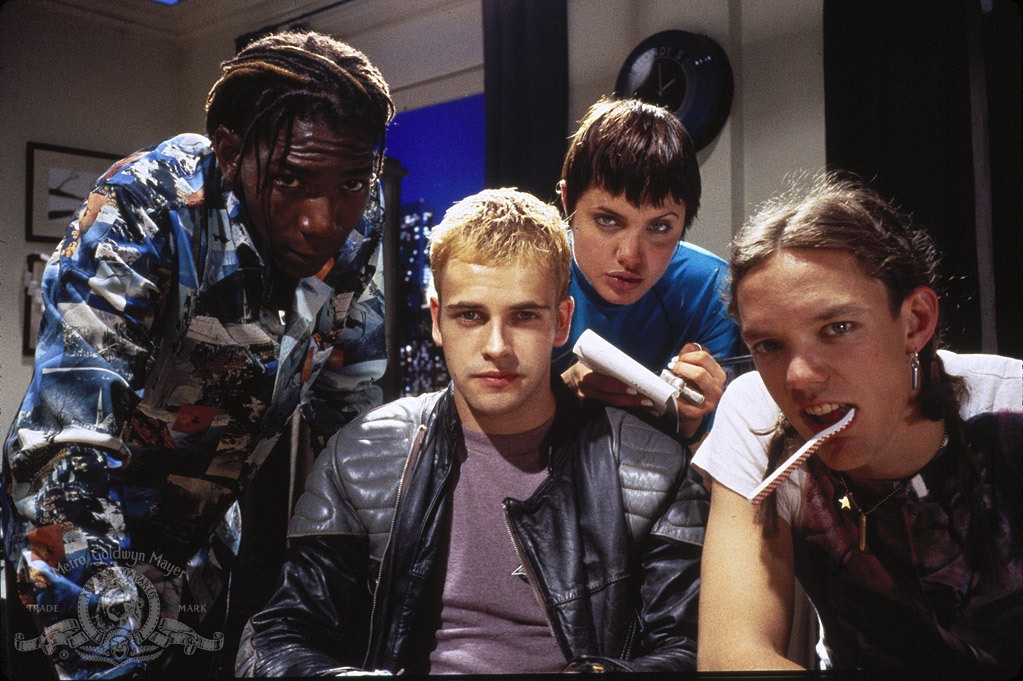
Today, the traffic sucked. I was finishing coffee at home when my wife warned me. So I wound up deciding to work from home. While doing something on the computer, saw that Hackers was playing on YouTube. So, of course I watched it.
Unironically, Hackers is one of my favorite movies. I only ever caught it on rental from Blockbuster back in the day and have watched it many times since. It was among the first movies that would expose me to a kind of culture that could be considered Queer and “woke.” Even though I was hard-wired as a fundamentalist at the time of my viewing, Hackers sorta dented the shell and began to nudge me into a direction of tolerance. Further, it played a big role in making me into a reader. Matthew Lillard’s character, Cereal Killer, alludes to 1984 and there’s a classic scene where he’s showcasing a bunch of the books used for networking standards and Dade (Johnny Lee Miller’s character) is listing off the vernacular titles to the impressive nods of the other characters (Phreak and Joey). Then there’s the scene in the Advanced English class where Dade shares a (mis)quote of Ginsberg’s “Howl.” I wanted to be like that. I wanted to be seen as cool, but also smart and well-read. But I digress.
What struck me about this viewing of Hackers was how prescient it could be. Yes, it is a film about computer hacking that is made for movie audiences in 1995—which is to say, a time where “average” people thought computers were still mystery machines full of bewildering power on a par with magic. The depiction of super-computers and that hilarious and user-hostile interface on the “Gibson” are corny and comical. But the heart of that movie is in the right place, much like how Point Break gets the spirit of surfing better than most Hollywood films about the sport do. And, as such, the film depicts an intellectual divide among computer nerds that is today coming to fruition.
In one corner we have The Plague, played by Fischer Stevens. There is a suggestion that he’s a bit of a sell-out, a hacker who got a job running information security at a major mineral corporation. Perhaps. But he’s more straightforwardly characterized as a guy who sees himself as a lone-gun, as possessing superior knowledge and intelligence and that these factors grant him the license to do whatever he wants. He tells Dade, our protagonist, that hackers are effectively a different breed of human, that they are “samurai” or “keyboard cowboys” and that the rest of the world are “cattle.” Both the image of the samurai and the cowboy are popularly depicted as loners, traveling the land free from any moorings, obligated only to themselves and their code (which takes on extra meanings from a computer-centered point of view). The Plague seeks to enrich himself at the expense of others, because why not? He sees himself as smarter and anyone not smart enough to do the same as him is a sucker. He is the American idealized individual, remade for the digital age.
In the other corner we have Dade Murphy. Known by two handles throughout the film: Crash Override and Zero Cool, Dade and his friends represent a different sort of computer hacker. Theirs is part of a subculture. At one point in the film, a federal agent reads aloud from “The Conscience of a Hacker” by Lloyd Blankenship, also known as the “Hacker Manifesto:”
This is our world now. The world of the electron and the switch; the beauty of the baud. We exist without nationality, skin color, or religious bias. You wage wars, murder, cheat, lie to us and try to make us believe it's for our own good, yet we're the criminals. Yes, I am a criminal. My crime is that of curiosity. I am a hacker, and this is my manifesto.
This is the exact quote from the film (sourced from IMDB), and is a selection from the actual document itself, likely edited to better summarize the ethos of our protagonists. Dade and his friends see themselves as, primarily, curious explorers (to use a phrase from near the beginning of “The Conscience of a Hacker”) who no longer define themselves by the markers that have conventionally been placed on them. We see this in action in the film whenever Dade is brought into the wider hacker subculture, particularly with the characters of Razor and Blade, two decidedly Queer-coded characters of East Asian ethnicity, who are also seen inhabiting a club full of diverse and varied people. These hackers are presented as the kind of “individual” that was commonplace among subcultures of the mid-90s, but their individuality is not a form of individualism. Rather, they represent a collectivist mentality and tend to see their intelligence and skills as tools for building a better society, using the infrastructure of the old in order to do so. Indeed, seldom is Dade ever pictured alone in the film. He is almost always sharing the screen with his friends, underscoring the collectivist characterization.
The theme of the film is pretty explicitly stated in the beginning when Dade hacks into a TV station in order to take down a Rush Limbaugh type character’s show and replace it with The Outer Limits. This era of the 1990s was an inspired time, where many of us believed that the internet opened up a new avenue for tolerance. It was also a tool for disruption, of bypassing the strictures of unfettered capitalism. Quoting also from “The Conscience of a Hacker,” Razor and Blade (hosts of a kind of “pirate TV” show, who are teaching their audience a form of “blue boxing” using a micro-cassette recorder—a technique that was already out of date by the time the movie premiered) say “this is a service that would be dirt cheap if it wasn't run by profiteering gluttons.” Adding, “remember, hacking is more than just a crime. It’s a survival trait.”
Hackers predicted the kind of world in which we are currently living. One where some hackers became “Tech Bros,” oligarchs seeking to hoard wealth no matter the human and environmental cost (recall that The Plague is fine with causing a worldwide environmental disaster, while also pinning the crime on a bunch of high school students, so long as he gets his money and stays out of jail). The individualist who believes that they are inherently superior and that that superiority obligates them to a life of wealth and leisure.
But the other kind of hacker still remains. Those who still believe that these tools are useful for liberating people, that a better world is still possible. In this sense, Cereal Killer gets to deliver what I think is the most iconic line in the movie:
Listen, we got a higher purpose here, alright? A wakeup call for the Nintendo Generation. We demand free access to data, well, it comes with some responsibility. When I was a child, I spake as a child, I understood as a child, I thought as a child, but when I became a man I put away childish things. (Though it still bugs me that he says “Corinthians one” instead of “First Corinthians” right after this…)
Having access to these tools and this data comes with responsibility. They are not a license for doing whatever we want. They obligate us to look out for each other and help each other. In the film, this line delivery is the catalyst to get Dade and Burn (Angelina Jolie’s character) to end their playful rivalry, which in turn inspires an entire global community of hackers to work together to prevent the wealth hoarding Plague’s criminal actions from causing a global catastrophe.
This collectivist action is done under the call “Hack the Planet,” which is also the tagline for the movie.
This call goes deeper than the usage of network infrastructure to circumvent capitalistic exploitation. Hacking the planet involves a shift in thinking that moves beyond conventional lines of demarcation and into something focused on a common good. It refuses to see the world as a collection of individualists, but as a kind of organic whole. The “profiteering gluttons” want to keep the world divided and stupid in order to achieve their desired ends. But there are those who resist such things and refuse to accept this status quo.
One of the ironies of the internet is that it is a thing built on the protocols for military communication but is also the realm of knee-sock-wearing Queer folk. A tool for war has become a tool for peaceful liberation, a means for people to investigate (indeed even “hack”) their own self-understanding. The result does not have to be some kind of atomized individualism, but a kind of individuality that sees itself as a smaller part of a whole.
The Plague-like Tech Bros have done much to force their vision for the world on us. But another vision still exists. It might not broadcast on pirated TV signals, or rollerblade in the glitching lights of abandoned subway tunnels. It might not play Wipeout in a nightclub with people selling computer parts out front. But it still looks for workarounds. It still likes to play jokes on the Feds. It still sees a common humanity running through the labels and stigmas and geopolitical boundaries.
We can still use these tools to better the world. Because it is our world now. We might be seen as criminals. But so were most people who tried to make things better for us.
Hack the planet.
***
The Rev. Charles Browning II is the rector of Saint Mary’s Episcopal Church in Honolulu, Hawai’i. He is a husband, father, surfer, and frequent over-thinker. Follow him on Mastodon and Pixelfed.