The Catechetic Converter

history

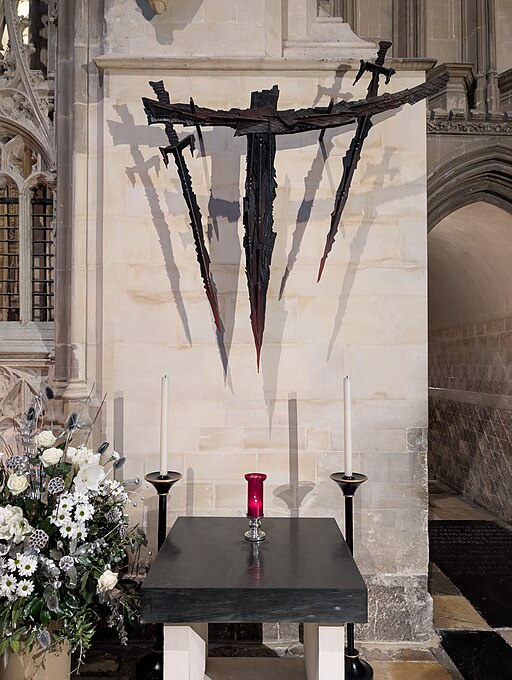
The altar of Saint Thomas in Canterbury Cathedral, marking the spot where he was martyred.

I’m sorry to say that I was not very familiar with Saint Thomas Becket (also known as Saint Thomas of Canterbury) until recently. He’s quite an important English saint with a famous memorial altar in Canterbury Cathedral that marks the spot of his martyrdom (seen in the header image). His shrine is also the place to which the characters in Chaucer’s Canterbury Tales are traveling and sharing their stories. The liturgist Richard Giles feels that Saint Thomas should be the patron saint of England.

Thomas Becket (sometimes “Thomas a Becket”) was the archbishop of Canterbury in the late 1100s. He was the son of a Norman family and managed, with great ambition, to become a highly valued member of Henry II’s inner court. The king saw an opportunity when Archbishop Theobald Bec died. Henry figured he could appoint a kind of ringer in the senior office of the Church in England, and so he managed to get Thomas appointed—despite the fact that Thomas was not ordained to any clerical office at the time. Within days, Thomas was ordained deacon, priest, then bishop in order to take charge of the archbishopric. He came to this office in the midst of a time when the English monarchy was attempting to both exert further control over the church and gain further independence from Rome. But Thomas had a fairly dramatic conversion experience as a result of his impromptu ordinations and wound up eschewing the vainglory of the royal court in favor of faithfulness to the Church. Once Henry’s close friend, he became a thorn in the side of the king and was regularly opposing him on church-related issues, even threatening excommunication at one point.

The story goes that Henry II, in a fit of frustration (and after Becket had been allowed to return from a multi-year exile in France), exclaimed among some of his advisors and knights “will no one rid me of this troublesome priest” (or some variation of this). Four of his knights took this as an order and made plans to assassinate Saint Thomas in the Cathedral. He was stabbed multiple times while Vespers was being chanted, the events expressed in gory detail by one of the monks wounded in the attack.

There are complicated elements in Saint Thomas’ story that carry overtones we still deal with today. Becket wanted “secular” legal systems to have limited authority over the clergy, preferring that the Church handle its own affairs. Such a practice has come to a head in the early 21st century where we’ve seen that when the Church is left to its own devices in terms of addressing clerical crimes, justice becomes elusive. However, at the same time, we also see the dangers inherent in a system where a government exerts control and influence over the Church. Becket was a champion of the established models of medieval Christendom, where monarchs were understood to be under the authority of the Church, with bishops serving as a kind check on kingly power. Henry II did not want to be held in such check and his frustrations with this idea ultimately led to the death of a beloved archbishop.

Thomas’ assassination is of a piece with other notable Christian leaders who attempted to challenge worldly power with the power of the gospel. Oscar Romero is one example, assassinated during Mass by right-wing political figures. Martin Luther King Jr. is, of course, another—assassinated because he became a more vocal opponent of the war in Vietnam and was beginning to shift his advocacy toward the exploitation of the working poor. Both saw their stances as being rooted in the gospel.

Thomas is a worthy saint for our consideration and devotion in our time. There is much pressure put on the Church (in all her forms) to capitulate to worldly powers. The radical right movements like MAGA and their ilk are the most current (and perhaps most egregious), but I’ve seen such pressure come from the left-side of things as well. Having grown up in a church quite given to right-wing political and social evils, I’m loathe to see a similar thing happen with more “progressive” churches like the Episcopal Church, where subscription to partisan talking points becomes seen as synonymous with “the gospel.” Indeed, I am of the conviction that faithfulness to Jesus Christ and His gospel will result in frustration from all forms of political partisanship. Jesus is one who disturbs worldly power, not one who makes it feel comfortable. If the Venn Diagram of one’s partisan politics and their theology is a circle, there’s a problem.

It is said that Thomas was prayerful and pious even as he was being struck by the swords. When the knights entered the cathedral, the monks wanted to bolt themselves in the sacristy for safety but Thomas would not let them. “It is not right to make a house of prayer into a fortress,” he said. After the third blow with a sword, one of the survivors of the attack recalled Becket as saying: “For the name of Jesus and the protection of the church, I am ready to embrace death.”

Saint Thomas of Canterbury was willing to face death rather than capitulate; choosing the assassin’s blade over easy comforts provided by temporal power. When his body was removed from the nave of the cathedral and his episcopal vestments removed, his fellow monks discovered that Thomas wore a hair shirt underneath it all—a garment of great discomfort and used for spiritual discipline and penance. It was a sign of the deep devotion this man had. Do I have the same level of devotion? Do you? How willing are we to hold to the gospel that’s been handed down to us in the face of pressure, coercion, even death? This is a challenging question.

Faithfulness is not always easy. Saint Thomas, like Saint John and Saint Stephen before him, testifies to this fact. The powers of this world are more than ready to execute anyone in service of their claims to power—the testimony of which Saint Thomas shares with the Holy Innocents.

Again, the Christmas season is not all garlands, tinsel, gifts, and lights. It is also blood and travail. This dichotomy is quite strikingly expressed in the hauntingly gorgeous Christmas hymn “A stable lamp is lighted.” I have us sing this hymn every Christmas Eve as a reminder that Christmas leads us to Easter, but we have Good Friday as an unavoidable stop along the way. The first verse of the hymn is a beautiful exposition on the Nativity story:

A stable lamp is lighted whose glow shall wake the sky; the stars shall bend their voices, and every stone shall cry. And every stone shall cry, and straw like gold shall shine; a barn shall harbour heaven, a stall become a shrine.

But the third verse takes us to Calvary:

Yet he shall be forsaken, and yielded up to die; the sky shall groan and darken, and every stone shall cry. And every stone shall cry for gifts of love abused; God's blood upon the spearhead, God's blood again refused.

The saints of the first week of Christmas embody this tragic element. The babe in the manger will ultimately, despite His dedicated following and popularity, be rejected because He usurps the status quo, overturns the way-things-are. Certain people will “come and adore Him” only to a point. So long as He stays in that manger, things are fine. It’s only when He grows and enters a house of prayer to drive out corruption that certain people begin to reconsider their love and commitment of Him.

The final verse of “A stable lamp is lighted” offers us a powerful closing word:

But now, as at the ending, the low is lifted high; the stars shall bend their voices, and every stone shall cry. And every stone shall cry in praises of the child by whose descent among us the worlds are reconciled.

In the end, as Saint John testified, the way-things-are will ultimately fall away to a world made as new. The sorts of powers that kill innocents and saints will be unmade and the world will be set as it was made to be.

***

The Rev. Charles Browning II is the rector of Saint Mary’s Episcopal Church in Honolulu, Hawai’i. He is a husband, father, surfer, and frequent over-thinker. Follow him on Mastodon and Pixelfed.

#Church #England #Episcopal #Anglican #Christian #Theology #History
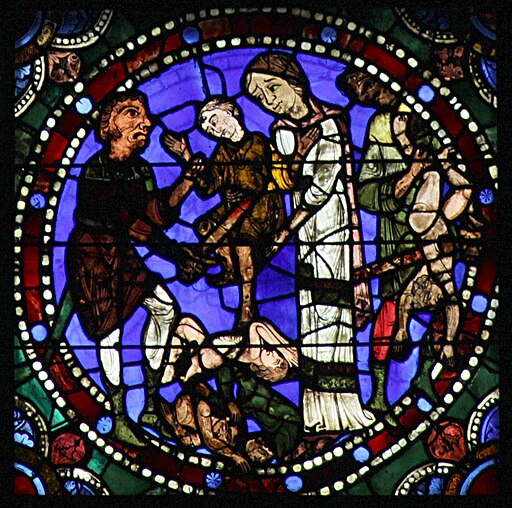
Detail of window at Chartes Cathedral showing the Massacre of the Innocents, taken from Wikimedia Commons

I was first really exposed to the Christian commemorations of the Holy Innocents thanks to a church name. Holy Innocents Episcopal Church outside Atlanta, to be exact. I visited that church and liked the architecture and liturgy and it inspired me to learn more about a story I had known since childhood but seldom dwelt on—much less saw as a focus of devotion.

It’s a story that largely gets left out of our Christmas commemorations in the Episcopal Church, partly because it is such a horrible story (and likely partly due to the more modern doubt of the story’s historical accuracy, which we’ll talk about in a bit). No one wants to follow up Christmas morning with a service about the mass-murdering of children.

At the same time, especially this year, this is a highly relevant story. Tragically, all over the world, politicians are playing like Herod and systematically executing anyone they deem a threat—including children.

Holy Innocents, also known Childermas, commemorates an event that, in all likelihood, never happened. Josephus, an important Jewish historian, took great care to showcase the brutalities of the Herodians and never once mentioned a mass slaughter of children. Outside of the gospel of Matthew there are no other historical accounts of this story and it seems likely to be something meant by the evangelist as a means to make connections between Jesus and Moses, a common theme throughout that particular gospel. So what are we to make of this fact? That we not only have a day marked on our calendar but also name churches and schools for an event that probably never happened?

This is one of the tough parts of reading the Bible. It’s not always “factual” in the ways to which we are accustomed today. Nevertheless, elements that we deem “fictional” can have a huge impact on our faith and wind up speaking Truth despite their (in)accuracy.

Consider the typical Christmas pageant. Aside from Mary, Joseph, a baby, angels, and some shepherds most of the story we dramatize is completely fictional and not related to what is written in the Bible. We tend to think of the birth of Jesus as being an event that culminates after Mary and Joseph, alone on a donkey, have gone to every house or inn in Bethlehem and been told “no vacancy” and so set up shop in a nearby stable. But none of the gospels mention a donkey and we’re only told that there was no room in “the inn”—nothing at all about conversations with inn-keepers or a door-to-door journey. Further, given the nature of the census, there was probably a caravan of people traveling to Bethlehem and others taking residence among the livestock because Bethlehem was not prepared for such an influx of extra people. What we think of when we think of the Christmas story is largely fictional, but that doesn’t mean there’s not truth in those elements. We crafted those details over the centuries in order to “flesh out” the story a bit, to give it the sort of texture that it invites. And those added details speak much of the faith and mindset of the church that crafted them.

The same is true of the Massacre of the Innocents. It might not have happened, but it’s very telling that no one finds the story improbable. There might not be any records to back it up, but the story sounds like the sort of thing Herod would have done—indeed, the sort of thing that rulers all over the world and all over our history books have done.

The sort of government that gleefully cancels aid and assistance to poor countries is acting like Herod. The one that uses starvation, particularly of children, as a weapon of retaliation is acting like Herod. The political entities that travel throughout villages to murder women and children are the ones acting like Herod.

The actual Herod may not have ordered a campaign to murder the children of Bethlehem out of some fear of losing power, but Herod for sure murdered plenty of children and other innocents during his reign out of a sense that because he was in charge he could do so—without any fear of God. And in this, Herod is an archetype. Plenty of gilded so-called rulers kill innocents in the name of preserving their name on the side of buildings. If they were honest, they do so out of a desire to kill the God that they are not.

Yesterday’s saint records Jesus saying “If the world hates you, know that it hated me first.” The poet Dianne di Prima says in her poem, “Rant” that “the only war that matters is the war against the imagination, all other wars are subsumed by it.” I tend to think that it’s more the case that all hatred is subsumed in hatred for Jesus and, therefore, all wars are the Battle of Armageddon, the war against Christ Himself.

If the story behind Holy Innocents is fictional, then it is worth asking what it is we’re commemorating this day. I think the answer is simple: Holy Innocents commemorates all children sacrificed on the altar of expedience or inconvenience by those in power attempting to cast themselves as gods. Those killed by starvation from the abrupt end to programs like USAID or in Gaza by the Israeli government. Those killed by radicals in Somalia and Sudan. Those dying thanks to bombs dropped on Ukraine. And that’s only looking at what’s currently happened in the news in recent weeks. These are who we commemorate on Holy Innocents. The gospel story is subsumed in the stories we see right now, and is itself reflective of those stories. The gospel story helps us Christians see the shape of the story happening around us, helps us in remembering where our allegiance lies.

Herod is the one who oversees the death of innocents. Christ is the one who sees them as holy.

***

The Rev. Charles Browning II is the rector of Saint Mary’s Episcopal Church in Honolulu, Hawai’i. He is a husband, father, surfer, and frequent over-thinker. Follow him on Mastodon and Pixelfed.

#Christmas #HolyInnocents #History #Theology #Church #Christianity #War #Gaza #Ukraine

Old door, opening into a church. Inside one can barely make out the shapes of people, candles, gold imagery.

What is a Christian?

This seems like it should be a simple question. “Christian” means “little Christ” or even “like-Christ.” So, anyone who attempts to be like Christ is a Christian, yeah? I mean, I’ve had this stated to me outright more than a few times over the years whenever I try to challenge one’s definition of Christianity.

But this is incorrect, even from a biblical standpoint. Because while, yes, the Bible does note that there’s a moment where these followers of Jesus’ disciples are called “Christian,” there is a broader bit of context to consider.

The people who would one day become known as “Christians” were originally called people of “the Way.” “Christian” was a later term applied to them, by the people of Antioch (with plenty of folks out there postulating that this might have been intended as an insult). So they were branded with this name, which they later embraced. But it was not the term that they first applied to themselves—nor was it a term Jesus gave them, at least not in a direct sort of way.

This is all to say that, in order to understand what it means to be “Christian,” we first have to consider what it meant to be people of “the Way.”

For starters, what was “the Way?” Perhaps the most concise answer to this question is provided by Jesus Himself: “I am the way, the truth, and the life; no one gets to the Father, except through me.” Now, the term “way” was already a loaded term for Jesus. As a Jew, He would’ve been taught that the Torah was “the way” to God. Following the commandments given by Moses and expanded by scribes and religious teachers continues to be the means by which Jews understand their life and relationship to God. Keeping these things puts them on the path (or, “way”) to God.

Regardless of what one might think about the theological claims about Jesus, He was very clearly a religious reformer/revolutionary. In the gospels, we see Him taking umbrage with the labyrinthine interpretations of the Law that were foisted upon every day people; we see Him opposed to a predatory financial system rooted in the Temple’s religious customs; we even see Him willing to buck deeply held notions around women and non-Jews. Jesus is very interested in expressing a different way of not only being Jewish, but also a different way for non-Jews to have a relationship with the God of Judaism (who was believed and proclaimed as THE God). Jesus lays out—in two sermons, acts of healing, and various parables—an alternative way of living, an actual practice, which He Himself embodies. And so when we get to that famous line in John’s gospel about Him being “the way” what He’s effectively saying is: “go where I go, live a life like mine, and you will see God, you will achieve what the Torah is all about.”

But Jesus’ followers came to see Him as more than an ethicist or reformer. Beyond those dimensions, indeed the soil from which those dimensions sprout, His followers see Him as God, living in human flesh. Which means there emerges a theological dimension to both understanding and following Jesus. And this is the thing that Christians spend their first 300 years or so hammering out, resulting in the Apostles’ and Nicene-Constantinoplian Creeds.

Today, it’s easy for us to look at those theological arguments and wonder what the big deal was all about. But try and consider things from the perspective of the ancients. They were trying to understand precisely who it was they were following and why they should follow Him at all. Because if He’s fully God as well as man, or a simply a human endowed with spiritual power, or even a sort of demigod, there are ramifications to what it means to follow Him.

The kernel of these ideas were held by those first people, articulated as “the Way.” So, this movement later rebranded as Christian carries with it pre-existing theological baggage that continues once the new name for the movement takes hold. It’s not simply a movement of people trying to live an ethical life akin to the one Jesus did. It’s a group of people who do this while also worshipping Jesus as God. Which means that “Christian” is a term that carries particular meanings rooted in both a way of life and a way of worship.

Theology requires a grammar. The conventional term for this grammar is “doctrine.” Misused, “doctrine” is about lines in the sand that separate degrees of faithfulness and rightness before God. But the correct view of doctrine is that it provides the boundaries for what makes a particular theology or religion definably itself. Further, those doctrines inform practices meant to embody what that theology or religion has to say or mean for its adherents.

Dance is a helpful example. There is a clear grammar to dance—whether hula, or ballet, or modern, etc. But once that grammar begins to be stripped away we begin to see something other than dance: perhaps floor gymnastics, or a form of martial arts. This is not to say that dance cannot innovate. It simply means that we have to either review the grammar of dance, or delineate when something ceases to be dance because it has strayed into a space where it uses a different grammar.

Consider the phenomenon of the modern smartphone. Many of us continue to refer to the device as a “phone” but it is completely unrecognizable from the device that Alexander Graham Bell first invented. Now, the “phone” portion of the device is a piece of software and part of what is actually a small personal computer. There is a clear line of recognizability from the wall-mounted telephone of yesteryear and the cellular telephone (today referred to as a feature phone). But the modern smartphone is built more from the design language (that is, “grammar”) of the personal MP3 player than it is the telephone.

Christianity is like this. The doctrines of the faith are what make it definable, following a trajectory of development where we can see certain commonalities in both belief and practice. At the same time, we have also seen a certain degree of disruption (to use the term in its tech-industry, startup sense), largely in the form of the Protestant Reformation, that has affected this notion and has lead us to a place where we have multiple things calling themselves “Christian” while only a few can be accurately identified by that term.

Which leads me, finally, to answer my initial question: what is a Christian?

A Christian is a person who follows Jesus as He has been understood by the Church. By this I mean that Christians believe in Jesus as He is articulated in the Creeds (particularly the Apostles’ and Nicene Creeds), and both worship and follow Him in the particular ways defined by the heritage of the Church. Christianity is practiced, not simply “believed.” It is the result of the out-working of what it means to follow Jesus and who Jesus is, placed amidst a trajectory (tradition) of continual out-working. Christianity carries continuity—of both practice and belief.

This is not to say that Christianity is something frozen in time. Rather, it is to suggest that innovations within Christianity (say, the ordaining of women to the priesthood, or same-sex marriage) have to carry continuity with what came before, either through a form of historic recovery (in the case of women’s ordination) or integration into that continuous stream (in the case of same-sex marriage).

The Creeds, as a source of Christian grammar, offer flexibility. They are “what” statements, not “how” statements. This means that there is wiggle-room in how these things are understood. However, there is not wiggle room in regards to the “What” being stated about Christian belief. For instance, we can differ on what it means when we say that we “believe in the resurrection of the dead and the life everlasting” (Saint Augustine of Hippo to Pierre Tielhard de Chardin offers a pretty solid range), but if we say that there is no resurrection of the dead and/or life everlasting then we have broken the boundaries of Christian grammar and are now speaking a different theological language. Similarly, the moment we elevate the Bible to a place traditionally occupied by Jesus, seeing it (and not Him) as the “authoritative Word of God,” we’ve also crossed a key boundary of Christian grammar and are now speaking a different religious language (the Chicago Statement on Biblical Inerrancy is probably the most notable instance of this, and held as the standard statement on “Biblical inerrancy” throughout much of Evangelicalism—interestingly, the Baptist Faith and Message 2000 seems to have amended its wording to better reflect that Jesus is the main revelation and the Bible is merely a testament to that fact; so not all Evangelical denominations are created equal here, it seems).

Additionally, there is a continuity of Christian practice that constitutes this grammar: gathered together as people who have been baptized, to share in bread and wine, informed by the reading and expounding of the scriptures and the singing of hymns and psalms, all assembled in an ordered fashion. And from this gathering emerges a way of life, an ethic, itself reflective of a particular grammar of action.

So, to be “Christian” is to be a particular thing. This is why Jehovah’s Witnesses and Mormons cannot rightly claim the name “Christian.” Yes, they profess Jesus. But their understanding of who Jesus is resides outside the grammar defined by the Creeds (which, by the way, are themselves a kind of summary of what the Bible is all about), by rejecting His divinity. They might be cousins to the Christian faith, but they are cousins removed (akin to the relationship between Muslims and Jews—both claim the same God, but they each have a unique grammar in regards to that God). “Christianity” loses coherence when we fail to assert these facts—which has led us to where we are today, with neo-fascists espousing abhorrent ideas and calling them “Christian.”)

Lastly, let me be clear about another point: saying that someone is not “Christian” is not the same thing as saying that they are headed for damnation. Jesus saying “no one gets to the Father apart from me” is, in my faithful estimation, Him saying that He’s the one who decides the ultimate fate of human souls in the afterlife. I tend to believe that, in time, everyone is welcomed into the always-open gates of the New Jerusalem. But, ultimately, Jesus is the one who saves. Not me. Not any particular institution. Rather, the Church is the place that gives us the language for what it means to be saved, to live into what Jesus has already done. Christianity is, as far as I’m concerned, this profoundly beautiful thing that allows us to live with the freedom that comes with being saved by Jesus. It gives us the language by which we can live thankfully in the light that we no longer feel we have to save ourselves, making it all up as we go along.

The Rev. Charles Browning II is the rector of Saint Mary’s Episcopal Church in Honolulu, Hawai’i. He is a husband, father, surfer, and frequent over-thinker. Follow him on Mastodon and Pixelfed.

#Christianity #Church #Jesus #History #Politics #Bible #religion #theology