A Year of Catechetic Converting

I started The Catechetic Converter a year ago. And I feel an obligation to write something in honor of that milestone, celebrating the fact that I’ve had my own website for a full year.
The post that has the most views is my first one, which is about Linux. And Linux and this site have an intertwined relationship in that my switch to Linux helped inspire me to get away from “Big Tech” in other ways. In fact, it was (I think) a post on Westenberg that inspired me to start the blog. The idea of having my own little corner of the web, not mediated by some corporation—and not built to make money—was appealing. Just a place to stick my random thoughts and ideas, putting them “out there” in the ether to see where they land, what they inspire… I loved that.
And Linux and this post are kind of intertwined because I have spent the past week staying up far too late most nights (in violation of one of my Lenten disciplines to go to bed by 10:30) trying to get a custom firmware to run on an MP3 player.
See, in continuance of the spirit of moving away from Big Tech, I have started disentangling myself from having everything on a phone. I asked for a Sony CyberShot F707 digital camera for Christmas (a model I had when it was brand new and stupidly donated to Goodwill or whatever several years back). And then I bought an Innioasis Y1, which hearkens back to iPods of yore (with a click-wheel and everything). This is a device that folks like to tinker with as well and I learned that people had managed to get a bespoke firmware known as RockBox—initially developed for old iPods—to run on the device, improving its functionality in numerous ways. So I planned to do this.
After what seemed like months, the device finally arrived. The standard, out-of-the-box firmware was fine, if a little rough. But the filing system for finding my music was wanting and so I decided to give RockBox a try because it offers more refinements in this area (plus a TON of fun custom themes for the device). Doing this requires downloading and running a program known as the Innioasis Updater, which was developed primarily for Windows and Mac but also includes a Linux version that is overtly said to be “unofficial” with warnings that I would be “on my own” with this. I got the sense that this would be a challenge.
I’ll spare you too many details, but I had to download another tool called MTKClient, which is written in Python, and had to run a ton of terminal commands to get running. It didn’t help that installation guides were written using LLMs and I needed to switch back and forth between two of them to get all the necessary steps right (the “official” one on GitHub failed to note the need to change directories in a couple of key places). I wound up needing certain drivers, having to write custom scripts. At one point I managed to accidentally remove all of my terminal commands thanks to forgetting to add the word “eval” to a directory. Then I also managed to lock myself into my machine (in this case a 2011-era Mac running Linux Mint) constantly trying to download Android Platform Tools from a broken mirror of a repository—which taught me a whole a range of new commands to fully purge a faulty download. After successfully installing both programs, I found that the updater would not properly read my device.
I attempted to install the program using my wife’s Windows 11 laptop and was reminded why I’ve spent over twenty years hating Microsoft.
But GitHub forums came to the rescue (where I also learned that the updater was vibe-coded using LLMs which probably explains a lot) and I got RockBox to run on the device. It now has a theme that looks like it belongs on the first MacIntosh (because even though we might have broken up, I still carry parts of her that are now parts of me). I’m listening to Maggie Rogers on the device as I write this—right after I celebrated this accomplishment with the Geto Boys’ “Damn It Feels Good To Be A Gangsta.”
***
This morning at my parish’s Bible Study, one of my parishioners noted that I tend to have a lot of information and ephemera in my head related to any number of things related to Christianity. “I tend to think of things more simply,” he said.
I told him that I also value simplicity, but I come to that simplicity through learning and accumulating knowledge about what I’m doing and believing. For me it’s like a bell curve by way of zen. What I mean is that the zen monk may take a guy out of the mud, put him on the stool for years and teach him koans and sutras, get him to the verge of enlightenment only to then throw him back in the mud because the guy needs to learn that enlightenment can be found in the mud. In other words, I like taking things apart just to get back to where I started because I now understand that start so much better.
Tinkering and futzing with my computer speaks to this because it helps me to consider the complexity behind simple things. Like right now I’m putting letters together into words on a document. But there is an astounding amount of calculations taking place to make this happen. The words you read on your screen are the result of carefully managed electrical currents running on circuit boards and through cables connected to liquid crystal fields that display what you’re seeing. And there are also an incomprehensible number of electrical charges going on among the synapses in your brain to not only cause you to see these words, but to interpret them as things that cause you to feel things and think other things.
In the Bible Study we looked at Jesus’ discussion with Nicodemus in the third chapter of John’s gospel. In that passage Jesus says that everyone born of the Spirit is like the wind (in the Greek language of John’s gospel there is a triple meaning of Spirit/wind/breath that Jesus is playing with here). The wind connects. The wind moves. This speaks to the complex connections between things, connections made by God. Connections where God can be found. And like the wind, once God shows up you know it.
***
I’m not really sure where I’m going with this. I guess I’m just on the other side of bell-curve, back where I started. Putting out thoughts and words into the ether to see where they land. To see what they inspire. Which is another wind-related word, by the way. I’m writing this on a miraculous piece of technology and you’re reading it on one equally so. In between us is a dense web of complexity and connection—including both electricity and wind. We can take a look at that complexity, investigate it, see how it runs. But in the end we come back to where we began:
A writer and a reader, brought together by some wind. A wind holy and mysterious.
***
The Rev. Charles Browning II is the rector of Saint Mary’s Episcopal Church in Honolulu, Hawai’i. He is a husband, father, surfer, and frequent over-thinker. Follow him on Mastodon and Pixelfed.

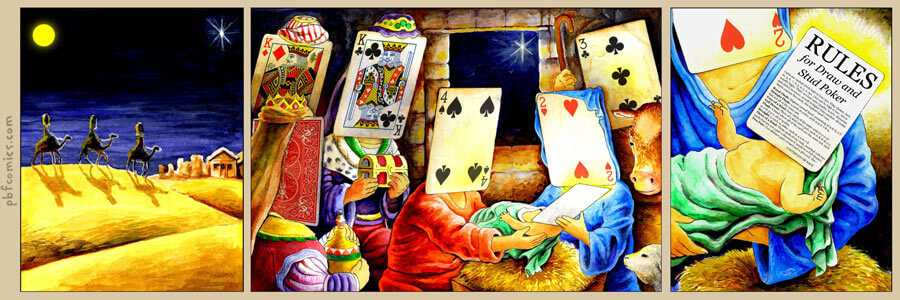 Honestly, this image is probably the actual best representation of what “the Logos made his home among us” means. (